
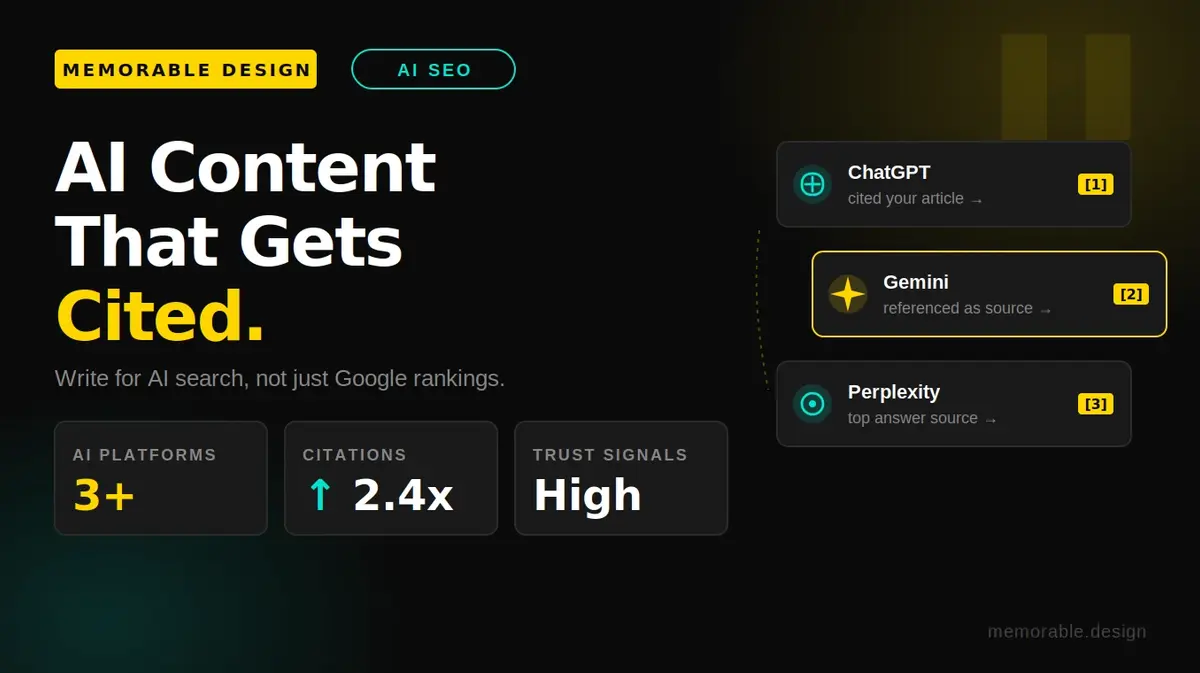
Content writing in 2026 is shifting from SEO ranking to AI citation. Instead of keyword stuffing, AI models prefer clear structure, early answers, unique data, and strong authority signals. Content with headings, tables, FAQs, and real insights is more likely to be cited by AI tools like ChatGPT and Perplexity, boosting visibility and trust online.
The digital landscape has fundamentally shifted, leaving traditional keyword-stuffing strategies firmly in the past. If you want your brand to survive this new era, you must learn how to write content ai cites rather than merely hoping a search engine indexes your pages. Large Language Models (LLMs) like Gemini, ChatGPT, and Perplexity do not just look for matching keywords anymore; they scan the web for authoritative, highly structured data that they can confidently reuse as source material. If your articles are buried under mountains of marketing fluff, AI models will simply skip over them and link directly to your competitors.
At Memorable Design, we focus on building digital assets that balance human-centric beauty with cutting-edge technical optimization. Getting your work recognized by modern generative answer engines requires a meticulous blend of clear data presentation and undeniable subject-matter authority. In this comprehensive guide, we will pull back the curtain on how LLMs extract information and show you exactly how to craft pieces that serve as verified references for artificial intelligence.
The Shift From Indexation to Generative Citation

Traditional search engines focus on pointing users to a destination via ten blue links. Modern answer engines operate completely differently by summarizing vast data pools and dropping numbered footnotes to credit their primary sources.
Why Getting Indexed is No Longer Enough
Simply showing up in a search engine's database does nothing for your brand if an automated assistant synthesizes your entire industry's information without mentioning your name. To win the citation game, your web pages must provide clear "Information Gain" meaning you offer unique data, real-world case studies, or firsthand experiences that cannot be found anywhere else. When an LLM recognizes a truly unique, authoritative data point on your site, it is structurally incentivized to link to you to validate its own generated response.
Understanding How LLMs Parse Text
Large language models do not read your blog posts the way humans do; they process text by breakings down information into semantic chunks. According to available industry data from recent platform audits, an estimated 44% of all AI search citations are pulled exclusively from the first 30% of a webpage. If you hide your primary insights deep within a sprawling conclusion, the automated crawler will lose interest and move on to a site that serves the answer up on a silver platter.
Structuring AI Friendly Content Writing for High Retrieval

If you want an algorithm to confidently quote your brand, you have to format your articles using highly predictable, structured layouts. The easier it is for a bot to parse your sentences, the more likely your site will become a preferred reference.
Leading With Declarative Answers
Adopt an inverted pyramid writing style by stating your primary conclusion or answer in the absolute first sentence of a section. Avoid vague or conversational filler introductions like "In today's fast-paced digital world." Instead, use direct, active language that immediately satisfies the user's intent, and then spend the subsequent paragraphs expanding on the finer technical nuances.
The Power of Clean Heading Hierarchies
Maintaining an unyielding, logical heading hierarchy is essential for high-performing ai friendly content writing. When you nest a clear H3 question directly beneath an explicit H2 topic heading, you create an ideal semantic framework for an LLM to scan. Data insights show that content utilizing a consistent heading-to-bullet layout is roughly 40% more likely to be rephrased and cited by generative engines compared to walls of unorganized text.
The Blueprint for Citable Content AI
To maximize your visibility across generative search engines, you should optimize your layouts to favor data formats that algorithms naturally prefer to scrape.
Utilizing Comparative Data Layouts
Comparative roundups and specialized tables account for over 30% of all current AI search engine citations. LLMs excel at processing structured contrasts, making cleanly formatted data tables an absolute goldmine for earning high-quality backlinks.
| Content Element | Ideal Length / Format | Estimated Citation Lift | Best Practice Strategy |
| Introductory Answer | 40–60 Words | 44% Increase | Place in the first 30% of the page. |
| Data Tables | 3-5 Rows, Explicit Headers | 32% Increase | Compare specific metrics clearly. |
| Heading Spacing | 120–180 Words per Section | 70% Increase | Keep text chunks highly focused. |
| Schema Markup | FAQ or Dataset Schema | 44% Increase | Validate your code for search bots. |
Designing High-Intent Sectional Snippets
When planning out your editorial calendar, prioritize depth over sheer breath. A 3,000-word deep-dive article will consistently outperform shorter posts in AI search systems, but only if each individual sub-section can stand entirely on its own as an isolated, citable unit of knowledge.
Advanced Strategies to Optimize Content for LLMs

Moving beyond on-page formatting, you must understand how to position your brand as a recognized entity across the broader digital ecosystem to secure consistent footnotes.
Building Off-Site Consensus Signals
When an assistant generates a recommendation, it cross-references its internal training data with live web indexes to build a consensus. If your company name is mentioned alongside your core specialty on authoritative platforms like Reddit, specialized industry directories, and YouTube transcripts, the model's confidence score surges. This cross-platform footprint tells the algorithm that your business is a legitimate, verified authority within your niche.
Injecting Genuine Human E-E-A-T
Purely automated text often lacks the specific, lived-in details that algorithms look for when choosing top-tier references. To make your content for llms highly citable, infuse your writing with hard metrics, named subject-matter experts, and real-world project outcomes. Mentioning specific failures, unique testing methodologies, or unexpected project results provides the exact type of high-value, non-generic information that automated systems are desperate to cite.
Five Golden Rules for Creating Highly Quotable Assets
Consistently earning links in automated overviews requires building an editorial workflow designed around technical clarity. Keep these essential rules in mind to optimize your digital text for machine processing.
Proactive Writing for Machine Retrieval
- Embrace Extreme Specificity: Swap out generic overview articles for hyper-targeted guides that focus intensely on solving one highly specific user problem.
- Embed Schema Code: Always implement granular FAQ, Product, or Article schema markup to provide search bots with explicit context regarding your text.
- Eradicate Vague Hyperbole: Eliminate empty marketing buzzwords like "revolutionary" or "synergistic" and replace them with verifiable, objective facts.
- Update Statistics Regularly: Generative search engines actively prioritize fresh data, so revise your core industry resource pages every few months.
- Anchor Internal Links Intelligently: Use highly descriptive, context-rich anchor text for your internal links to reinforce the semantic relationships between your pages.
The Technical Execution: Making Pages Easily Scrappable
Even the most brilliant article will fail to secure citations if search bots face technical barriers when attempting to crawl and categorize your website.
Managing Crawler Access and Chunking
Ensure your site's technical backend is completely open to major automated user-agents by verifying your robots.txt directives. From an editorial standpoint, execute strict semantic chunking by forcing every single paragraph to focus on proving one singular, distinct idea. This structural isolation allows scrapers to smoothly extract an exact text fragment without dragging along irrelevant surrounding context.
Conclusion
Learning how to write content ai cites is the ultimate goal for forward-thinking digital publishers. By structuring your pages with immediate, declarative answers, utilizing clear tabular data, and proving your hands-on expertise, you transform your website into an invaluable repository of knowledge that automated systems can easily reuse. Focus on clarity, eliminate stylistic fluff, and design your assets to be easily understood by both humans and machines alike.
When you are ready to completely transform your online presence with a stunning, strategically engineered digital footprint, let Memorable Design help you craft a brand identity that commands attention across every search medium!
Frequently Asked Questions
What types of content do AI models cite most frequently?
Automated search models heavily prioritize data-dense formats such as comparative listicles, direct question-and-answer pairs, original proprietary research reports, and detailed statistical tables. They actively seek out clear, objective facts that can validate the specific claims they present to users.
Does keyword density still matter for modern AI search engines?
No, traditional keyword density metrics are essentially obsolete in the modern era of semantic search. LLMs analyze concepts, entity relationships, and overall topical depth rather than simply counting the number of times a specific keyword phrase appears on a webpage.
How can I track if my website is being cited by AI models?
You can track your generative visibility by conducting routine manual audits of your top commercial queries inside platforms like ChatGPT and Perplexity. Additionally, monitor your direct referral traffic in Google Analytics 4 and keep a close eye on impressions within Google Search Console’s emerging AI Overview tracking fields.
