
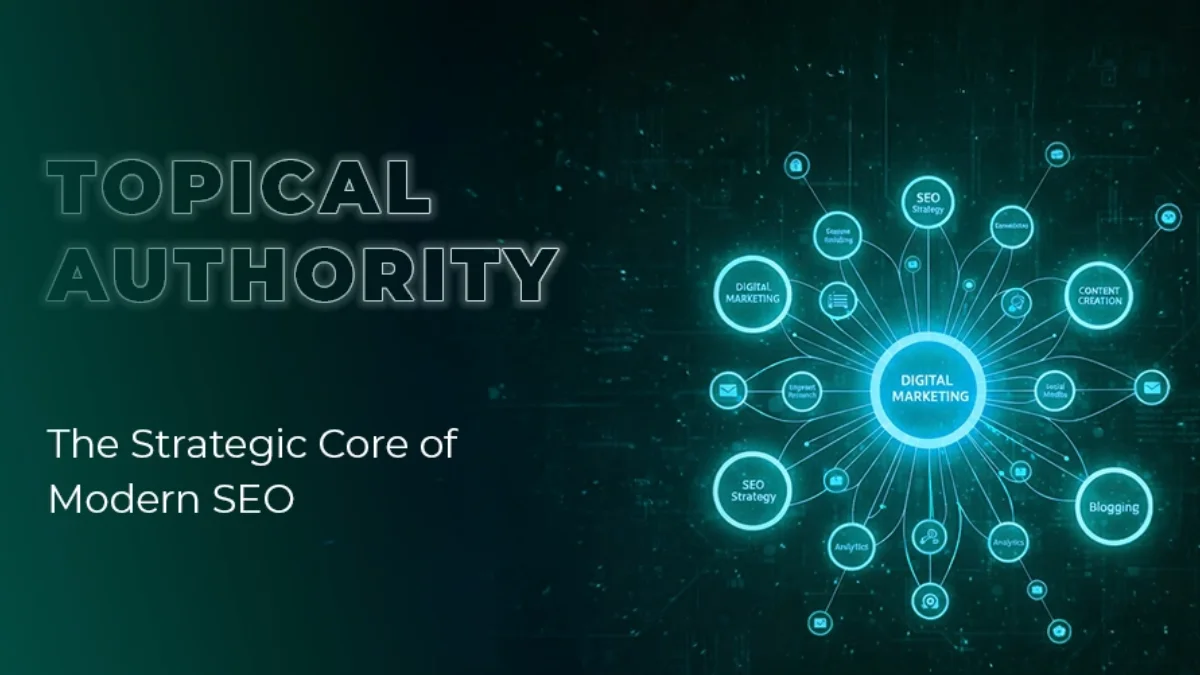
A topical authority map is the difference between writing random blog posts and building a brand that owns its subject. Most websites publish content with no plan. As a result, search engines never understand what the site is really about.
Ruslan Smirnov, founder of Memorable Design, has spent over 20 years watching this pattern repeat. Brands chase single keywords, win a few, then stall. The fix is rarely more content. The fix is better structure.
Search has changed fast. Google now rewards depth across a full subject, not one lucky page. AI Overviews and tools like ChatGPT Search and Perplexity pull from sources that show consistent expertise. A topical authority map gives you that consistency on purpose.
This article walks growth brands and business owners through the entire process. You will learn the core concepts, the build steps, common mistakes, and the future of this approach. By the end, you will know exactly how to plan content that ranks and converts.
WHAT IS A TOPICAL AUTHORITY MAP?
What is a topical authority map?
A topical authority map is a visual or written plan that groups one core topic with all of its related subtopics, so a website can cover a subject completely and signal deep expertise to search engines and AI systems.
Detailed Explanation: Think of your main subject as a hub. Around that hub sit dozens of smaller pages that each answer one specific question. When you link these pages together with purpose, you build a web of meaning that machines can read.
Search engines reward this structure because it proves you understand the full subject, not just one slice. A strong topical authority map covers the obvious questions and the hidden ones competitors skip. That coverage is what builds trust.
CORE CONCEPTS YOU MUST UNDERSTAND
- Topic Clusters: A topic cluster is one pillar page plus many supporting pages. The pillar covers the broad subject. The supporting pages each dig into one detail. A topical authority map is the master plan that holds all your clusters together.
- Semantic SEO: Semantic SEO means optimizing for meaning, not just exact words. Search engines now understand context, synonyms, and relationships between ideas. A good topical authority map feeds these systems the full meaning of your subject.
- Entity SEO: An entity is a person, place, brand, or concept that search engines recognize. When your content connects clear entities in logical ways, you become easier to understand and trust. Your topical authority map should map these entities, not just keywords.
- Information Gain: Information gain rewards content that adds something new. If your page repeats what already ranks, it gains little. A smart topical authority map plans for fresh angles, real examples, and original data on every page.
WHY A TOPICAL AUTHORITY MAP MATTERS MORE IN 2026
Why does a topical authority map matter more now?
A topical authority map matters more in 2026 because AI search engines and Google AI Overviews choose sources based on demonstrated expertise across a whole subject, not single-page wins.
Detailed Explanation: AI answers now sit at the top of many searches. These systems scan for sources that cover a topic deeply and consistently. A scattered site rarely qualifies. A site built around a topical authority map often does.
Google’s Helpful Content System pushes the same direction. It rewards sites that serve people with complete, useful answers. It quietly demotes thin sites that chase traffic with shallow posts. Ruslan Smirnov puts it plainly. In his words, brands that win in 2026 stop thinking in keywords and start thinking in subjects. The topical authority map is how you make that shift real.
There is also a trust dividend. When a visitor lands on a deeply covered topic and finds answer after answer, confidence grows. That confidence turns readers into leads, and leads into customers.
THE MEMORABLE VISIBILITY FRAMEWORK
Most guides stop at theory. At Memorable Design, we use a practical model called the Memorable Visibility Framework. It guides how we build every topical authority map for growth brands.
The framework has four stages. Each stage answers one question. Together they turn a blank plan into a ranking, converting system.
- Map. Define the core subject and every subtopic that surrounds it. This is the topical authority map itself, the foundation for everything that follows.
- Build. Create the pillar page first, then the supporting pages. Each page targets one clear intent and adds real information gain.
- Connect. Link pages with purpose so both users and search engines see the relationships. Smart internal links pass authority and guide the reader.
- Convert. Layer design and clear calls to action on top. Strategy gets the traffic. Design and copy turn that traffic into revenue.
This is the SEO and design compound effect in action. Each stage feeds the next, and the results grow over time instead of flattening out.
STEP-BY-STEP: HOW TO BUILD A TOPICAL AUTHORITY MAP
You build a topical authority map by choosing one core topic, listing every subtopic and question around it, grouping them into clusters, assigning search intent, and planning internal links between all pages.
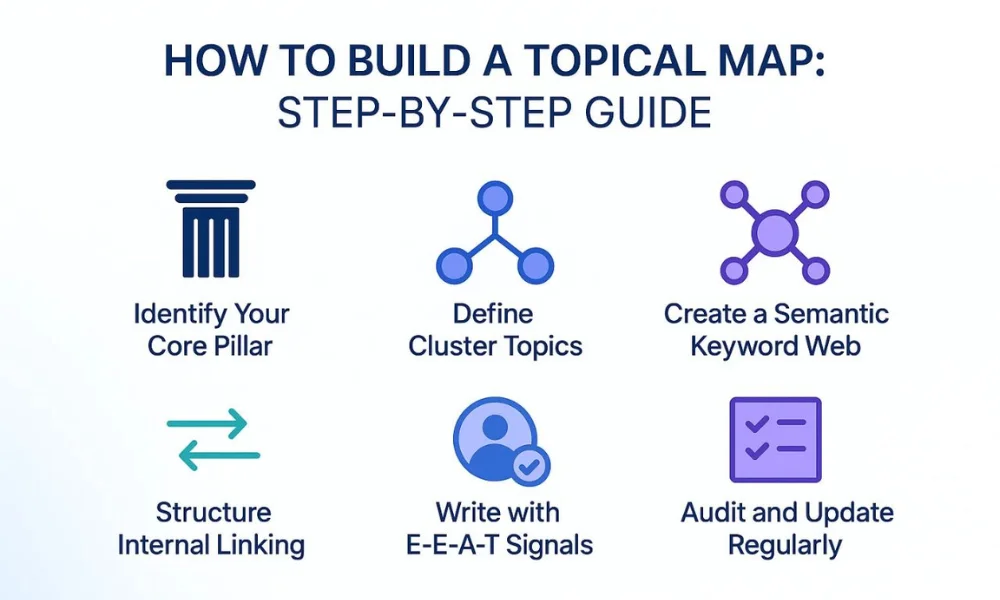
Follow these steps in order. Each one builds on the last.
1: Choose Your Core Topic
Pick the one subject your brand wants to own. It should match your services and your audience. For an agency like Memorable Design, that might be SEO strategy or brand design.
2: List Every Subtopic
Brainstorm every related question, problem, and idea. Use People Also Ask, customer questions, and competitor content as fuel. Aim for breadth here, since gaps will hurt your topical authority map later.
3: Group Into Clusters
Sort your subtopics into clean clusters. Each cluster gets one pillar page and several supporting pages. This grouping is the skeleton of your topical authority map.
4: Assign Search Intent
Tag each page with its intent. Some pages inform, some compare, and some sell. Matching intent to page type keeps your topical authority map sharp and useful.
5: Plan Internal Links
Decide how pages connect. Supporting pages link up to pillars. Pillars link out to supporting pages. These links carry meaning across your whole topical authority map.
Step 6: Prioritize and Publish
Start with the pages that bring quick wins and high commercial value. Publish in batches, then expand. A topical authority map is a living plan, not a one-time task.
EXAMPLE: A TOPICAL AUTHORITY MAP IN ACTION
Imagine a growth brand selling project management software. The core topic is project management. The topical authority map then branches into clear clusters. One cluster covers methods, with pages on agile, scrum, and waterfall. Another covers tools, with pages comparing software options. A third covers team skills, with pages on delegation and communication.
Each cluster has a pillar page that explains the broad idea. Supporting pages handle the details. Internal links tie everything together so the brand owns the full subject.
Within months, this structure helps the brand rank for dozens of related terms. AI Overviews start pulling answers from these pages. The topical authority map turns a quiet blog into a trusted hub.
USE CASES FOR GROWTH BRANDS
A topical authority map serves many goals. The right use depends on where your brand stands today.
- For new sites, it sets a clear path from day one. Instead of random posts, you build with structure and avoid wasted effort. That focus speeds up early results.
- For stuck sites, it reveals gaps. Many brands rank for a few terms but miss the topics that surround them. The map shows exactly what to add to break the plateau.
- For competitive niches, it builds a moat. When you cover a subject more deeply than rivals, you become hard to beat. Depth is a lasting advantage that single pages cannot match.
RANDOM CONTENT VS TOPICAL AUTHORITY MAP
| Factor | Random Content | Topical Authority Map |
|---|---|---|
| Planning | Post by post | Full subject planned upfront |
| Rankings | A few lucky keywords | Dozens of related terms |
| AI visibility | Rarely cited | Frequently cited |
| Internal links | Weak or missing | Strong and purposeful |
| Trust signals | Low | High |
| Long-term growth | Flat | Compounds over time |
| Effort efficiency | Wasted on overlap | Focused and clean |
PILLAR PAGE VS SUPPORTING PAGE
| Element | Pillar Page | Supporting Page |
|---|---|---|
| Purpose | Cover broad topic | Answer one detail |
| Length | Long and complete | Focused and specific |
| Keywords | Broad head terms | Long-tail terms |
| Links | Out to many pages | Up to the pillar |
| Intent | Educate broadly | Solve one problem |
| Role in map | Hub | Spoke |
BENEFITS OF A TOPICAL AUTHORITY MAP
The benefits stack up fast once the system runs.
- First, you rank for more terms because you cover more ground. Each new page strengthens the whole topical authority map.
- Second, you win more AI citations. AI tools favor sources that show consistent depth. A complete map makes your brand an easy choice for these systems.
- Third, you build lasting trust. Visitors who find answer after answer start to see you as the expert. That trust shortens the path from reader to customer.
- Fourth, your team works smarter. With a clear map, writers know what to create and why. No more guessing, and no more overlapping posts that compete with each other.
LIMITATIONS AND HONEST TRADE-OFFS
A topical authority map is powerful, yet it is not magic. It takes time to plan and build. Brands that want instant results often feel impatient during the early months.
It also demands quality. A large map filled with thin content can backfire. Each page must add real value, or the whole structure loses strength.
There is a resource cost too. Building out a full map needs writers, editors, and often design support. Brands with tiny teams may need to phase the work or bring in a partner.
Even with these limits, the long-term payoff is strong. The trade-off is patience and effort now for compounding growth later.
COMMON MISTAKES TO AVOID
Many brands build a topical authority map then trip on the same errors. Watch for these.
- The first mistake is going too broad. When a core topic is huge, the map becomes shallow everywhere. Pick a focused subject you can truly own.
- The second mistake is ignoring intent. Pages that miss what the searcher wants will not rank, no matter how many you publish. Match each page to a clear need.
- The third mistake is weak internal linking. A topical authority map without strong links is just a list. The links create the authority, so plan them with care.
- The fourth mistake is publishing thin content to fill the map. Quantity without quality hurts you. Each page must earn its place with real information gain.
BEST PRACTICES FROM MEMORABLE DESIGN
At Memorable Design, we refine every topical authority map with a few proven habits. These keep the system strong as it grows.
- Start with audience questions, not just keyword tools. Real customer language reveals topics that data alone misses. Those topics often hold the best opportunities.
- Build the pillar page early, even if it changes later. The pillar anchors the cluster and gives supporting pages a clear home. A strong center keeps the map stable.
- Pair every cluster with smart design. Clean layouts, fast pages, and clear calls to action turn rankings into revenue. Strategy and design must move together, not apart.
- Review and refresh the map each quarter. Search shifts, and so do your goals. A living topical authority map stays useful far longer than a static one.
EXPERT TIPS FROM RULESLAN SMIRNOV
Ruslan Smirnov shares the lessons that 20 years of SEO taught him. These tips cut through the noise.
His first tip is to think in subjects, not keywords. Keywords come and go. Subjects last, and a topical authority map built on a strong subject ages well.
His second tip is to lead with information gain. He says the fastest way to stand out is to publish what no one else will. Original data, real examples, and honest takes win.
His third tip ties back to design. In his view, traffic with no conversion is vanity. A topical authority map should always end in a clear path to action.
INDUSTRY TRENDS SHAPING THIS APPROACH
Several trends push brands toward the topical authority map model. AI search leads the list.
- Tools like Google AI Overviews and Perplexity now answer questions directly, and they favor deep sources.
- Search behavior is also shifting to conversation. People ask full questions in natural language. A broad topical authority map covers these long, specific queries far better than a thin site.
- Trust signals matter more each year. Google’s E-E-A-T guidelines reward real experience and clear expertise. Deep topic coverage is one of the strongest ways to show both.
- Design and SEO keep merging too. The brands winning today treat them as one system. That belief sits at the heart of how Memorable Design builds every map.
FUTURE OUTLOOK: 2026 TO 2028
Between 2026 and 2028, the topical authority map will become the standard planning method for SEO, since AI search engines increasingly reward complete subject coverage and consistent expertise.
Detailed Explanation: Expect AI answers to grow more dominant. As they do, the gap between deep sites and thin sites will widen. A strong topical authority map will be the price of entry, not a bonus.
Entity and semantic understanding will sharpen. Search engines will read relationships between ideas with more skill. Brands that map these relationships clearly will hold a real edge. Design will play a bigger role too. As traffic gets harder to win, conversion will decide who profits. The brands that join strategy and design inside one topical authority map will pull ahead.
Personalization may also rise. AI tools could tailor answers to each user. Even then, the deeply mapped, trusted source remains the safest bet for visibility.
ACTIONABLE CHECKLIST
Use this checklist to start your own topical authority map today.
- Choose one focused core topic you can own
- List every subtopic, question, and pain point
- Group subtopics into clean clusters
- Assign clear search intent to each page
- Build the pillar page for each cluster first
- Write supporting pages with real information gain
- Plan internal links between all pages
- Add clear calls to action on key pages
- Pair the map with clean, fast design
- Review and refresh the map every quarter
CONCLUSION
A topical authority map is no longer optional for brands that want to win in search. It is the structure behind every site that ranks deeply, earns AI citations, and turns readers into buyers. Strategy decides what you build, and design decides whether visitors stay and convert.
The shift is simple to understand and hard to ignore. Brands that think in subjects beat brands that chase keywords. The Memorable Visibility Framework gives you a clear path from a blank plan to compounding growth.
If you want to see where your site stands, Memorable Design offers a free SEO audit. We will map your core topics, spot the gaps, and show you the fastest path to authority. When you are ready to turn your content into a real growth engine, we are here to help you build it.
FREQUENTLY ASKED QUESTIONS
What is a topical authority map in SEO?
A topical authority map is a content plan that links one core topic to all of its subtopics. It helps a website cover a subject completely. This depth signals expertise to search engines and AI tools, which improves rankings, trust, and visibility in AI answers over time.
How long does it take to build topical authority?
Most brands see early movement within three to six months. Full authority on a competitive subject often takes nine to twelve months. The timeline depends on content quality, publishing speed, and competition. Consistent effort and a clear topical authority map speed up the process and protect against wasted work.
Is a topical authority map better than chasing keywords?
Yes, in most cases. Single keywords bring short wins that often fade. A topical authority map builds broad, lasting coverage that ranks for many related terms. It also earns more AI citations and trust. This compounding effect makes it a stronger long-term strategy for growth brands.
How many pages does a topical authority map need?
There is no fixed number. A focused subject may need twenty pages, while a broad one needs over one hundred. What matters is full coverage of your subject with quality content. Start with the highest-value clusters, then expand your topical authority map steadily over time.
Can a small business use a topical authority map?
Absolutely. Small businesses often benefit most because they can own a narrow niche. A focused topical authority map lets a small team beat larger rivals on depth. Start with one tight subject, publish quality pages, and grow the map as resources allow.
