
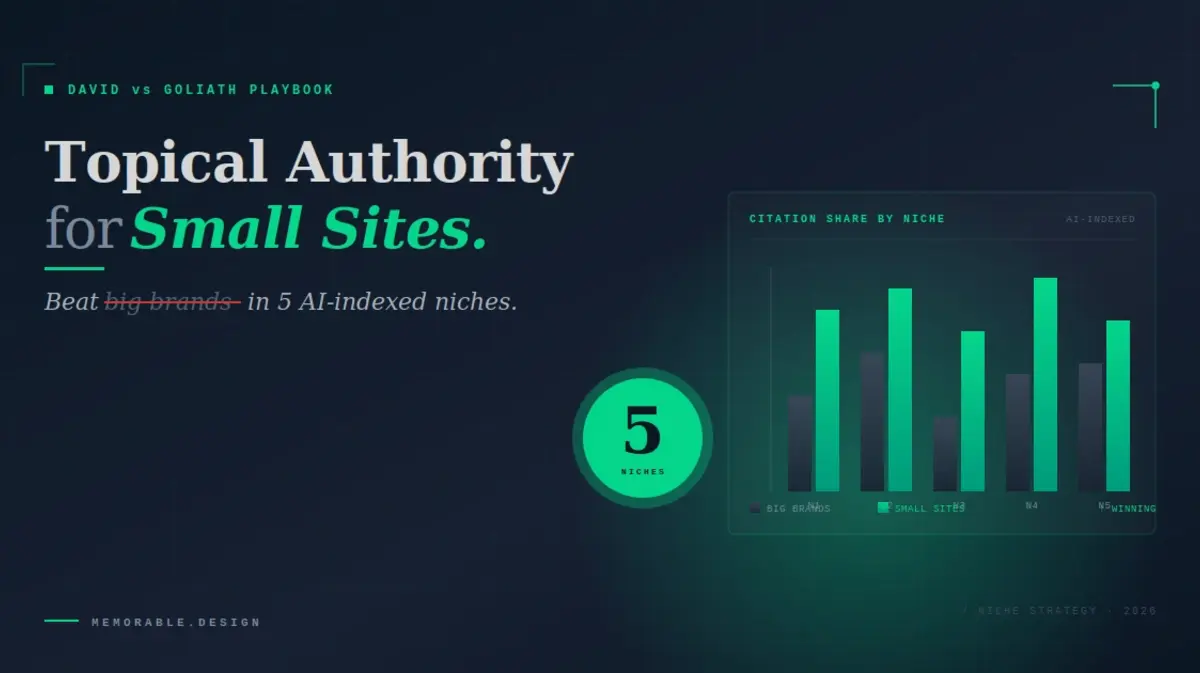
The document discusses how small websites can compete with larger brands in search engine rankings, especially after the February 2026 Google Core Update. The update has created opportunities for smaller sites to leverage AI and target niche topics to improve their visibility. By focusing on AI-indexed niches, small websites can effectively challenge bigger competitors that traditionally dominated Google rankings.
In the David vs. Goliath world of modern search, small websites are finally finding their slingshot. For years, massive brands dominated the first page of Google simply by having high domain authority and deep pockets. However, the February 2026 Google Core Update has leveled the playing field. Today, the secret weapon is topical authority seo small site owners can use to bypass traditional ranking hurdles. By proving you are the most comprehensive resource on a specific, narrow subject, you can outrank billion-dollar corporations that only cover that topic broadly.
To win in 2026, you must understand that AI-driven search engines prioritize depth over breadth. You build topical authority seo small site presence by creating an interconnected web of high-quality content that answers every possible question a user might have within a micro-niche. At Memorable Design, we have seen that when a small site stops trying to "rank for everything" and starts trying to "own one thing," the algorithm responds with higher visibility and better conversion rates.
What is Topical Authority in the AI Era?
Topical authority is a measure of a website's credibility and expertise on a specific subject. Unlike the old days of SEO, where you could rank for a single keyword with one good blog post, 2026 search requires a topical authority strategy. This means creating "clusters" of content that signal to search engines you have exhausted the topic.
AI search models, like Google’s Gemini and Search Generative Experience (SGE), look for niche authority by analyzing how well your pages connect to one another. If your site covers "Organic Urban Beekeeping" better than a giant home-and-garden site covers "Beekeeping," the AI will cite you as the primary source for urban queries. This is how small sites are winning today.
The 5 AI-Indexed Niches Where Small Sites Thrive
Not all niches are created equal. Some are so saturated that a small site will struggle regardless of quality. However, certain sectors are perfectly built for a topical authority seo small site approach. Based on available data, these five niches currently favor depth and specific expertise over general brand power.
1. Hyper-Local Sustainable Living
While big brands talk about "going green" in general terms, a small site focusing on "Zero-Waste Living in the Pacific Northwest" can dominate. By focusing on local recycling laws, native plants, and regional weather patterns, you create a content cluster ai search engines find irresistible.
2. Specialized Retro-Tech Restoration
General tech sites focus on the latest iPhones. A niche site dedicated to "1980s Analog Synthesizer Repair" provides original, helpful content that big media companies simply don't have the expertise to produce.
3. Ethically Sourced Micro-Batch Coffee
The coffee world is massive, but "Sourcing High-Altitude Yemeni Beans" is a narrow enough subject for a small site to own. This is where niche authority truly shines—when you are the only one talking about the soil pH of a specific valley in Yemen.
4. Adaptive Fitness for Remote Workers
Fitness is a broad "Big Brand" niche. However, "Physical Therapy Exercises for Digital Nomads with Desk-Related Neck Pain" is a specific problem. Small sites can address these pain points with more nuance and authentic experience.
5. AI-Assisted Hobbyist Crafting
As people integrate AI into their hobbies, such as "Using AI for Custom Knitting Patterns," there is a vacuum of content. A topical authority seo small site can quickly fill this gap by providing practical tutorials that big sites are too slow to adopt.
Building Your Content Cluster: The Tactical Roadmap
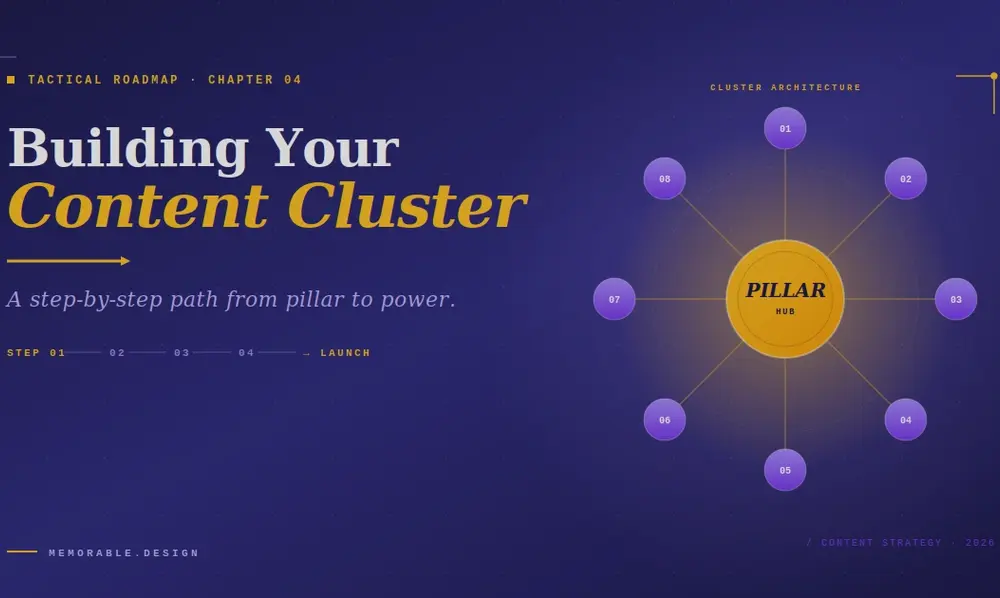
To outrank big brands, you cannot just write random articles. You need a structured content cluster ai search engines can easily index. At Memorable Design, we recommend the "Hub and Spoke" model. This involves one massive pillar page (the Hub) that links to 15–20 smaller, highly specific articles (the Spokes).
| Strategy Component | Purpose | Memorable Design Pro Tip |
| Pillar Page | Broad overview of the niche | Aim for 3,000+ words of foundational info. |
| Supporting Posts | Answering "Long-Tail" questions | Focus on "How-To" and "Why" queries. |
| Internal Linking | Contextualizing the data | Link from Spokes back to the Hub with keyword-rich anchors. |
| Semantic SEO | Covering related sub-topics | Use variations of your keywords to show depth. |
Why a Topical Authority Strategy Beats Keyword Research
Traditional keyword research is often a race to the bottom. Everyone is fighting for the same high-volume terms. A topical authority strategy flips this. Instead of looking for what people are searching for, you look for what information is missing. You aren't just trying to rank for a keyword; you are trying to become the "Knowledge Graph" for that subject.
When you implement a topical authority strategy, you naturally pick up hundreds of long-tail keywords that you didn't even target. This is because search engines recognize the semantic relevance of your entire site. For a topical authority seo small site, this leads to "Topic Dominance," where your site appears multiple times in a single AI-generated overview.
Leveraging Niche Authority for Trust and E-E-A-T
Experience and Expertise are the two most important letters in Google’s E-E-A-T guidelines for 2026. Big brands often use freelance writers who have never touched the products they are reviewing. A small site owner has a distinct advantage here. By sharing "unfiltered" experience—photos of your own synth repairs or videos of your coffee roasting process—you build niche authority that an AI can distinguish from generic marketing copy.
Trustworthiness is built over time. By consistently providing original, well-cited, and helpful content, you signal to both users and algorithms that you are a reliable source. This niche authority is what prevents your site from being "hallucinated away" by AI models. When the AI knows your site is the definitive source, it will cite your brand by name.
Optimizing for Content Clusters and AI Search
The way AI "reads" your site is different from how a human reads it. AI looks for patterns and structured data. To succeed in content cluster ai search optimization, you must ensure your technical SEO is as tight as your writing. Use schema markup to tell the AI exactly what your entities are.
If you are writing about a specific coffee bean, use "Product" or "Organization" schema to link it to specific geographic locations or historical dates. This level of detail is often ignored by big brands because it is too time-consuming at scale. For a topical authority seo small site, these technical details are the difference between being a "blog" and being a "resource."
Future-Proofing Your SEO with Memorable Design
At Memorable Design, we believe that the future of search is personal and precise. As AI search becomes more conversational, users will ask increasingly specific questions. A general site cannot answer "What is the best way to clean a 1982 Roland Juno-60 slider?" But your topical authority seo small site can.
By staying ahead of the curve and focusing on high-quality, original content, you protect your traffic from future updates. The 2026 landscape rewards those who do the hard work of truly understanding their niche. Don't be intimidated by the big brands; their size is their weakness, and your focus is your greatest strength.
Essential Steps to Outrank Giants
Building authority is a marathon, not a sprint. To help you organize your efforts, here are the core pillars of a successful small-site strategy.
Identifying the Knowledge Gaps
Research your competitors, but don't look at what they have. Look at what they are missing. Use tools like "People Also Ask" to find the granular questions that big sites answer in only one sentence. These are your opportunities for 2,000-word deep dives.
Mastering the Internal Link Web
A topical authority seo small site lives or dies by its internal links. Every new post should link to at least three other relevant pages on your site. This creates a "silo" effect, keeping both users and bots engaged with your content longer.
Conclusion
The 2026 SEO landscape is not a threat to small sites—it is an invitation. By focusing on topical authority seo small site owners can build a moat around their traffic that big brands simply cannot cross. It requires a disciplined topical authority strategy, a commitment to deep niche authority, and a clever content cluster ai search structure.
At Memorable Design, we are excited to see the rise of the specialist. When you provide truly helpful, original, and exhaustive content, you aren't just gaming an algorithm; you are helping people find the exact answers they need. Keep your niche narrow, your content deep, and your internal links tight. The giants aren't as tall as they look when you're standing on the peak of authority.
Frequently Asked Questions (FAQs)
How long does it take to build topical authority?
It is estimated that it takes 3 to 6 months of consistent, high-quality publishing to see significant movement. Because a topical authority seo small site doesn't have high domain power, you must rely on the algorithm recognizing your content density over time.
How many articles do I need for a content cluster?
Based on 2026 search trends, a robust content cluster ai search usually requires one pillar page and at least 15–20 supporting articles. This provides enough data points for the AI to categorize you as an expert.
Can a small site still rank for high-volume keywords?
Yes, but only after you have established niche authority. Once you own the long-tail and specific queries, search engines start to trust your site for the broader, higher-volume terms within that same topic.
What is the most common mistake in a topical authority strategy?
The most common mistake is "Topic Bleed." This happens when a site starts covering subjects outside its narrow niche. For a small site, staying hyper-focused is the only way to maintain your topical authority strategy and keep your rankings.
