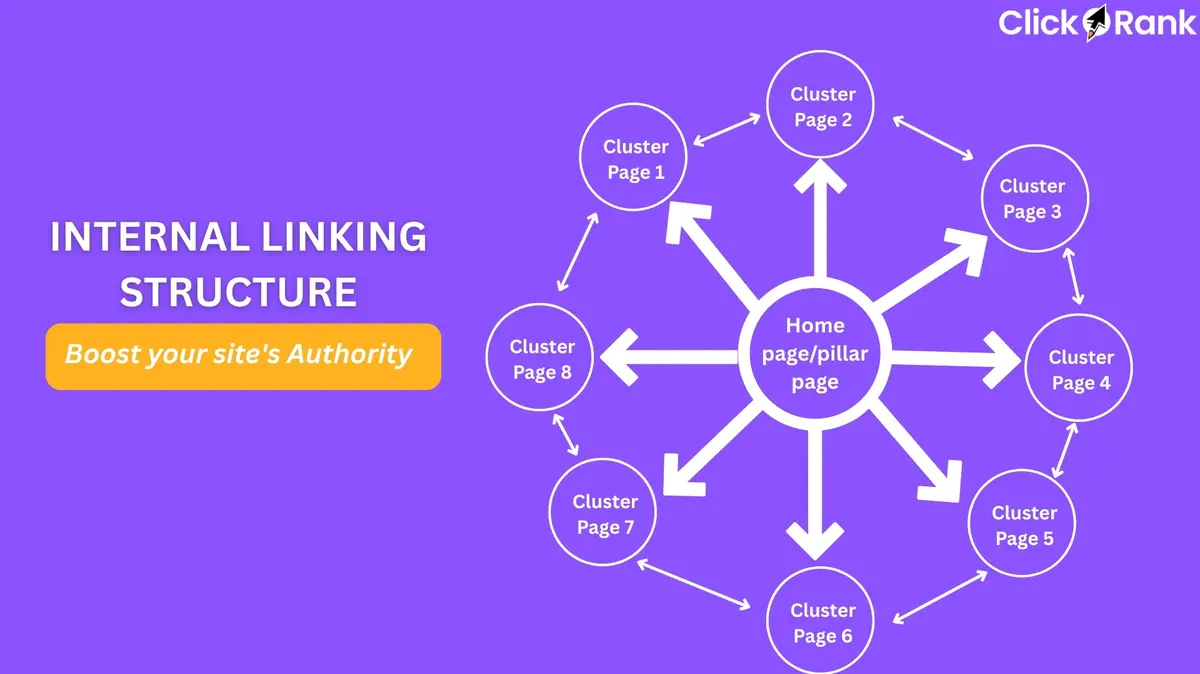
The Hub-and-Spoke model is a powerful internal linking strategy designed for AI-driven SEO. It uses a central "Hub" page linked to detailed "Spokes" on specific topics. This model builds topical authority, boosts E-E-A-T, and enhances AI citation. By focusing on semantic context, descriptive anchor text, and clear site architecture, brands can ensure better visibility, higher rankings, and increased credibility in 2026.
In the landscape of 2026, search engine optimization has evolved into something much more complex than just ranking on a page. We are now optimizing for AI-driven engines that don't just index keywords—they map concepts. To win in this environment, your internal linking strategy 2026 must move beyond simple navigation. You need to build a semantic architecture that allows AI crawlers to understand the depth of your expertise. By using the Hub-and-Spoke model, you create a clear roadmap that helps AI models cite your brand as a primary source of truth.
The Hub-and-Spoke model is an architectural framework where a central "Hub" page (covering a broad topic) links out to several detailed "Spoke" pages (covering specific sub-topics), and those spokes link back to the hub. This creates a closed loop of topical authority. A successful internal linking strategy 2026 ensures that every piece of content you produce is connected to a larger knowledge graph. At Memorable Design, we’ve observed that websites using this structured approach see a significant lift in "Answer Engine" citations because AI models can easily verify the site's E-E-A-T (Experience, Expertise, Authoritativeness, and Trustworthiness).
Why the Hub-and-Spoke Model Wins in 2026
The February 2026 Google Core Update focused heavily on "Information Density" and "Topical Integrity." AI agents, like Google’s Gemini or OpenAI’s SearchGPT, are designed to find the most comprehensive answer with the least amount of "crawl friction." When your site is a scattered collection of unrelated posts, these agents struggle to verify your authority. However, when you implement hub and spoke seo, you are essentially handing these AI agents a pre-packaged encyclopedia of your brand’s knowledge.
This model works because it mimics the way Large Language Models (LLMs) organize information. They look for clusters. By grouping your content into topic clusters internal linking becomes the glue that holds your authority together. If a "Spoke" page about "Logo Psychology" links back to a "Hub" page about "Brand Strategy," the AI understands that your brand has deep, multi-layered expertise in the design space.
The Anatomy of an AI-Ready Internal Linking Strategy
To build an internal linking strategy 2026 that actually moves the needle, you have to think like a data scientist. You aren't just linking for clicks; you are linking for context. Every internal link should serve as a "semantic bridge" that tells a crawler, "If you want to understand the technical details of the topic I just mentioned, go here."
At Memorable Design, we categorize the internal linking process into three distinct layers: the Pillar, the Cluster, and the Bridge. Each serves a specific purpose in building your site’s "Knowledge Vault."
Comparison: Traditional vs. AI-First Internal Linking
| Feature | Traditional SEO Linking | AI-First Strategy (2026) |
| Primary Goal | PageRank distribution | Semantic context & Citation |
| Link Placement | Randomly within text | Structured within clusters |
| Anchor Text | Keyword-heavy | Natural, descriptive, & relevant |
| Crawl Path | Linear | Hierarchical (Hub-and-Spoke) |
| User Intent | Navigation | Knowledge discovery |
1. Defining Your Pillar (The Hub)
The Hub is your high-level overview. It should be a comprehensive guide that touches on all aspects of a broad subject without going into excruciating detail on any single one. This page is the "home base" for your ai content clusters. For example, if your pillar is "The Future of Digital Branding," you will touch on AI, color theory, and user experience briefly, while linking out to specialized articles for the "deep dives."
A common mistake in hub and spoke seo is making the hub too thin. In 2026, the hub must be a high-value asset in its own right. It should provide a clear executive summary that an AI agent can scrape to provide a "quick answer" to a user, with the spokes serving as the "evidence" for that answer.
2. Crafting the Spokes (The Clusters)
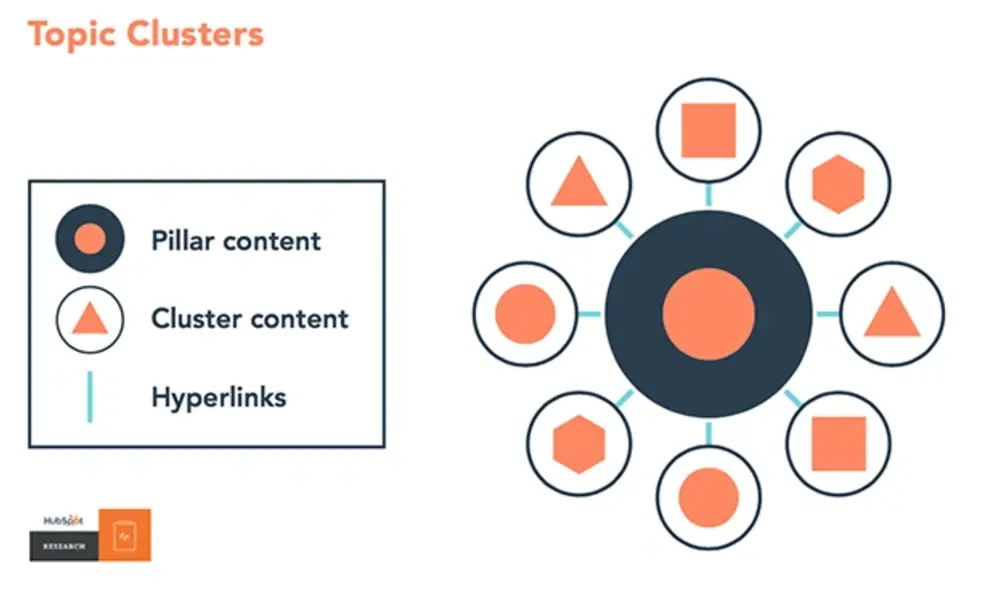
The Spokes are where you demonstrate your "Expertise" and "Experience." These are the granular, highly specific articles that solve a single problem or answer a single question. In a topic clusters internal linking ecosystem, the spokes are the workhorses. They catch the "long-tail" AI queries those highly specific questions users ask their voice assistants or AI chats.
When writing ai content clusters, ensure each spoke is tightly focused. If you are writing about "Accessible Color Palettes for Web Design," don't drift into "Typography." Keep the content pure so that the internal link back to the Hub is logically sound. This purity helps AI models categorize your content with 100% accuracy, which is essential for being cited in AI overviews.
3. The Power of "Semantic" Anchor Text
Gone are the days of using "click here" or "read more." In a modern internal linking strategy 2026, your anchor text is metadata. It tells the AI exactly what the destination page is about before the bot even clicks the link. At Memorable Design, we suggest using anchor text that describes the relationship between the two pages.
Instead of linking the word "SEO," try linking "the evolution of internal linking strategy 2026." This provides a much stronger signal to the crawler. It confirms that the destination page isn't just a generic SEO article, but a specific, timely piece about modern strategy. This level of detail is what separates a "trustworthy" site from a "generic" one in the eyes of the February 2026 update.
Technical Execution: Making the Hub-and-Spoke Model Work
Implementation is where many brands stumble. You can have great content, but if the "pipes" aren't connected correctly, the AI won't see the cluster. Hub and spoke seo requires a disciplined approach to site architecture. You should ideally use a "Siloing" technique where spokes only link to their specific hub and to other related spokes within that same cluster.
Rules for Clean Semantic Architecture
- Avoid "Orphan" Pages: Every spoke must link back to at least one hub. A page with no internal links is invisible to AI agents.
- Limit Cross-Cluster Linking: Don't link a spoke in the "Gardening" cluster to a hub in the "Car Repair" cluster unless there is a very strong, logical reason. It confuses the "Topical Authority" signals.
- Prioritize Deep Links: Instead of always linking to your homepage, link to the most relevant hub or spoke. This keeps the "link equity" within the knowledge graph.
- Audit for Link Rot: Ensure all internal links are active. Broken links are a major "Trust" red flag for the 2026 Core Update.
- Use Breadcrumbs: This provides an secondary, automated topic clusters internal linking path that AI crawlers use to map your site hierarchy.
How AI Content Clusters Fuel Citations
When a user asks an AI, "How do I build a brand in 2026?", the AI doesn't just look for one article. It looks for a source that seems to know the entire landscape. By having a well-organized set of ai content clusters, you prove to the AI that you aren't just a "one-hit wonder." You are a library.
At Memorable Design, we call this "The Citation Loop." If the AI finds a relevant spoke on your site, and that spoke links to a high-quality hub, and that hub links to four other relevant spokes, the AI perceives your site as the "definitive source." Consequently, when the AI generates its response, it is far more likely to include a "Source: Memorable Design" citation at the bottom of the answer.
Boosting E-E-A-T Through Internal Links
The "Experience" part of the 2026 Core Update is often shown through case studies. Use your internal links to connect educational content to real-world examples. If you have a spoke explaining hub and spoke seo, link it to a case study spoke where you show the results of that strategy.
Linking your "Expertise" (the how-to) to your "Experience" (the results) is the ultimate "Trust" signal. It proves that you don't just know the theory—you’ve done the work. This interconnectedness is the backbone of a high-ranking internal linking strategy 2026. It turns your website from a simple blog into an authoritative knowledge base.
Maintaining Your Linking Ecosystem
Internal linking is not a "set it and forget it" task. As you add more ai content clusters, you must go back to your old pillars and update them with links to the new spokes. This is known as "Reverse Linking." It keeps your old content fresh and signals to Google that your older, authoritative pages are still relevant and being updated with new insights.
We recommend a quarterly "Link Audit" at Memorable Design. During this audit, we check if new spokes have been properly integrated into the hub and spoke seo model. We also look for opportunities to consolidate "thin" spokes into larger, more authoritative pieces, ensuring the site remains lean and high-density.
Summarizing the Hub-and-Spoke Advantage
The transition to AI-first search has made site structure as important as the content itself. By adopting an internal linking strategy 2026, you are building a future-proof foundation. You are moving away from chasing keywords and moving toward owning topics.
- Topical Authority: You become the "go-to" source for a specific niche.
- Crawl Efficiency: AI bots can map your site faster and with less energy.
- Higher Citations: You provide the "semantic proof" AI engines need to trust your data.
- Better UX: Users find it easier to navigate deep into your knowledge base.
- SEO Longevity: Clusters are harder for competitors to displace than single keywords.
Conclusion
The era of random blogging is over. To thrive in the world of the February 2026 Google Core Update, you must be intentional. Your internal linking strategy 2026 must be built on the logic of hub and spoke seo, creating a dense, interconnected web of high-quality information. This isn't just about "SEO"; it's about being the most helpful and trustworthy resource in your industry.
When you invest in topic clusters internal linking, you are telling the digital world that your brand has something valuable to say. You are providing the structure that AI engines crave and the depth that human readers appreciate. Let Memorable Design help you architect a site that doesn't just rank, but leads. By focusing on ai content clusters and a rigorous internal linking strategy 2026, you can ensure your brand remains a cited authority for years to come. Remember, in the age of AI, the best-connected content wins.
FAQs
What is the most common mistake in an internal linking strategy 2026?
The most common mistake is "Over-linking." Many sites try to link every keyword to another page. This creates a "web of noise" that confuses AI agents. You should only link when it provides genuine semantic value or deeper context to the current topic.
How many spokes should a hub have in a hub and spoke seo model?
Based on available data, a healthy cluster usually contains one hub and 5 to 15 spokes. If you have more than 20 spokes, you might want to consider breaking them into two separate, more specific "Sub-Hubs" to maintain topical clarity.
Do ai content clusters work for small websites?
Absolutely. In fact, ai content clusters are the best way for small sites to compete with giants. By owning a very specific "niche" topic through tight internal linking, a small site can outrank a massive one that only covers the topic broadly.
How does Memorable Design implement these strategies?
At Memorable Design, we start by mapping out a "Brand Knowledge Graph." We identify the core pillars of your expertise and then systematically build out topic clusters internal linking them together to ensure your site is recognized as an authority by both humans and AI.
Is anchor text still important for topic clusters internal linking?
Yes, but the focus has shifted. It is no longer about "exact match keywords" for ranking. It is about "descriptive clarity" for the AI to understand the relationship between the two connected pages.
