
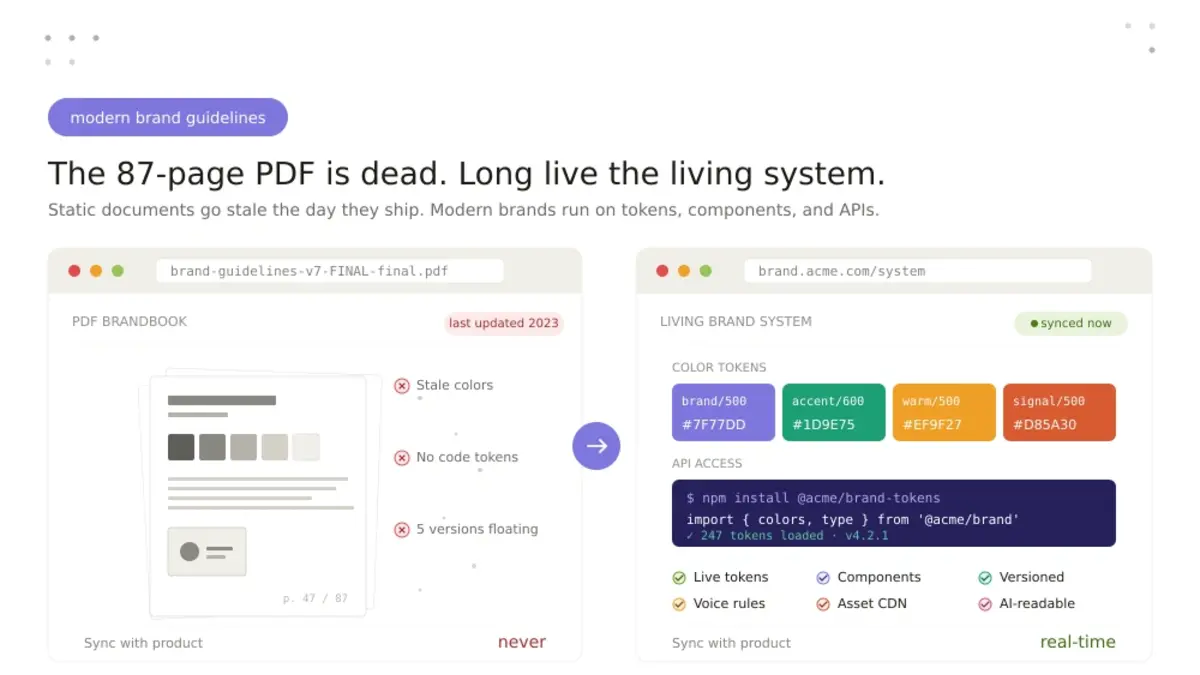
The document discusses the shift from static brand guidelines, such as lengthy PDF documents, to dynamic, interactive, and easily accessible modern brand guidelines. It highlights how traditional methods often result in outdated or neglected brand elements, leading to inconsistencies. The new approach ensures that brand assets are continuously updated, searchable, and user-friendly, making them more effective in maintaining brand consistency across teams and platforms.
Imagine spending months perfecting your brand’s visual identity. You’ve selected the ideal hex codes, narrowed down the typography, and refined the logo spacing. You package it all into a beautiful, 60-page PDF and send it to your team. Six months later, you find a marketing presentation using an outdated logo and a font that isn't even in your system.
The reality is that modern brand guidelines have moved beyond the static PDF. Traditional brandbooks are failing because they are difficult to update, hard to search, and impossible to scale in a fast-moving digital world. To maintain consistency today, companies are switching to digital brand guidelines centralized, cloud-based hubs that live and breathe with the brand.
At Memorable Design, we’ve seen firsthand how static files become "digital graveyard" residents. If your guidelines aren't accessible, they aren't being used.
The Fatal Flaws of the Traditional PDF Brandbook
For decades, the PDF was the gold standard. It was portable and preserved layout integrity. However, in an era of TikTok, rapid UI updates, and remote collaboration, the PDF has become a bottleneck.
1. The Version Control Nightmare
When you update a single color or a social media icon in a PDF, you have to re-export the file and re-distribute it. Inevitably, someone on your team will keep using "Brand_Guidelines_V3_FINAL_Final.pdf" while the rest of the world is on V5. This leads to brand dilution and costly design corrections.
2. Static Assets in a Motion-First World
Modern branding isn't just about static logos. It involves UI animations, video transitions, and interactive components. A PDF cannot demonstrate how a button should hover or how a logo should animate during a loading screen. Modern brand guidelines need to support rich media to be truly effective.
3. Friction Kills Compliance
If a developer needs a logo, they have to open the PDF, find the right page, and then go searching in a separate Dropbox folder for the actual file. This friction encourages "eye-balling it," where employees grab low-res images from Google or old Slack messages instead of using the source of truth.
What Defines Modern Brand Guidelines?
The shift toward a brand guidelines website isn't just a trend; it’s a functional necessity. A digital hub acts as a single source of truth that is always up to date. Unlike a file tucked away in a folder, a brand guidelines website is searchable and interactive.
| Feature | Static PDF Brandbook | Modern Digital Guidelines |
| Accessibility | Requires download; often lost in emails. | Web-based; accessible via URL. |
| Updates | Requires manual re-distribution. | Real-time updates for all users. |
| Asset Delivery | Links to external folders. | Direct download of SVG, PNG, and CSS. |
| Searchability | Limited to "Ctrl+F" within text. | Searchable database of components. |
| Interactivity | Zero (Fixed images). | Live code snippets and video previews. |
By moving to a brand guidelines website, brands ensure that every stakeholder—from the intern to the external ad agency—has the exact same information at the exact same time. Memorable Design advocates for this transparency because it protects the integrity of the creative work.
Why "Living Brand Guidelines" Are the Future
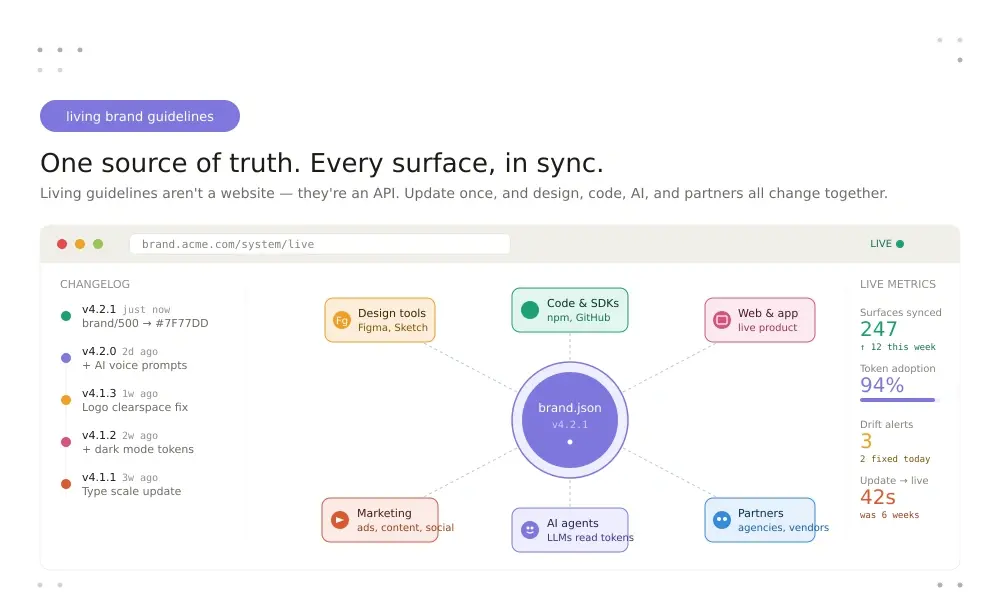
We often refer to the new standard as living brand guidelines. This means the documentation is connected to the tools your team actually uses.
Integration with Design Systems
For tech-forward companies, living brand guidelines are often synced with Figma or GitHub. When a designer changes a primary color in the design system, the digital brand guidelines update automatically. This eliminates the gap between "the rules" and "the reality" of the product.
Searchability and Speed
Imagine a social media manager needs to know the specific "don'ts" for Instagram Reels. Instead of scrolling through a 50-page document, they can use a search bar in their digital brand guidelines to find the "Social Media" section instantly. This speed encourages people to actually check the rules before they create.
Developer-Friendly Documentation
One of the biggest advantages of living brand guidelines is the inclusion of code. Instead of telling a developer that a header is "Bold Helvetica 24px," you provide the actual CSS snippet. This ensures that the brand looks identical across the marketing site and the mobile app.
Transitioning to a Digital Brand Guidelines Model
Making the switch from a static file to a brand guidelines website can feel like a massive undertaking, but it is an investment that pays for itself in saved time. At Memorable Design, we suggest focusing on three core pillars: Centralization, Accessibility, and Evolution.
Building the Infrastructure
You don't necessarily need to build a custom site from scratch. Platforms like Frontify, ZeroHeight, or even a well-structured Notion page can serve as modern brand guidelines. The goal is to have a URL that your team can bookmark.
Auditing Your Assets
Before migrating to digital brand guidelines, audit your current assets. Are your logos available in SVG format? Do you have a clear hierarchy of typography? This is the perfect time to trim the fat and ensure only the most current, high-quality files are available for download.
Creating an "Always-On" Culture
Once your brand guidelines website is live, delete the old PDFs. Make the digital link the only way to access brand assets. When the guidelines are easy to navigate, your team will naturally gravitate toward them. Memorable Design believes that the best brand protection is a low barrier to entry.
The Role of Memorable Design in Brand Longevity
At Memorable Design, we believe that a brand is a promise kept. If your visual identity is inconsistent, that promise feels broken. We specialize in creating modern brand guidelines that don't just sit on a shelf but actively help your team grow.
By focusing on living brand guidelines, we help companies stay agile. Whether you are a startup or an established enterprise, having a brand guidelines website ensures that as you scale, your voice remains clear and your visuals remain crisp.
The era of the "Finished Brandbook" is over. We are now in the era of continuous brand evolution.
FAQs
What is the main difference between a PDF and digital brand guidelines?
A PDF is a static document that becomes outdated the moment a change is made. Digital brand guidelines are web-based platforms that allow for real-time updates, direct asset downloads, and interactive elements like video and code.
Are digital brand guidelines expensive to maintain?
While there is an initial setup time, living brand guidelines save money in the long run by reducing design errors and the time spent searching for files. Many tools offer affordable tiers for growing brands.
Who should have access to our brand guidelines website?
Ideally, everyone. Transparency is key. You can have a public-facing version for the press and a password-protected section for internal teams and partners to access sensitive files.
Why does Memorable Design recommend moving away from PDFs?
PDFs create friction. When people can’t find what they need quickly, they guess. We recommend modern brand guidelines because they ensure 100% compliance by making the right way the easiest way.
How often should we update our living brand guidelines?
Your living brand guidelines should be updated as your brand grows. Whether it's adding a new sub-brand or refining your social media voice, the digital format allows you to make these changes instantly without reissuing a new document.
