The document discusses the challenges of naming a brand in 2026, emphasizing the need for names that are both human-friendly and AI-searchable. It highlights the importance of choosing a name that is short, distinct, and easy for voice assistants to recognize, while also navigating crowded trademark registries and AI search filters. The goal is to create a name that stands out in a digital landscape.
The golden age of "just pick a cool word" is over. In 2026, finding a name for your business is a strategic battle against crowded trademark registries and AI search filters. Learning how to name a brand today requires balancing human emotion with technical discoverability. To succeed, your brand name must be short, phonetically clear for voice assistants, and distinct enough to claim a digital footprint. At Memorable Design, we believe the best names aren't just creative; they are engineered to be found and remembered.
Why Naming Has Changed in the Age of AI
In previous years, you just needed a name that sounded professional and had a dot-com. Now, we live in a world of LLMs (Large Language Models) and Answer Engine Optimization (AEO). If your name is too generic, AI search engines will aggregate you with every other similar business.
When you look at how to name a brand in this climate, you have to consider "Semantic Distinctiveness." This means choosing a name that doesn't just describe what you do, but creates a unique "cluster" in a search engine’s database. A generic name like "Fast Delivery" is a nightmare for SEO, whereas a name like "Zippo" (though already taken) creates a specific mental and digital hook.
The Modern Brand Naming Process
The brand naming process is no longer a one-afternoon brainstorming session. It is a multi-step journey that combines linguistic flair with data-driven validation. At Memorable Design, we break this down into several key phases.
Phase 1: Identity and Archetyping
Before you look at words, look at your soul. What is the personality of your business? Is it a "Explorer" brand like Patagonia or a "Magician" brand like Disney? Defining your archetype helps narrow down the phonetic sounds that will resonate with your audience.
Phase 2: Ideation and Linguistic Mapping
This is where most people get stuck and reach for a generic brand name generator. While those tools are fine for a starting point, they often produce "soulless" portmanteaus (like NexaCore or Cloudly). Instead, try mapping out metaphors, Latin roots, and visual imagery associated with your service.
Moving Beyond Brand Name Generator Alternatives
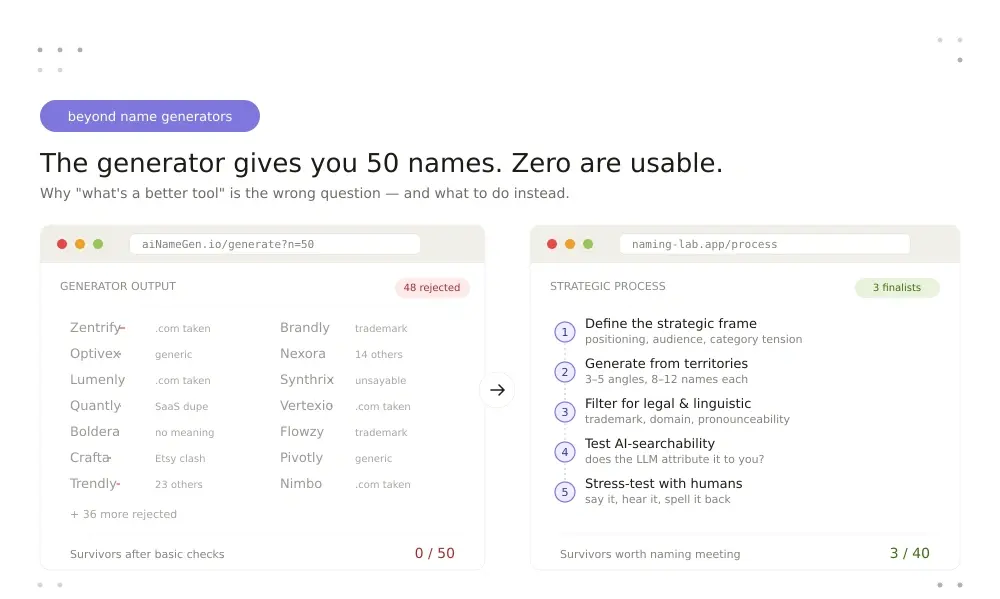
While automated tools are popular, the market is currently saturated with "AI-generated" names that sound exactly the same. To stand out, you need brand name generator alternatives that focus on human psychology.
Use the "Crowded Room" Test
Imagine your brand name being whispered in a crowded room. Can someone repeat it back to you without asking "How do you spell that?" If the name requires a spelling lesson (like "Xyzzy"), it will fail in the world of voice-activated AI search.
Semantic Association
Instead of a generator, try using a reverse dictionary or a visual thesaurus. Look for words that describe the result of your service rather than the service itself. If you are a cleaning company, don't look for words about "soap"—look for words about "clarity" or "renewal."
| Approach | Pro | Con |
| Descriptive (e.g., Whole Foods) | Instant clarity | Hard to trademark |
| Abstract (e.g., Kodak) | Unique & distinctive | High marketing cost to explain |
| Metaphorical (e.g., Amazon) | Strong emotional hook | Can be confusing initially |
| Modern/Hybrid (e.g., Memorable Design) | High SEO value | Requires careful balance |
Solving the Domain Name Available Problem
The biggest heartbreak in the brand naming process is finding the perfect name only to realize the domain is owned by a squatter for $50,000. In 2026, the ".com" is still king, but it is no longer the only path to success.
Thinking Beyond the .com
If your preferred domain name available search comes up empty, consider "Action Domains." These are domains like .app, .tech, or .store. However, the most successful modern brands are now using "Descriptor Domains"—for example, Get[BrandName].com or WeAre[BrandName].com.
The Social Handle Sync
A name is only as good as its availability across platforms. Before you fall in love, run a check on Instagram, TikTok, and X (formerly Twitter). If you have to add five underscores and a number to your name just to get a handle, it’s time to head back to the drawing board.
Making Your Brand AI-Searchable
When someone asks an AI, "Who is the best graphic firm?" you want your name to be easily identified. This is a crucial part of how to name a brand in the mid-2020s.
Avoid Common Nouns
If you name your company "Apple," you need a billion-dollar budget to make sure people find you and not the fruit. For smaller businesses, using a unique, coined word or a rare combination of words helps AI algorithms categorize you correctly without competition from everyday objects.
Phonetic Simplicity
AI voice assistants often struggle with "clever" spellings. If your brand is "Klean" instead of "Clean," Siri or Alexa might direct users to a competitor. Stay as close to standard phonetics as possible while remaining unique. This is a core reason why Memorable Design focuses on clarity over "clutter."
Two Categories of Brand Guidelines
Foundational Elements
In this category, focus on the structural integrity of the name. A brand name must be short, typically under three syllables, to ensure it fits well on mobile screens and social media icons. It should also be "global-ready," meaning it doesn't have a negative or embarrassing meaning in other languages. This structural check is the first line of defense against a name that "sucks."
Emotional Resonance
The second category deals with how the name feels in the mind of the consumer. It should evoke a specific emotion—be it trust, excitement, or calm. Names that use "plosive" sounds (letters like P, K, and B) often feel more energetic, while "fricative" sounds (S, F, V) feel more fluid and sophisticated. Matching the sound to the brand's mission is an art form.
Final Checks: The "Non-Suck" Audit
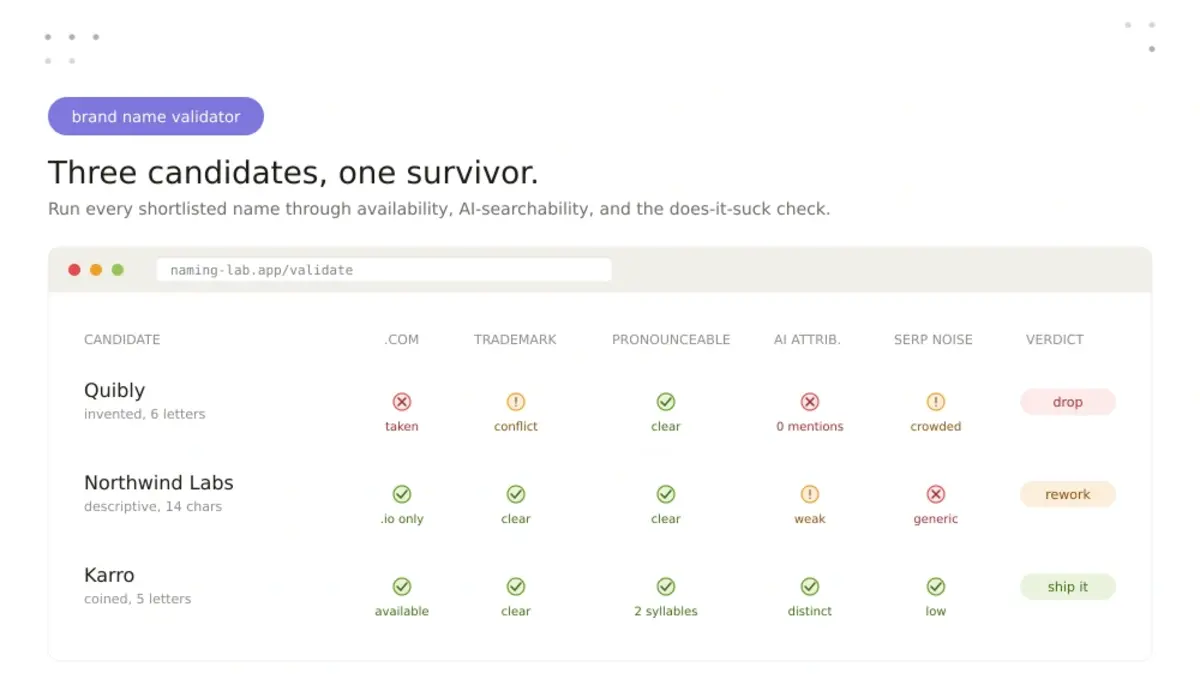
Before you commit, put your name through the "Non-Suck" audit. This is a practical checklist we use at Memorable Design to ensure a name has staying power.
- The Billboard Test: If you saw the name on a billboard at 60mph, would you remember it?
- The "CEO" Test: Can you say "I am the CEO of [Name]" without feeling embarrassed?
- The Negative Space Check: Does the name accidentally spell something weird when written as a URL? (e.g., TherapistFinder.com vs TherapistFinder.com—be careful with "Therapist").
Learning how to name a brand is about avoiding these "cringe" moments just as much as it is about being creative.
Conclusion: The New Era of Naming
To summarize, finding a name in 2026 is a blend of human psychology and technical strategy. You must move past the basic brand name generator and engage in a deep brand naming process that accounts for AI searchability and global trademarks. Ensure your domain name available search includes social handles and modern TLDs to avoid overpaying for a .com.
At the end of the day, a name is the first chapter of your brand's story. It should be a vessel that you can fill with meaning over time. If you follow these steps, you won’t just find a name that’s available—you’ll find one that thrives. If you need expert help navigating this journey, Memorable Design is here to ensure your brand starts on the right note.
FAQs
1. How long should a brand name be?
Ideally, a brand name should be 1–3 syllables. Short names are easier to remember, fit better on digital assets, and are less likely to be butchered by voice assistants.
2. What if my .com is taken?
Don't panic. If your ideal domain name available search fails for a .com, consider using a prefix like "Go," "My," or "The," or opt for a relevant industry TLD like .io or .design. Consistency across social handles is often more important than the .com itself.
3. Are AI brand name generators good?
Most brand name generator alternatives are better than the standard ones, but they should only be used for inspiration. Real naming requires a human touch to ensure the name doesn't have negative cultural connotations or phonetic issues.
4. How do I know if my name is AI-searchable?
Try asking an AI tool to "Define [Your Potential Name]." If it returns a specific result that isn't related to your industry, you may have too much competition. You want a name that allows you to "own" your specific niche in the digital space.
5. Is it worth paying for a premium domain?
It depends on your budget. If a how to name a brand strategy leads you to a perfect name but the domain is $10,000, consider if that money is better spent on marketing. In 2026, search engines are smart enough to find you even if you don't have a "premium" keyword domain.
