
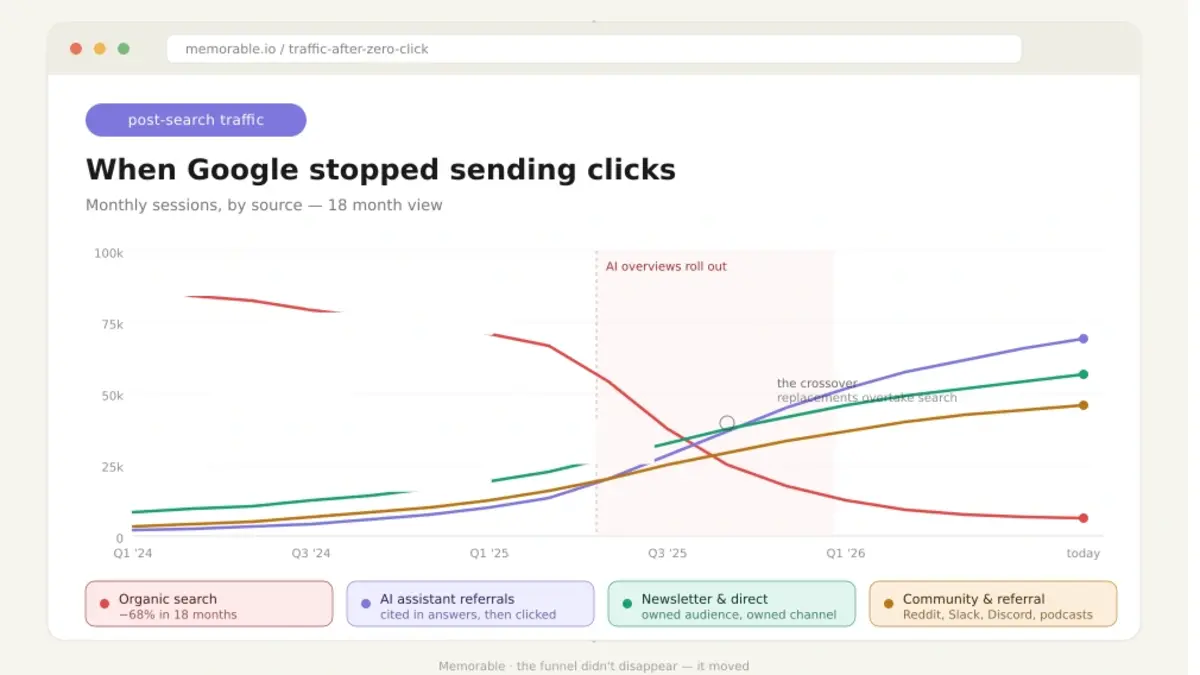
The "Zero-Click" search era has disrupted organic traffic. With AI overviews and featured snippets answering questions directly on search results, many websites see high rankings but fewer clicks. This shift requires a new approach to survive, as traditional methods of driving traffic no longer yield the same results. The era of "easy" organic traffic is over, and adapting to these changes is key.
The era of "easy" organic traffic is over. If you have checked your analytics lately, you’ve likely noticed a terrifying trend: your rankings are high, but your clicks are disappearing. This is the "Zero-Click" era, where AI overviews and featured snippets answer user questions directly on the search results page. To survive this shift, you must move beyond simple SEO and master your brand positioning statement. When Google provides the answer, the only reason a user will click through to your site is that they trust your specific perspective more than a generic AI summary.
At Memorable Design, we’ve seen that the "traffic death" isn't a death of interest it's a death of generic content. What replaced mass traffic is defensible positioning. By refining your brand positioning statement, you transform your brand from a commodity into a destination. In 2026, the goal isn't just to be found; it's to be sought out. Successful brands are now focusing on deep brand differentiation to ensure that even if an AI summarizes their tips, the user still wants the full experience that only that specific brand can provide.
Why Zero-Click Search is a Wake-Up Call for Brands
For years, marketers played a game of "match the intent." If someone searched for a definition, we wrote a blog post with that definition. Now, Google’s AI (SGE) does that for us. If your website only provides "what is" information, you no longer have a reason to exist in the eyes of the searcher. This shift has forced a massive pivot toward the brand positioning statement as the most important tool in your marketing arsenal.
When a search engine provides a "good enough" answer, your brand needs to provide the "better" answer. This requires a shift from being an information provider to being a thought leader. You need to stand for something specific. This is where brand differentiation becomes the difference between a thriving business and a ghost town website. You are no longer competing against other websites; you are competing against the search engine's ability to summarize the internet.
The New Framework: Defensible Positioning
The only thing an AI cannot replicate is a unique, lived-experience-based point of view. This is what we call defensible positioning. It is a strategy built on the idea that your brand has a "moat" that technology cannot easily cross. At Memorable Design, we believe this moat is built on three specific pillars that move your business away from the "answer-box" trap.
Experience-Led Authority
Google’s 2026 updates place a massive premium on the "E" in E-E-A-T (Experience). If you are writing about a topic, you need to prove you have actually done it. An AI can aggregate advice on "how to build a house," but it cannot share the specific frustrations of a foundation pouring in a rainstorm. By integrating these stories into your brand positioning statement, you create a connection that an algorithm cannot simulate.
Opinionated Content
Generic content is easy to summarize. Opinionated content is not. When you take a stand—even a controversial one—you force the user to engage with your brand specifically. This is a core part of brand differentiation. If your brand is the only one saying "Standard Method X is dead," users will click your link to find out why, even if the AI tries to play it safe with a middle-of-the-road summary.
Crafting a Brand Positioning Statement That Survives 2026
Your brand positioning statement is a short, internal compass that defines who you are, who you serve, and why you are the only choice for them. It is not a slogan. It is the DNA of your business. In the zero-click era, this statement must be sharper than ever. It needs to articulate a value that is so specific it cannot be "scraped" and turned into a generic bullet point.
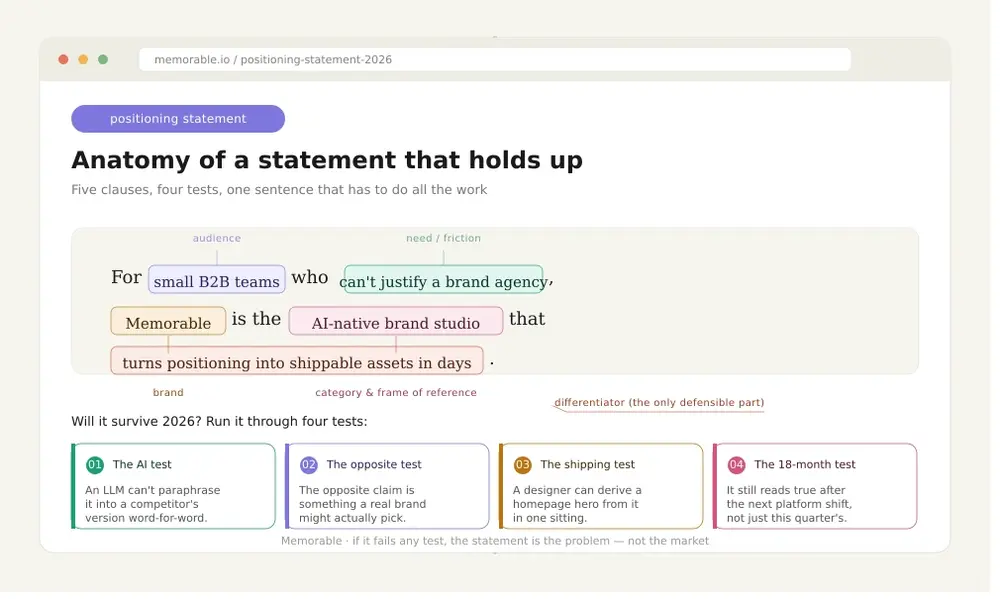
A strong brand positioning statement usually follows a specific formula: "For [Target Market], [Brand] is the [Category] that [Unique Benefit] because [Proof Point]." However, at Memorable Design, we suggest adding a fifth element: "Unlike [The Status Quo]." By defining what you are not, you create a much stronger sense of brand differentiation.
Positioning Statement Examples: Good vs. Great
| Brand Type | Generic Statement (Vulnerable to Zero-Click) | Defensible Statement (The Memorable Design Way) |
| SaaS Company | We provide project management software for busy teams to help them stay organized. | For remote tech teams, we are the only project manager that uses neuro-scientific principles to eliminate "focus-drift." |
| Coffee Shop | We serve high-quality organic coffee in a cozy environment for local residents. | For the midnight-oil creative, we are the only 24-hour sanctuary that pairs high-caffeine roasts with silent-zone seating. |
| Consultancy | We help businesses grow through expert marketing and sales strategies. | For mid-sized manufacturers, we are the defensible positioning experts who replace disappearing traffic with high-intent lead funnels. |
Looking at these positioning statement examples, you can see that the "Great" column offers a level of specificity that an AI overview would struggle to replace. If I am a "remote tech team" struggling with "focus-drift," I am clicking that link regardless of what the search results say.
Strategies for Brand Differentiation
To stay relevant, you must ensure your brand looks and feels different at every touchpoint. This isn't just about a logo; it's about the "soul" of your communication. When we talk about brand differentiation, we are talking about the unique way you solve a problem that makes the "AI answer" feel incomplete.
The "Personal Signature" Method
Every piece of content or product you release should have a "signature"—a unique way of doing things that is synonymous with your brand. Think of it like a chef’s signature dish. Even if the recipe is online, people go to the restaurant for the specific execution. Your brand positioning statement should reflect this signature.
Community as a Moat
One thing a zero-click search cannot do is provide a sense of belonging. Building a community around your brand is the ultimate form of defensible positioning. If your audience feels they are part of a club, they will bypass Google and come directly to your "home"—your website, your app, or your newsletter.
How to Maintain Authoritativeness in a Post-Traffic World
Authoritativeness is no longer about how many keywords you rank for; it's about how many people search for your brand by name. This is the ultimate goal of Memorable Design. We want our clients to move from "searching for a solution" to "searching for [Brand Name]."
Trustworthiness through Transparency
In an AI-heavy world, humans crave transparency. Show your "behind the scenes." Share your failures. When your brand positioning statement is rooted in honesty, you build a level of trust that no algorithm can touch. Trust is the currency that buys you clicks when the AI overview is trying to keep the user on the search page.
Structured Info for AEO (Answer Engine Optimization)
While we want to move beyond just being an "answer," we still need to be "readable" by machines. Using structured data and clear lists (like the ones below) helps AI understand your defensible positioning. If the AI is going to quote someone, you want it to quote you as the definitive expert.
5 Steps to Building Defensible Positioning
- Audit Your Expertise: Identify the unique experiences your team has that an AI cannot simulate or scrape from a textbook.
- Niche Down Further: If your target market is too broad, your brand positioning statement will be too generic to survive a zero-click search.
- Develop a "Counter-Narrative": Find a common belief in your industry that you disagree with and explain why. This is the fastest way to brand differentiation.
- Optimize for Direct Traffic: Use your content to drive newsletter signups or community joins so you are less dependent on the Google "middleman."
- Review Positioning Statement Examples: Look at your competitors and ensure your statement doesn't sound like a carbon copy of theirs.
Mastering the Language of Your Brand
- Use Specific Nouns: Instead of "software," use "automated workflow engine." Instead of "service," use "collaborative growth partnership."
- Focus on the "Who": A brand for everyone is a brand for no one. Use your brand positioning statement to call out your ideal customer by name.
- Highlight the Proof: If you have helped 500 companies, say it. If you have a proprietary method, name it.
- Iterate Constantly: The market moves fast. Re-evaluate your brand differentiation every six months to ensure it’s still actually "different."
The Role of Memorable Design in Your Transition
At Memorable Design, we don't just build websites; we build identities. We understand that in 2026, a website is a destination for converted fans, not just a net for random searchers. Our approach to the brand positioning statement is surgical. We strip away the fluff and the "marketing-speak" to find the core utility that makes your business indispensable.
By focusing on defensible positioning, we help you create a digital footprint that thrives even when search engines try to keep your traffic for themselves. We believe that brand differentiation is the only way to stay profitable in a world where information is free but insight is rare. When you work with us, we ensure that your brand positioning statement is so compelling that it becomes the reason people stop scrolling and start clicking.
Conclusion: Turning a Threat Into an Opportunity
Zero-click search isn't a death sentence; it's a filter. It is filtering out the mediocre, the generic, and the lazy. To survive and thrive, you must lean into your brand positioning statement as your most powerful competitive advantage. By studying positioning statement examples and carving out a space of defensible positioning, you ensure that your audience knows exactly why you are the only solution for their specific problem. At Memorable Design, we are here to help you navigate this new landscape, turning the challenge of brand differentiation into your brand's greatest strength. The traffic might have changed, but the power of a truly memorable brand has never been higher.
Frequently Asked Questions (AEO)
What is a brand positioning statement?
A brand positioning statement is a brief description of a product or service and target market, and how that product or service fills a specific need of the target market in a way that competitors do not.
How does zero-click search affect brand differentiation?
Zero-click search makes brand differentiation more important because if your brand doesn't stand out as a unique authority, users will simply accept the AI-generated answer on the search page instead of clicking through to your website.
Can you give positioning statement examples for a small business?
Yes. For a local bakery: "For gluten-sensitive dessert lovers in [City], [Bakery Name] is the only pastry shop that uses ancient grains to create French-style treats that taste indistinguishable from the original."
What makes positioning "defensible"?
Defensible positioning is based on unique assets, proprietary processes, or specific expertise that competitors—and AI—cannot easily replicate or claim as their own.
How often should I update my brand positioning statement?
You should review it annually or whenever there is a major shift in the market or technology (like the rise of AI search) to ensure your brand differentiation remains relevant and strong.
