
Key Takeaways:
- SEO ranks website links on search result pages
- GEO formats content for direct AI summary answers
- Combining both strategies builds maximum online visibility in 2026
- Focus shifts from keywords to topical context and structure
Have you searched for something online lately and noticed you didn't even need to click a link to get your answer? That quick summary right at the top is changing how we find information every single day.
When we talk about GEO vs SEO, we are comparing two ways to show up online: traditional SEO ranks your pages in Google link lists, while generative engine optimization helps your content feed direct answers inside AI search results. Understanding this shift helps you reach more readers without losing your existing search traffic.
AI Overview:
GEO vs SEO represents the shift from link ranking to AI answer engines in 2026. Traditional SEO helps websites rank in engine search results through keywords and backlinks. Generative engine optimization tailors content for AI search engines like ChatGPT and Gemini to cite your work in direct answers. Combining both methods gives your site strong organic visibility across all platforms.
Understanding Search in 2026
Remember when getting to position one on Google was the only goal that mattered? Things look a bit different now. Search engines do not just list web links anymore. They synthesize complete answers right on the screen. Traditional search engines send a user query through the system to return a ranked list of links, requiring the user to click through to a website. AI answer engines take that user query and synthesize a direct answer on the spot, allowing the user to read the information immediately or click a cited source. This evolution brings us to traditional SEO alongside generative engine optimization.
Both methods help people find your business, but they work under very different rules. If you run a website, you might wonder if your old strategies are suddenly useless. The short answer is no. Traditional SEO still drives solid traffic, but AI search optimization ensures you do not get left behind when users ask AI tools for recommendations. At memorabledesign.com, we see this evolution as a natural step forward for digital content rather than a total breakdown of old tools.
What is Traditional SEO?
Let us start with the foundation we all know. Search engine optimization is the practice of improving your site to increase visibility when people search for products or services. It relies heavily on search intent, technical crawlability, and building domain authority.
When you practice traditional SEO, you build content around explicit keyword phrases so algorithms can index your pages accurately.

Here are the main components that drive classic search rankings:
- On-page optimization like title tags, headings, and clear keyword placement.
- Technical elements such as quick page loading speeds, mobile usability, and clean site architecture.
- Off-page signals including quality backlinks and digital brand mentions across the web.
Traditional SEO focuses on earning that click to your website page. You want the user to see your title in search results, feel curious, and click through to read your full post.
What is Generative Engine Optimization (GEO)?
Generative engine optimization focuses on optimizing content so AI models cite your brand within conversational answers. Instead of just sorting links, AI search models read across many sources, pull out key insights, and draft a natural response for the user.
If your site provides clear data, unique quotes, and structured facts, the AI engine is much more likely to reference you as a source. This process relies heavily on semantic search and topic authority rather than repeating exact phrases. While traditional SEO wants a user to click through, GEO aims to make your brand the trusted source inside the answer itself.
GEO vs SEO: The Core Differences
How do these two approaches actually stack up when you plan your weekly content updates? It comes down to how algorithms ingest your writing and what they give back to the user.
| Feature | Traditional SEO | Generative Engine Optimization (GEO) |
| Primary Goal | Rank higher on search result pages to get clicks | Get cited inside AI generated answer summaries |
| Target Audience | Human searchers clicking links | AI language models scanning for facts |
| Content Focus | Exact keywords and search volume | Entity coverage, clear facts, and context |
| Success Metric | Organic clicks, impressions, and rank position | Brand citations, AI mentions, and direct referral traffic |
| Key Signals | Backlinks, page speed, and keyword placement | Clear structure, authoritative quotes, and unique data |
When comparing GEO vs SEO, you can see they are not direct enemies. They simply target different stages of how modern users gather information online.
Key Strategies for AI Search Optimization
So how do you actually write for generative engines without breaking your current site rankings? You do not need to rewrite your entire website from scratch.
Instead, tweak how you present information so both humans and language models understand your point immediately. Here are practical steps to make your site friendly for AI search optimization:
1. Give Direct Answers Early
Place your core definition or main point right near the top of the section. AI models prefer content that answers questions without unnecessary fluff or long backstory delays.
2. Use Clean Structure and Plain Formatting
Break up complex points into clear sections with simple language. Avoid over-complicated jargon or confusing sentence structures that might obscure your main ideas. Using simple tables and short lists helps machines extract facts accurately without misinterpreting your meaning.
3. Add Original Facts and Experience
Generative models love fresh insights they cannot easily guess from old data training sets. Sharing personal insights, original surveys, or unique real-world examples gives these models a clear reason to cite your exact page. At memorabledesign.com, we always recommend sharing original team learnings to stand out from generic copy.
How Search Engines Process Content in 2026
To understand why GEO vs SEO matters today, it helps to see how content moves from your editor to the reader's screen. In traditional SEO, a crawler indexes your text, checks your keyword density, measures backlinks, and ranks your URL on a page. In generative engine optimization, an LLM evaluates your content for authority, factual accuracy, and clarity.
It then merges your insights with other trusted pages to present a single answer. In the traditional path, your content moves to the indexer, goes through keyword analysis, and achieves a rank position. In the GEO path, your content is processed by an LLM reader, integrated into an entity knowledge graph, and turned into a synthesized response with citations. If your page is hard to read or full of vague buzzwords, the AI simply skips past it and cites another source that states facts clearly.
Balancing GEO and SEO for Your Site
You might ask yourself if you need to pick just one path for your business. The answer is a clear no. The best digital approach builds a strong foundation in traditional SEO while adding clear layers for AI search optimization. When your technical site structure is fast and crawlable, both search crawlers and AI bots can easily read your pages.
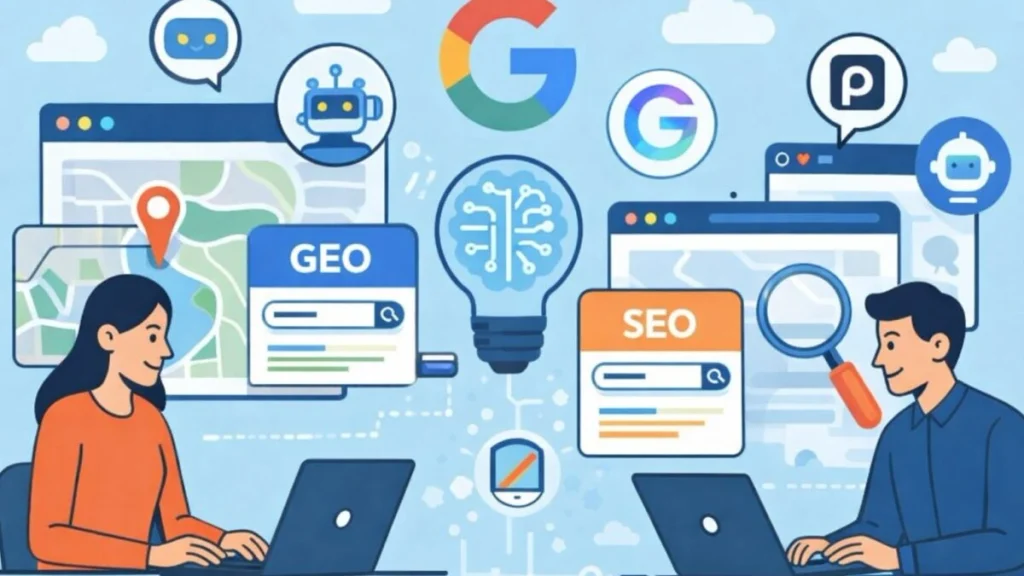
When your content uses natural language and direct logic, human readers stay happy while AI engines extract clear citations. Merging both fields creates a resilient strategy that handles algorithm changes with minimal stress. It ensures you stay visible whether a user types a short keyword query into Google or asks a long question in a conversational AI chat.
Practical Examples of GEO vs SEO Content
Let us look at how sentence structure changes depending on your focus. A post optimized strictly for classic rankings might repeat a keyword phrase multiple times across every header, sometimes feeling a bit forced.
A post built with generative engine optimization focuses on clear, structured context:
- Classic Style: "If you want the best running shoes, our best running shoes guide lists the best running shoes for marathon training."
- GEO Style: "Marathon runners need shoes with high energy return and durable cushioning. Based on lab testing, shoes with carbon plates reduce muscle fatigue over 20 miles."
Notice how the second sentence offers real facts that an AI answer engine can pull and cite easily. It provides immediate value to a human reader while giving language models structured information to reference. Keeping your tone helpful, direct, and realistic builds long-term trust with every audience.
Building this balance takes consistent effort, but team resources at memorabledesign.com can help you design clear frameworks that work across all platforms.
Conclusion
Navigating the shift between GEO vs SEO does not have to feel overwhelming. While traditional SEO brings steady visits by ranking web links, generative engine optimization ensures your brand stays visible in conversational AI answers.
Focus on clear writing, structured facts, direct logic, and natural topic authority. By combining both approaches today, you set up your site for steady growth no matter how search habits evolve in 2026.
Frequently Asked Questions
What is the main difference in GEO vs SEO?
SEO ranks your web links on search engine pages, while GEO optimizes content so AI models cite your site in direct answer summaries.
Does generative engine optimization replace traditional SEO entirely?
No, GEO works alongside classic optimization strategies. Traditional search drives high web traffic, while AI optimization captures conversational searchers.
How do I optimize my content for AI search engines?
Use clear headings, answer questions directly early in your text, include structured facts, and avoid conversational fluff.
Why are direct answers important for modern search engines?
Search platforms aim to save users time. Direct answers help AI models extract facts quickly and cite reliable website sources accurately.