
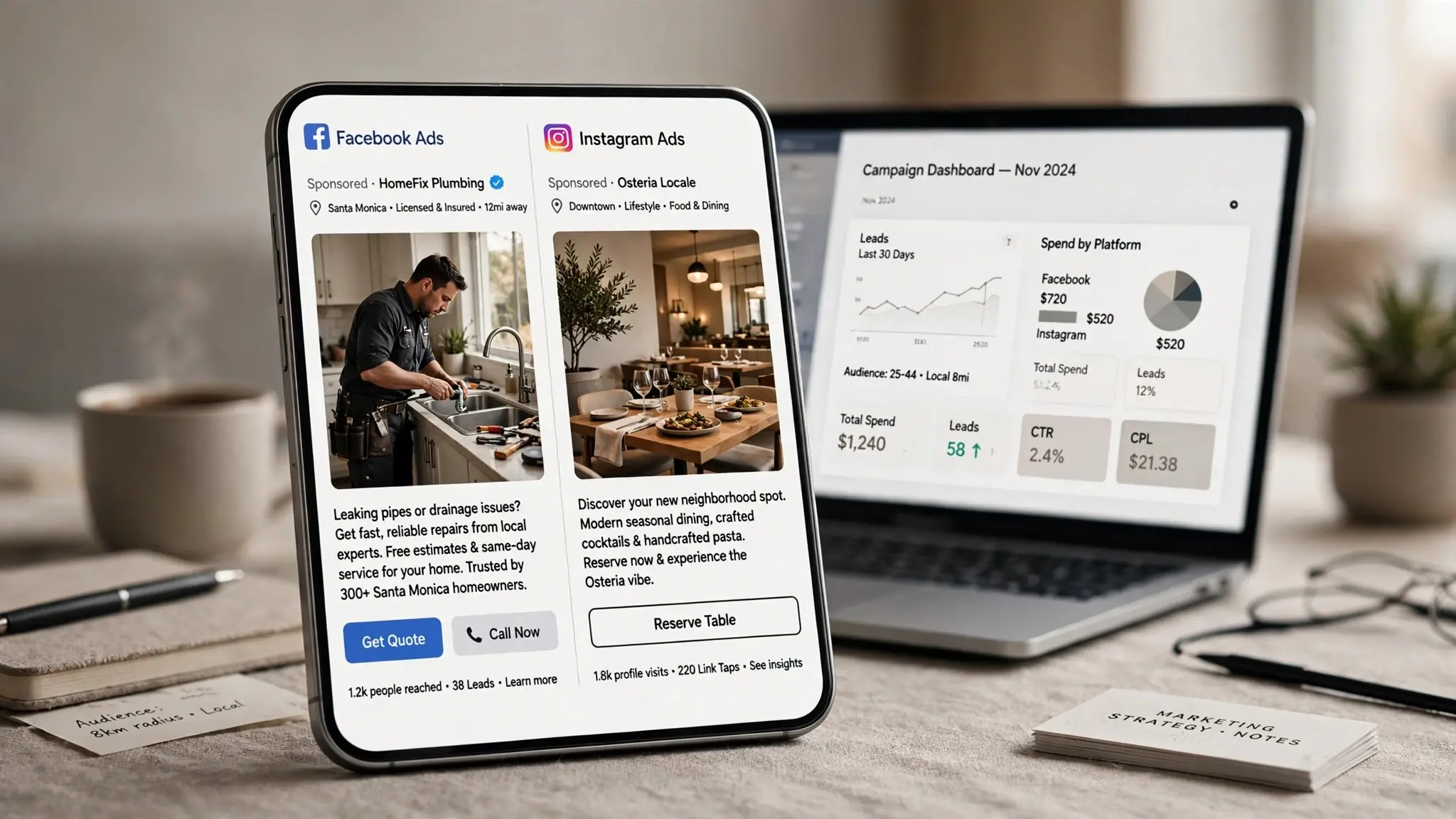
If you are weighing facebook ads vs instagram ads for your local business, here is some good news you might not expect: you are not really choosing between two different advertising systems. Both platforms run on the same engine, the same ad manager, the same targeting options, and the same auction. The real choice is about which audience you want to reach and what kind of creative you can produce consistently.
Here is the direct answer. Facebook Ads usually reaches a broader and older local audience and often delivers cheaper leads, making it the safer default for most local service businesses. Instagram Ads usually skews younger and more visual, and it demands stronger imagery and video to work, making it the better choice for businesses where appearance sells, like restaurants, salons, fitness studios, and boutiques.
Since both run from the same platform, the smartest approach is often to run both placements and let your results show which audience converts better for your specific business.
I have managed local campaigns across both placements for years, and the businesses that struggle are usually the ones that treat them as separate battles instead of what they are: two doors into the same advertising machine. Let me walk you through how each behaves, what each costs, and how to let your own data settle the question.
Facebook Ads vs Instagram Ads: Same Engine, Different Neighborhoods
Because Meta runs both platforms through one ad system, every technical piece carries over. Your audiences, budgets, and campaigns can run across both apps simultaneously, and the platform will optimize delivery toward whichever placement performs better. This is why the facebook ads vs instagram ads question is less about machinery and more about people and creative.
The audiences differ in ways that matter for local businesses. Facebook still holds the larger and older user base, with strong reach among people over thirty five who are often the decision makers for home services, medical practices, and professional services. Usage peaks in the evening and skews toward community groups, local events, and marketplace browsing, which suits businesses that live on local trust.
Instagram skews younger and more visual. Its users expect polished imagery, short video, and style, and they respond to aesthetics that would feel out of place in a Facebook feed. Discovery happens through hashtags, location tags, and the explore page, which means a strong Instagram ad can keep working organically long after the paid placement ends.
The practical takeaway: the platform choice is really an audience choice and a creative capability choice. If your best customers skew older and your business is about trust and service, Facebook carries the load. If they skew younger and your business is about how things look, Instagram earns its budget.
Creative Demands: Where the Two Platforms Split
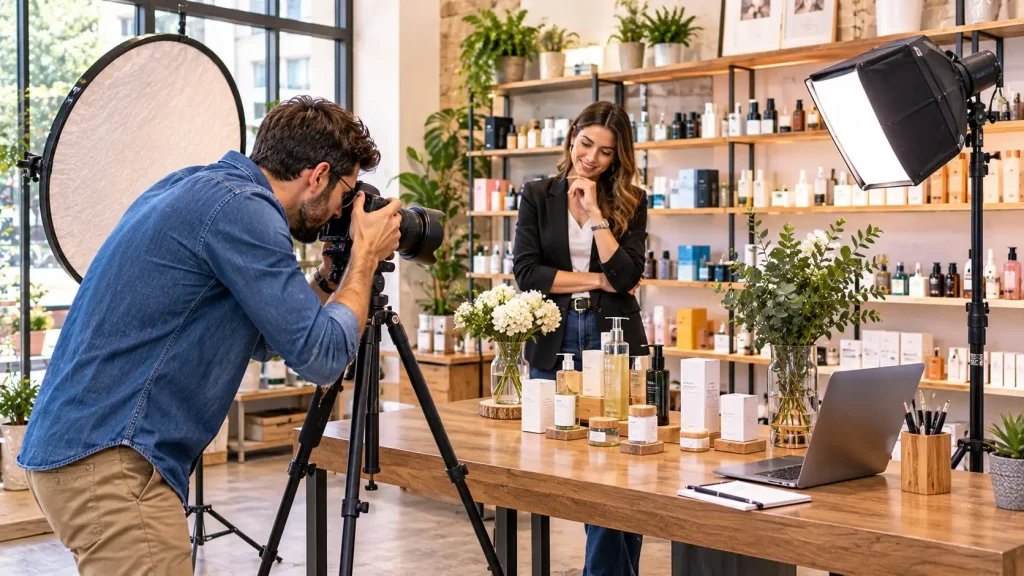
This is where most local businesses get surprised. Both platforms reward strong creative, but they punish weak creative at different rates.
Facebook is comparatively forgiving. A clear photo, a straightforward offer, and a believable testimonial can perform well, because the audience responds to information and social proof. Video helps, especially short clips that demonstrate a service, but production quality matters less than clarity. A plumber showing a before and after with a phone camera can win on Facebook.
Instagram is less forgiving. The feed is a visual competition, and ads that look like ads get scrolled past instantly. Strong Instagram creative usually means professional photography, short engaging video with captions, and a visual style consistent with your brand. That raises the cost of entry, because either your business naturally produces visual content or you need to invest in someone who does.
The lesson from years of campaign data: never force one creative across both platforms. Let Facebook carry message driven ads and Instagram carry visual driven ads, even when both promote the same offer.
Cost and Lead Quality Patterns
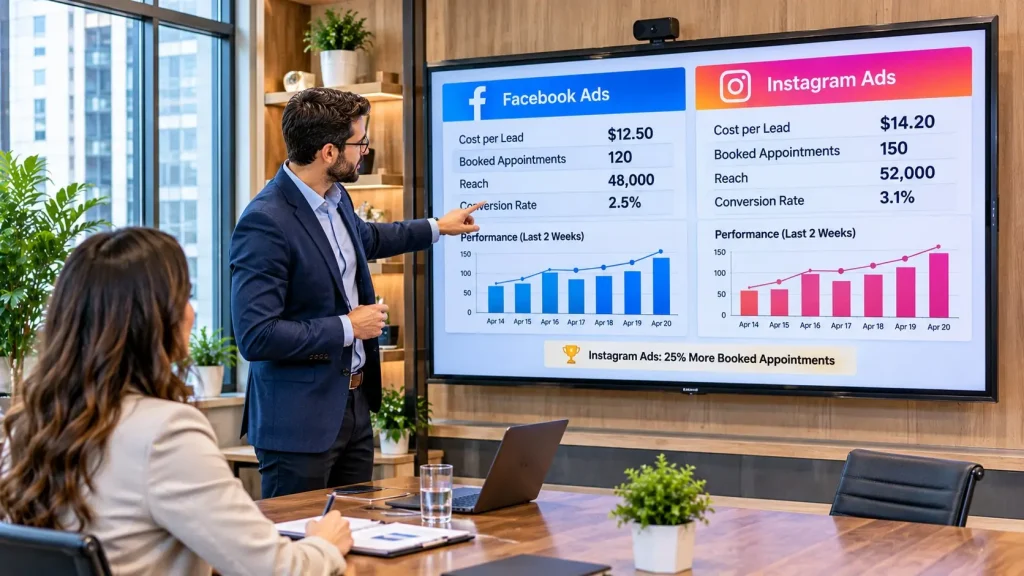
Because both placements share the same auction, costs do not differ as dramatically as beginners expect, and the differences that exist follow audience behavior more than platform mechanics.
Facebook often produces cheaper local leads, partly because its older audience converts readily on straightforward offers like free estimates and consultation bookings. Instagram leads can cost more on paper, but for visual businesses they often convert better because the person has already seen your work quality in the ad itself.
The pattern I watch most closely across local accounts is not cost per lead but cost per booked appointment, and that number tends to follow creative strength more than platform choice.
A few practical notes keep budgets honest. Placement optimization, letting the system deliver ads across both apps, usually outperforms manual splitting for small budgets.
Retargeting across both platforms is consistently among the cheapest sources of local leads, because familiarity does the persuading. And lead forms within the apps produce volume but require fast follow up, since a person tapping a form out of mild curiosity cools within hours.
How to Choose Based on Your Business
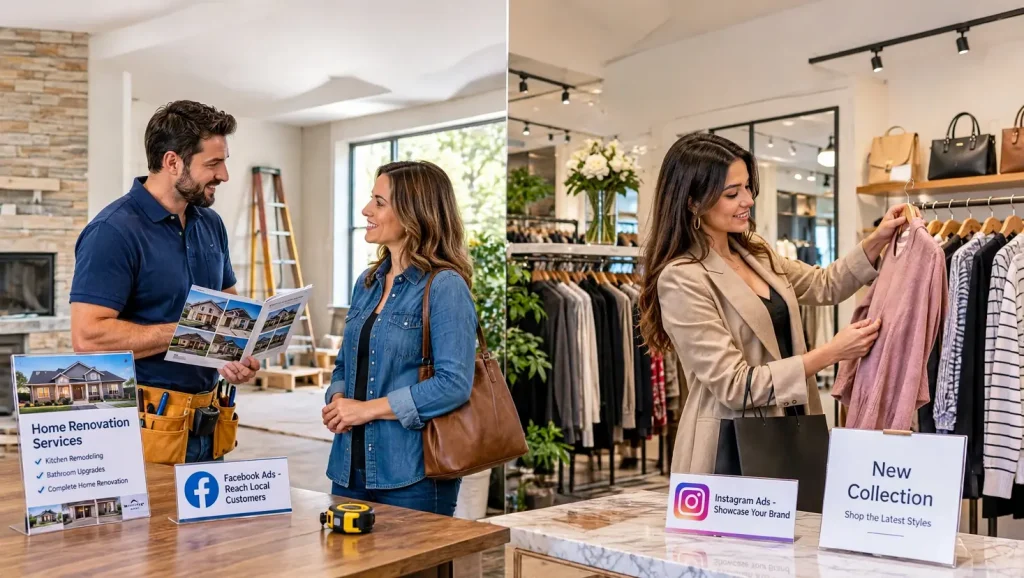
Instead of abstract pros and cons, match the platform to your reality with four questions.
First, who is your typical customer? If they are over thirty five and booking services for a household, Facebook deserves the majority of your budget. If they are under thirty five and buying based on style, Instagram moves to the front. Second, how visual is your business? Restaurants, salons, boutiques, and fitness studios live on Instagram's strengths, while plumbers, accountants, and clinics fit Facebook's information friendly feed.
Third, what content can you produce consistently? Strong phone photography every week beats a professional shoot once a year. Fourth, what is your offer? Straightforward value offers perform on Facebook, while aspirational and lifestyle offers perform on Instagram.
The broader paid social dynamics that decide success on either platform, from boosted posts to retargeting, follow the same rules we cover in our comparison of Google Ads versus Meta Ads for local service businesses, and the organic versus paid logic from our social comparison guide explains why your profile content multiplies every paid dollar.
The Simple Testing Framework
Because both placements share one system, testing them against each other is cheap and fast, and I recommend every local business run the same simple experiment before committing serious budget.
Build one campaign with your strongest offer and two versions of creative: a message driven version and a visual driven version. Run automatic placements so ads deliver across both apps, and let the system gather two weeks of data. Then compare cost per booked appointment by placement, not by click or impression. In most accounts, one placement clearly outperforms for the specific offer, and that answer is worth more than any general advice, including mine.
Refresh creative on a steady rhythm, because ad fatigue arrives faster than budgets expect, and watch frequency so your ads do not wear out their welcome with a small local audience.
Mistakes That Waste Budgets
Local businesses burn social ad budget in predictable ways on both platforms.
The first mistake is boosting posts. Boosting optimizes for engagement, and engagement is not appointments. Real campaigns with conversion objectives consistently outperform boosted posts at identical spend.
The second mistake is sending ad clicks to a homepage instead of a focused page about the exact offer, which quietly doubles effective lead costs. The third mistake is judging within the first week, before the system has learned which local users convert.
On the creative side, the biggest mistake is repurposing Facebook style ads onto Instagram without adapting, because feed norms differ enough that the same image can win on one platform and flop on the other. The second is ignoring video captions, since most social video plays without sound.
The deepest mistake on both platforms is chasing cheap leads instead of booked jobs. A low cost per lead that never answers the phone is the most expensive outcome in local advertising.
Frequently Asked Questions
Which is better for local businesses, Facebook ads or Instagram ads?
Facebook ads usually reach a broader and older local audience at cheaper lead costs, while Instagram ads reach a younger, more visual audience. Since both share one ad system, running both and comparing cost per appointment usually beats choosing on theory.
Do Facebook ads and Instagram ads cost the same?
They run on the same auction, so costs are similar, but Instagram often demands stronger creative, which raises the real cost of entry. The platform that wins on cost per booked job depends on your audience and creative quality.
Can I run the same ad on Facebook and Instagram?
You can, but adapting creative to each platform's style usually outperforms one size fits all. Facebook tolerates message driven ads, while Instagram rewards polished visuals and video.
Which platform is better for restaurants and salons?
Instagram usually fits restaurants, salons, boutiques, and fitness studios because these businesses sell on appearance, and Instagram's audience expects exactly that kind of content.
How much should a local business budget to test?
A few hundred dollars over two weeks per offer is enough to compare placements meaningfully. Commit to judging on booked appointments rather than clicks before scaling.
