
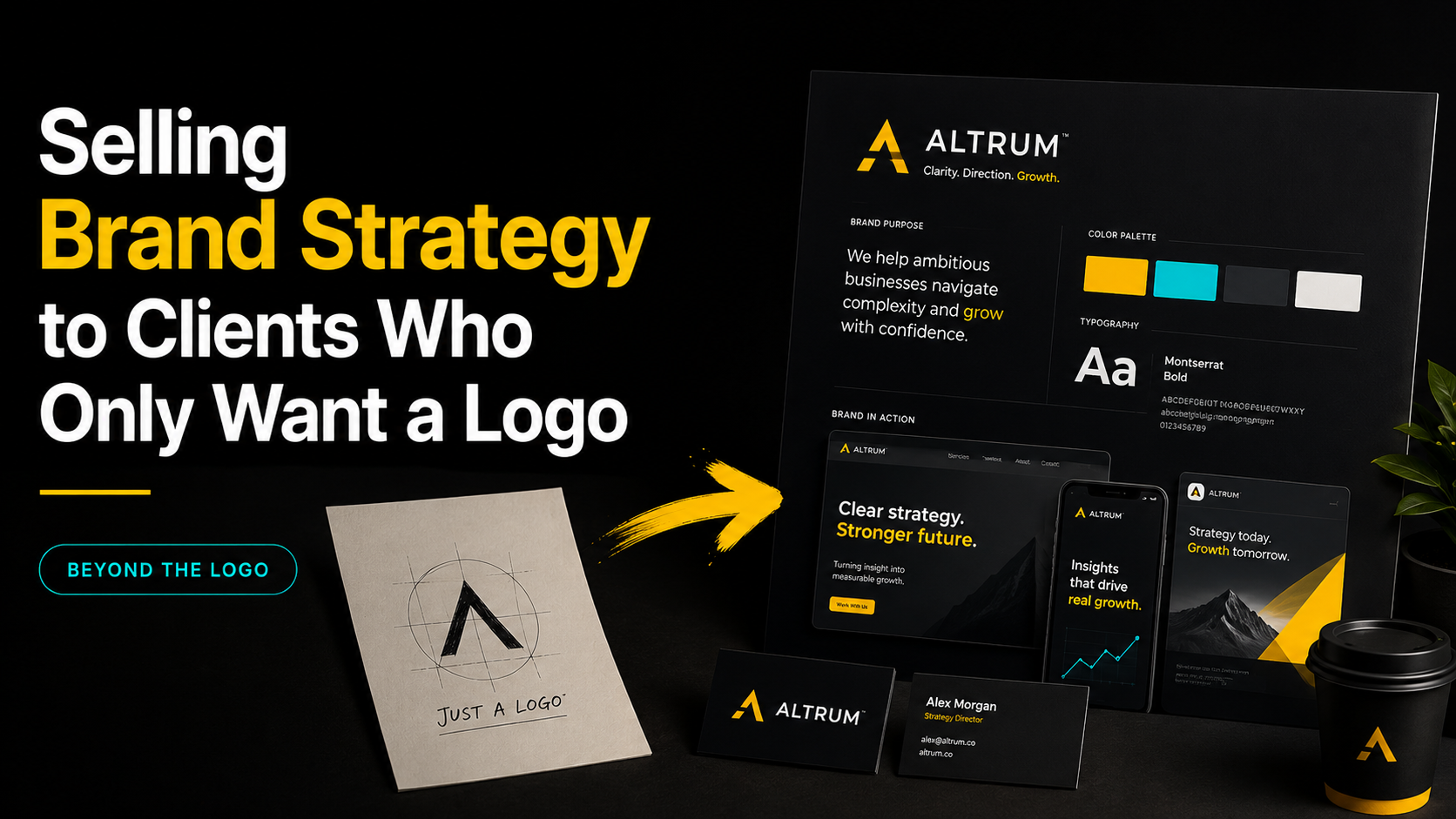
Key Takeways
- Clients think they need a logo, but the real need is business positioning
- Logo demand comes from visibility bias and “commodity design” thinking
- Strategy sells best when framed as risk reduction, not theory
- Rename “strategy” into simple, outcome-focused language (sprints, alignment)
- Embed strategy inside design packages instead of selling it separately
- Shift conversations from visuals → business goals and market problems
Every freelance designer and creative agency owner knows the feeling. A prospect slides into your inbox or schedules a discovery call, completely convinced that a shiny new vector mark will magically solve their declining sales, muddy messaging, and lack of audience engagement. They come looking for a quick visual fix, completely unaware that a logo without positioning is just an expensive sticker.
Successfully selling brand strategy clients on the deeper value of positioning requires moving away from defensive, academic lectures and shifting toward a consultative approach focused entirely on their business goals. Instead of telling them why a logo isn't enough, you must reveal the hidden business risks of skipping foundational discovery work. By framing discovery as a risk-mitigation tool that protects their visual investment, you can effortlessly upsell brand strategy packages without ever sounding pushy, elitist, or incredibly annoying.
At Memorable Design, we have spent years refining this exact conversational shift. This comprehensive guide will break down the exact frameworks, psychological triggers, and onboarding adjustments you need to convert logo only clients into high-value strategy partners.
AI Overview
Most clients asking for a logo are actually solving deeper business problems like weak positioning or unclear messaging, but they don’t realize it. Instead of pushing “strategy” directly, designers should frame it as risk reduction and business alignment that protects their visual investment. By diagnosing pain points, simplifying language, embedding strategy into packages, and using practical framing like “market alignment sprint,” you can upsell brand strategy naturally without sounding pushy or annoying.
The Root Cause: Why Clients Stop at the Logo
To change a prospect's mind, you must first understand why they are hyper-focused on the visual output in the first place. Most business owners are not intentionally dismissing your strategic expertise; they simply do not know what they do not know.
The Visibility Bias
A logo is tangible, highly visible, and easy to conceptualize. A client can easily imagine a new emblem sitting proudly on their website header, stamped on their product packaging, or printed on a fresh stack of business cards. Brand strategy, on the other hand, feels abstract, invisible, and overwhelmingly academic to an exhausted founder who is trying to scale an operation. They focus on the logo because it represents the finish line of their immediate visual problem.
The Commodity Trap
The internet has spent the last decade teaching businesses that visual assets are cheap, readily available commodities. When platforms offer crowd-sourced design contests or cheap digital generation tools for under fifty dollars, business owners assume that visual design is a simple, frictionless transaction. If you approach them using a design strategy upsell pitch that sounds exactly like a generic retail upgrade, their immediate defensive reflex will be to protect their wallet and stick to their original, limited scope.
Shifting from an Order Taker to a Trusted Guide
The secret to changing the entire dynamic of a discovery call lies in altering your intake process. If your website intake form asks, "What assets do you need?" you are automatically setting yourself up to be treated as a basic digital production line.You must change the conversation by asking deep, diagnostic questions that force the client to confront the underlying business challenges driving their aesthetic request. When you stop asking what style of graphics they prefer and start asking how they plan to win market share from their top three competitors, the relationship instantly transforms. You transition from a simple pixel-pusher into a crucial growth partner who understands business mechanics.
4 Steps for Selling Brand Strategy Clients Smoothly
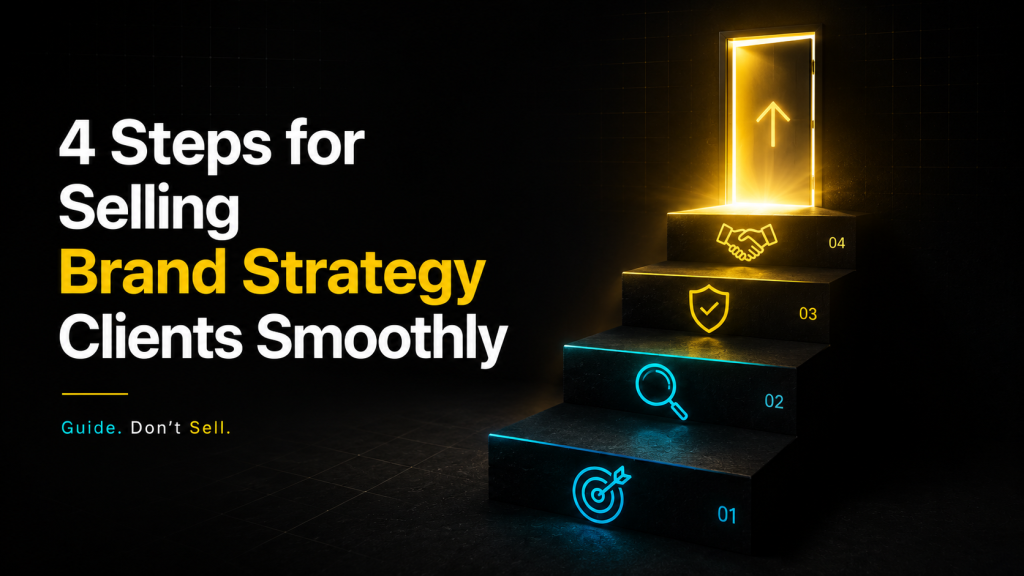
Successfully executing a design strategy upsell does not require complex sales manipulation or aggressive scripts. It relies on a logical, empathetic diagnostic process that guides the client to realize the necessity of foundational work all on their own.
1. Diagnose the Business Pain Before Touching Pixels
When a prospect tells you they just want a visual mark, ask them what specific commercial shift triggered this sudden creative request. Are they struggling to command a premium price in a highly crowded local market? Are they launching a brand-new service lines that their current customer base finds confusing? By linking their visual aesthetic directly to a concrete commercial metric, you show them that an isolated visual graphic cannot fix a broken underlying business position.
2. Rename Strategy to Sound Practical and Actionable
The word "strategy" carries a lot of corporate baggage and often makes small business owners envision endless, useless slide decks. At Memorable Design, we recommend swapping out intimidating industry jargon for practical, outcome-based phrasing. Instead of selling an abstract "Brand Positioning Workshop," reframe the exact same process as a "Market Alignment Sprint" or a "Target Audience Blueprint." Use simple, clear language that emphasizes the concrete blueprint they will receive at the end of the session.
3. Use the "Insurance Policy" Framing Technique
One of the most effective ways to upsell brand strategy to highly skeptical, numbers-driven buyers is to position the discovery phase as an essential insurance policy for their visual identity. Explain that jumping straight into vectors without a clear target market profile is an incredibly high-risk gamble. If the design direction is based purely on personal aesthetic whims rather than objective consumer data, they run an estimated 70% risk of needing a total visual overhaul within twelve months because the messaging fails to connect with real buyers.
4. Create an Inseparable Product Ecosystem
Stop offering strategy as an optional line-item add-on that clients can easily cross off with a pen to save a quick buck. Instead, bake a streamlined version of your discovery process directly into your base creative packages. Make it incredibly clear that your agency cannot physically generate a highly effective, tailored visual identity without first running through your foundational diagnostic blueprint.
Comparing Creative Workflows: Strategy vs. Asset-First
To help your prospects visualize why rushing straight into software tools is a massive business mistake, it helps to show them exactly how the creative journey differs when built on a solid foundation.
| Project Stage | The "Logo Only" Vulnerable Approach | The Memorable Design Strategic Workflow |
| Initial Research | Based entirely on client's personal taste | Driven by competitive market analysis |
| Design Concepting | Guessing what looks modern or trendy | Tailored to attract a highly specific audience |
| Feedback Cycles | Endless, frustrating subjective revisions | Grounded in objective business goals |
| Market Lifespan | Estimated 12–18 months before failing | Built to last safely for 5–10 years |
Based on available industry data, projects that skip the initial positioning phase experience three times as many revision loops, which completely drains your project profit margins and leaves the client feeling highly frustrated.
Handling Common Client Objections Without Arguing
When you attempt to upsell brand strategy, you will naturally encounter a few common pushbacks. The trick is to validate their underlying concern completely before gently reframing their perspective.
"We already know exactly who our target audience is."
- The Response: "That is amazing, and it is going to give us a massive head start! Our foundational discovery process is designed to take that deep internal knowledge out of your head and translate it into actionable visual parameters. This ensures that every color choice, typography pairing, and spatial layout we create acts as a silent sales tool that communicates your exact value proposition instantly."
"We don't have the budget or time for a full workshop."
- The Response: "I completely understand wanting to keep this initial project lean and moving quickly. However, the biggest budget drain in creative development isn't the initial research—it's the costly process of creating beautiful artwork that ultimately targets the wrong demographic. Spending a brief period aligning our goals right now saves you thousands of dollars in revisions and prevents a messy market launch."
Adjusting Your Proposals for Natural Alignment
If your current proposals feature a massive, terrifying financial barrier labeled "Brand Strategy" right at the top, you are going to scare away well-meaning logo only clients before they understand the value.
Try restructuring your pitches by offering two distinct, highly integrated avenues. Option A can be a comprehensive, full-scale corporate transformation package. Option B can be a streamlined visual identity package that includes a mandatory, built-in "Brand Alignment Sprint" as its very first phase. By embedding your strategic discovery work directly into the creative timeline as a non-negotiable prerequisite, you preserve your professional integrity, ensure a superior creative result, and successfully master selling brand strategy clients without creating friction.
Conclusion
At the end of the day, selling brand strategy clients on a comprehensive creative experience is not about forcing people to buy expensive services they do not genuinely need. It is about stepping into your role as an expert guide and protecting your clients from making uneducated, short-sighted business investments.
When you learn to identify the business pain hiding beneath a simple aesthetic request, you can introduce a design strategy upsell that feels like a natural, supportive solution rather than an annoying corporate pitch. By using the frameworks shared by Memorable Design, you can build a more sustainable, highly profitable creative practice centered around deep, transformative business value.
Frequently Asked Questions
What if a client absolutely refuses strategy and only wants a logo?
If a prospect completely refuses to participate in any diagnostic conversation and demands an isolated graphic file, you have to make a professional boundary choice. You can either accept the project as a low-touch, production-only asset task, or you can politely decline the work and refer them to a basic online platform. At Memorable Design, we find that clients who refuse to value foundational alignment almost always turn into nightmare accounts with endless, subjective revisions.
How do I price a built-in brand strategy phase for smaller businesses?
If you are working with smaller local businesses, you do not need to pitch a massive, month-long corporate workshop. Scale your discovery process down into a highly efficient, single-day "Alignment Sprint." Price this phase as roughly 25% to 30% of the total identity project cost, and explain that it serves as the essential architectural blueprint for all future visual production work.
Do I need to deliver a massive strategy document to the client?
Absolutely not. Clients do not want to read a dry, jargon-filled ninety-page PDF that sits forgotten in a shared cloud drive. They want a concise, highly visual "Brand Playbook" that outlines their unique positioning, core customer personas, and primary brand pillars. Focus entirely on utility, clarity, and actionable insights over sheer page volume.
Can I upsell strategy to an existing design client after the project wraps?
Yes, this is an incredible way to generate recurring revenue. Once you have delivered an exceptional visual identity, check in with the client three to six months later. Ask them how the market is reacting to the new look, and use their real-world feedback to pitch an advanced strategic roadmap for their social media, content marketing, or upcoming product expansions.