
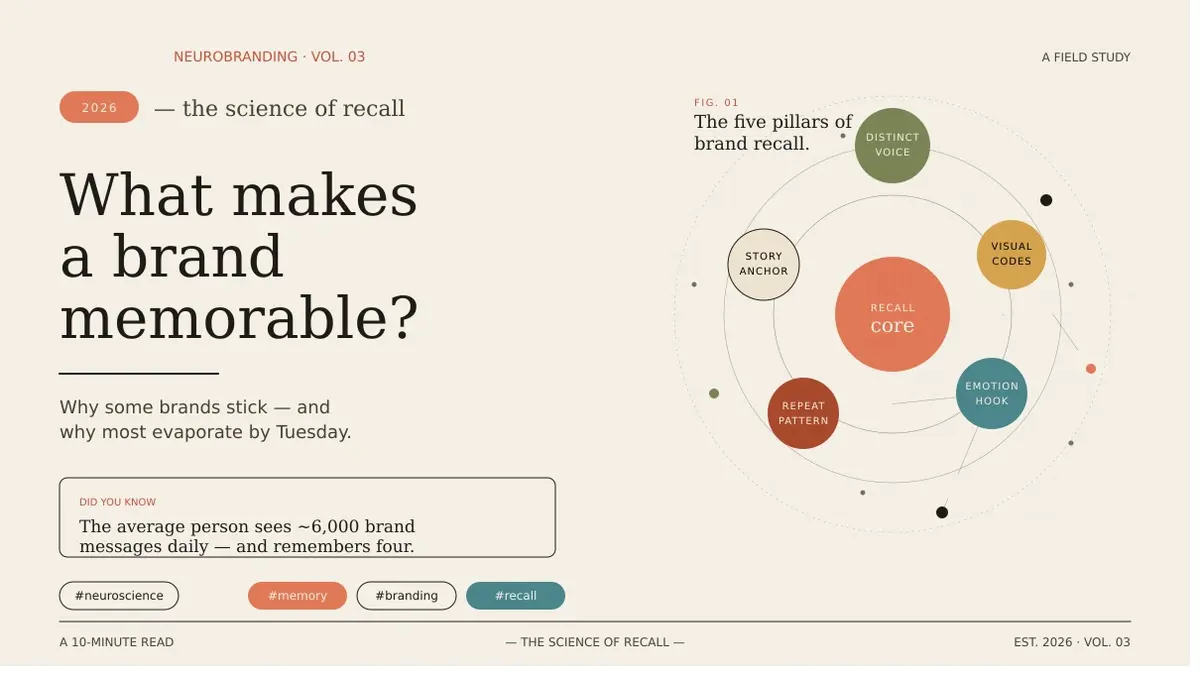
The article discusses the science of brand recall in 2026, emphasizing the importance of emotional arousal, sensory cues, and repeated exposure to high-utility content for making a brand memorable. It highlights the need to understand cognitive retention and the neurological pathways that influence memory. A brand must master distinctive assets like colors, sounds, or shapes to occupy a specific "neural folder" in the consumer's mind.
In an era where the average person is exposed to thousands of digital impressions daily, simply being "seen" is no longer enough to drive growth. To succeed in today's economy, businesses must move beyond "vibes" and understand the cold, hard data behind cognitive retention. So, what makes a brand memorable in 2026? It is the strategic combination of emotional arousal, consistent sensory cues, and the neurological "pathway" created by repeated exposure to high-utility content. Memory isn't a fluke; it’s a biological response to specific stimuli that your brand can and should engineer.
At Memorable Design, we look at the data to bridge the gap between creative flair and mathematical certainty. To be truly remembered, a brand must occupy a specific "neural folder" in the consumer's mind. This is achieved by mastering distinctive brand assets such as specific colors, sounds, or shapes and aligning them with the principles of brand recall psychology. By the end of this guide, you will understand that memorability is less about being "cool" and more about being cognitively accessible at the exact moment a purchase decision is made.
The Neural Architecture of Brand Recall
To understand what makes a brand memorable, we have to look at how the human brain filters information. Our brains are designed to forget almost everything we see to save energy. Only information that is deemed "meaningful" or "unusual" makes the cut from short-term to long-term memory.
The Role of High-Arousal Emotions
According to recent studies in brand memory science, emotional intensity acts as a "Save" button for the brain. When a consumer experiences a strong emotion whether it’s the relief of a solved problem or the joy of a clever joke the amygdala signals the hippocampus to store that event with higher priority.
This is why generic corporate messaging fails. It produces zero emotional arousal, leading the brain to categorize it as "background noise." Memorable Design focuses on creating "pattern interrupts" visual or verbal cues that break the monotony of the scroll and force the brain to pay attention.
Frequency vs. Recency in Memory
There is a common myth that you just need to be "first" in a category. However, brand recall psychology suggests that "mental availability" is a mix of how often you are seen and how recently you were seen.
A brand that appears once a month with a massive ad spend is often less memorable than a brand that appears three times a week with smaller, high-value touchpoints. This consistent "drip" of information strengthens the synaptic connections in the consumer's mind, making your brand the default choice when the need arises.
The Power of Distinctive Brand Assets
In 2026, the battle for attention is won through "shorthand." If a customer has to read your name to know it’s you, you’ve already lost half the battle. Truly memorable brands use distinctive brand assets to trigger recognition instantly, even without a logo present.
| Asset Type | Cognitive Function | Example |
| Color Palette | Instant emotional priming | Tiffany Blue / UPS Brown |
| Sonic Branding | Auditory memory bypass | Netflix "Ta-dum" / Intel Chime |
| Typography | Structural familiarity | Disney Script / Coca-Cola Font |
| Characters/Masocots | Relatability and story-linking | Geico Gecko / Duolingo Duo |
By diversifying your assets, you create multiple "entry points" for memory. A customer might forget your slogan, but they will remember the specific shade of purple you use or the specific "click" sound your app makes. At Memorable Design, we emphasize that these assets must be protected and repeated across every single platform to build true "mental real estate."
Brand Memory Science: The 3-Step Encoding Process
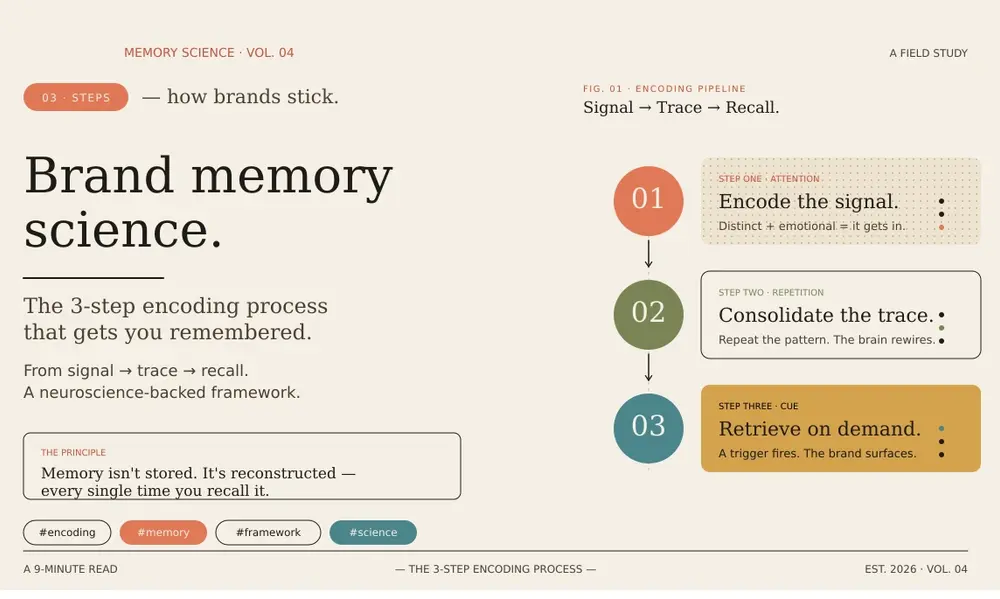
How does a person go from "Who is this?" to "I only buy from them"? It follows a specific scientific path called encoding, storage, and retrieval. Understanding this path is the secret to knowing what makes a brand memorable over the long haul.
Step 1: Encoding through Sensory Novelty
The brain first encodes information through the senses. In a digital-first world, this is primarily visual and auditory. If your design looks like every other SaaS company white backgrounds, blue buttons, "friendly" illustrations the brain sees it as a single, blurred category. Encoding requires "distinctiveness." You must look different enough to be categorized as a new "file" in the brain.
Step 2: Storage through Associative Linking
Storage happens when your brand is linked to an existing concept. This is a core tenet of brand memory science. If you sell coffee, you want your brand linked to the concept of "The Morning Ritual." You aren't just selling a beverage; you are attaching your brand to a pre-existing neural pathway. The stronger the link to a daily habit, the more permanent the memory becomes.
Step 3: Retrieval and the "Ease" Factor
Retrieval is the final test. When a customer thinks, "I need a new pair of running shoes," which brand pops up first? This is called "Top of Mind Awareness" (TOMA). Retrieval is governed by how "easy" it is for the brain to find the information. If your distinctive brand assets are clear and your messaging is simple, the brain can retrieve your brand in milliseconds.
Practical Insights for Building Recall
If you want to move the needle on your metrics, you need to apply brand recall psychology in a way that is practical and measurable. We recommend focusing on these three foundational pillars of memory.
1. The Rule of Simplicity
The human brain can only hold about seven "chunks" of information in its working memory at once. If your brand message has five different value propositions, your audience will remember zero. Pick one core "truth" and repeat it until it becomes synonymous with your name.
2. Visual Consistency is Safety
Every time you change your brand's font or color scheme "just to try something new," you are essentially deleting the memory file your customer started to build. Consistency builds a sense of safety and familiarity. At Memorable Design, we advise our clients to find their "Visual Signature" and stick to it for years, not months.
3. Narrative Transportation
Humans are evolutionarily hardwired to remember stories better than facts. When you wrap your brand in a narrative—a founder's struggle, a customer's transformation, or a vision for the future you use "narrative transportation" to move the brand into long-term storage.
Why "Vibes" Are Failing Brands in 2026
For years, marketers relied on "vibes" a vague sense of coolness or trendiness. But in 2026, the "vibe" market is saturated. Everyone has a nice aesthetic. To stand out, you must shift toward "Cognitive Design."
What makes a brand memorable now is its ability to reduce cognitive load. Life is more complex and noisier than ever. The brands that win are the ones that are the "easiest" to think about. This doesn't mean being boring; it means being highly structured. When you use a distinctive brand assets framework, you are essentially providing a "map" for the consumer's brain to follow.
Measuring Memorability: Data Over Guesswork
How do you know if you are actually being remembered? In 2026, we use "Brand Lift" surveys and "Mental Availability" metrics to track progress.
- Spontaneous Recall: Asking "Which brands come to mind when you think of [Category]?" without providing a list.
- Prompted Recognition: Showing a logo or a color and asking if they recognize the brand.
- Asset Attribution: Showing a distinctive brand asset (like a mascot or a pattern) without the brand name and seeing if people can identify the company.
If your scores are low, it’s usually because your messaging is too fragmented. At Memorable Design, we help brands consolidate their identity so their data reflects real-world impact, not just vanity metrics like "likes" or "shares."
Summary of Key Memorability Facts
- Emotion is a Catalyst: Memory is a biological byproduct of emotional engagement.
- Distinctiveness is Mandatory: If you look like your competitors, the brain "clumps" you together, making individual recall impossible.
- Assets are Shorthand: Distinctive brand assets act as neural shortcuts to brand recognition.
- Consistency is Key: Frequent, smaller touchpoints are more effective for memory than infrequent, massive ones.
- Simplicity Wins: Reducing the "mental effort" required to understand your brand increases the likelihood of retrieval.
Conclusion: Engineering the Unforgettable
Building a brand that lasts isn't about luck; it is an exercise in brand memory science. By moving away from subjective "vibes" and toward a data-driven understanding of what makes a brand memorable, you position your business for long-term dominance. You must treat your brand identity as a living piece of software in the consumer's mind one that requires constant updates, clear navigation, and a user-friendly interface.
At Memorable Design, our goal is to help you create those neural shortcuts. Whether through the development of distinctive brand assets or the application of brand recall psychology, the objective remains the same: to make your brand the first and most obvious choice. In a world of infinite options, the most memorable brand doesn't just win the sale it wins the future. Stop hoping to be remembered and start designing for it.
Frequently Asked Questions
What makes a brand memorable to consumers today?
In 2026, a brand becomes memorable by being "cognitively accessible." This means having a clear, simple message and a set of distinctive brand assets that the brain can identify in less than a second. It’s a mix of repeated exposure and the emotional value the brand provides.
How does brand recall psychology work?
Brand recall psychology is the study of how the brain encodes brand-related information. It relies on the "Encoding Specificity Principle," which suggests that we remember information better when it is associated with specific cues (like a color or a sound) that are present during both the learning and the retrieval stages.
What are distinctive brand assets?
Distinctive brand assets are non-brand-name elements (colors, logos, fonts, taglines, characters) that trigger the thought of a brand in a consumer's mind. Examples include the "M" of McDonald’s or the specific orange used by Hermès.
What is the difference between brand recall and brand recognition?
Brand recognition is "seeing and knowing" (I recognize that logo), while brand recall is "thinking and knowing" (I need a car, I think of Toyota). Recall is much harder to achieve but far more valuable for driving sales.
How can I apply brand memory science to my small business?
Start by picking one "Signature Element" a specific color or a unique way of speaking and use it everywhere. Don't try to be everything to everyone. Focus on being the "easiest to remember" for one specific problem your customers have.