
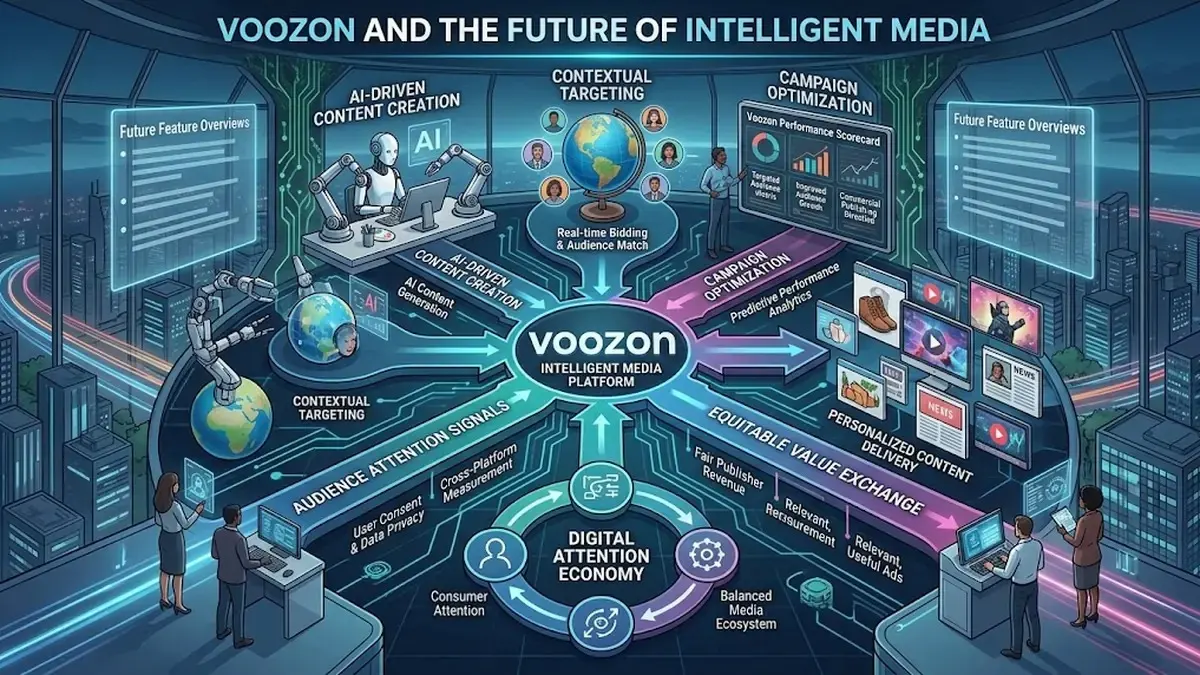
The internet has entered a new era. Content can be created faster, audiences can be analyzed at greater scale, and advertising campaigns can be optimized with tools that would have seemed out of reach just a few years ago. Yet one fundamental challenge remains: getting the right information in front of the right audience in a way that creates genuine value.
Artificial intelligence is changing how the industry approaches that challenge. It is influencing the production of digital content, the discovery of consumer interests, the development of advertising creative, and the measurement of marketing performance. At the same time, it is raising important questions about trust, originality, privacy, and the future of digital publishing.
Within this transformation, Voozon offers a name around which a forward-looking media and advertising concept could be developed.
Publicly available information establishing Voozon as a recognized AI media or advertising technology brand appears limited. Its specific ambitions, products, and technical capabilities should therefore not be assumed. Rather than inventing an established business history, this article explores a potential direction for the brand: a distinctive identity at the intersection of artificial intelligence, digital media, advertising intelligence, and audience relevance.
The concept is simple but ambitious. Instead of treating digital advertising as a competition for impressions, imagine a media ecosystem that places greater emphasis on understanding context, delivering useful information, and creating meaningful connections between businesses and audiences.
That is the opportunity worth exploring with Voozon.
1. The Internet Does Not Need More Content. It Needs More Intelligence.

The digital economy has spent decades optimizing distribution. Publishers learned how to produce at scale, social platforms made content instantly shareable, search engines organized information, and advertising networks created increasingly sophisticated ways to purchase exposure.
Artificial intelligence is accelerating content production even further.
But greater production capacity does not automatically create greater value. When content becomes easier to generate, audiences face an even greater challenge distinguishing useful information from repetition, noise, and unsupported claims.
The competitive question is changing.
It is no longer simply how much content a business can publish, how many advertisements it can distribute, or how many people it can reach. It is whether the information is relevant, whether the message deserves attention, and whether the experience helps the audience make a better decision.
This distinction could become central to Voozon's proposed positioning.
A brand built around intelligent media would focus on the relationship between information and usefulness. It would examine how AI can support better research, more thoughtful content discovery, more relevant advertising, and clearer measurement.
The emphasis would be on intelligence as a practical advantage rather than AI as a marketing buzzword.
2. Voozon as a Potential AI Media and Advertising Concept

Voozon could be positioned around a broader question: how can technology make the relationship between media, businesses, and audiences more effective?
This would give the brand a conceptual foundation rather than limiting it to a single advertising format or technology trend.
Under this proposed direction, Voozon could explore four connected areas.
AI and media intelligence
This area would examine how artificial intelligence influences digital publishing, content discovery, media operations, and audience engagement.
Topics could include AI-assisted research, automated content classification, recommendation systems, editorial analytics, and the changing economics of digital publishing.
The focus would be on explaining how these technologies work, where they create practical value, and what limitations organizations should understand before adopting them.
Advertising technology and campaign intelligence
Digital advertising is increasingly shaped by automation, data analysis, and machine-assisted decision-making.
Voozon could cover developments in contextual advertising, campaign optimization, creative testing, marketing analytics, and advertising measurement.
The objective would be to help readers understand the technology behind modern campaigns rather than simply repeat promotional claims about AI-powered marketing.
Audience relevance and content discovery
The ability to connect information with interested audiences is an important part of the digital economy.
A Voozon editorial strategy could explore how search systems, recommendation engines, contextual signals, and content organization influence discovery.
This area would also examine the boundaries of personalization, including privacy concerns, algorithmic bias, and the importance of transparent data practices.
As AI continues to influence content discovery, businesses can explore AI search optimization to improve how their content is discovered across evolving search experiences.
The business of intelligent media
Technology changes more than the tools used by publishers and advertisers. It can also affect business models, competitive advantages, operating costs, and customer relationships.
Voozon could examine how organizations evaluate AI investments, measure returns, develop digital products, and adapt to changing expectations in the media market.
Together, these four areas would offer a coherent editorial direction. They are potential areas of focus, not a description of services Voozon is confirmed to provide.
3. From Buying Attention to Earning Relevance
For much of the digital advertising era, visibility has been treated as a central objective. Businesses buy impressions, pursue clicks, and compete to place messages in front of potential customers.
Those metrics remain useful, but they reveal only part of the picture.
An advertisement can generate thousands of impressions without influencing a meaningful decision. A campaign can attract clicks without producing qualified leads. A large audience can be commercially irrelevant if the message does not match its needs.
The next generation of advertising strategies must look beyond exposure.
AI-assisted systems can help marketers analyze campaign data, compare creative variations, identify patterns, and evaluate contextual relevance. Used responsibly, these capabilities can support more informed decisions about where advertising belongs and how its performance should be assessed.
Consider a software company marketing automation tools to small businesses. A broad campaign may generate visibility among a large audience, while a more carefully planned strategy could place educational messages alongside relevant business-technology content.
The second approach is not guaranteed to perform better. Its value lies in establishing a clearer relationship between the subject, the audience's informational needs, and the commercial message.
This is the distinction that a future-facing Voozon concept could explore: advertising that prioritizes relevance alongside reach.
The goal would not be to eliminate advertising. It would be to understand how advertising can become more useful, more measurable, and more respectful of the people it reaches.
4. Contextual Intelligence Could Become a Defining Media Advantage
Context matters because people encounter information for different reasons.
Someone reading about cybersecurity may be investigating a business risk. Someone exploring travel destinations may be comparing possible experiences. A reader studying financial technology may be trying to understand a changing market.
These contexts are not interchangeable.
AI-based content analysis can help identify the subject of a page, recognize relationships between concepts, and classify information with greater detail than a basic category label might provide. This is also relevant to ChatGPT search optimization, where understanding content context and meaning can help publishers structure information for AI-driven discovery.
For publishers and advertisers, this creates an opportunity to make more thoughtful decisions about content organization and advertising placement.
For example, three articles might all belong to the technology category while covering entirely different subjects: enterprise cybersecurity, generative AI for designers, and semiconductor manufacturing.
A contextual strategy would recognize those differences and evaluate the relevance of potential advertising accordingly.
A Voozon editorial platform could explore this principle through research, case studies, industry commentary, and practical explanations of contextual advertising.
However, contextual analysis should not be confused with personal surveillance. Understanding the subject of a page is different from collecting sensitive information about the person reading it. A responsible approach would consider privacy, transparency, and the limitations of automated classification.
The strongest concept is not advertising that knows everything about everyone. It is advertising that better understands the environment in which a message appears.
5. Generative AI Will Change Creative Production, but Not the Need for Originality
Generative AI has lowered some of the barriers to producing marketing content. Teams can use these systems to brainstorm campaign concepts, draft initial copy, explore visual directions, and adapt messages for different formats.
That creates an opportunity for businesses to experiment more efficiently.
It also creates a problem: when content becomes easier to produce, generic content becomes easier to reproduce.
If every brand relies on similar prompts, templates, and automated workflows, the result may be a crowded market of messages that look and sound alike.
Originality therefore becomes more valuable, not less.
A Voozon concept focused on intelligent media could examine the difference between automation and creativity. It could explore how businesses use AI to accelerate production while preserving distinct brand voices, original ideas, accurate claims, and meaningful human judgment.
The central principle would be straightforward: AI can help develop possibilities, but technology alone does not establish whether an idea is memorable, trustworthy, or useful.
The competitive advantage comes from how intelligently the tools are applied.
6. Building Trust in an Era of Synthetic Content
Artificial intelligence can generate convincing text, images, audio, and video. While these capabilities open new creative possibilities, they also make it easier to produce inaccurate information, misleading endorsements, and fabricated representations.
For media organizations, credibility is therefore a strategic concern.
Readers need to know whether information is supported by reliable evidence. Advertisers need to ensure that their claims can be substantiated. Publishers need editorial processes that distinguish independent coverage from paid promotion. Creating reliable, well-researched content with clear supporting evidence can help publishers develop content that AI models actually cite.
A potential Voozon identity built around intelligent media should treat trust as a foundational principle.
That could mean emphasizing source verification, clear commercial disclosures, careful handling of AI-generated material, and transparent distinctions between confirmed facts and forward-looking analysis.
It would also mean resisting the temptation to describe a brand as an established technology provider without evidence.
In an environment where almost any business can claim to be AI-powered, credibility can become a meaningful differentiator.
The opportunity is not simply to discuss intelligent media. It is to approach the subject intelligently.
7. The Business Opportunity Behind AI Media
The commercial potential of AI in media extends beyond content generation.
Organizations are exploring AI-assisted analytics, advertising optimization, customer research, workflow automation, and tools that help them understand how audiences interact with information.
These applications address different problems, and their value depends on the circumstances in which they are used.
For a media-focused brand, this creates several possible strategic directions.
An editorial intelligence brand: Voozon could focus on explaining AI, media technology, and advertising trends through research-driven publishing.
A media industry insights platform: It could develop analysis around changing advertising models, publishing economics, audience discovery, and emerging technologies.
A future technology business: If the owners choose to develop actual software or advertising services, Voozon could eventually explore a product-led direction supported by research, market validation, technical development, and demonstrated capabilities.
These options are not equivalent. An editorial publication does not automatically become an advertising technology provider, and a strong brand concept does not establish product-market fit.
Any move toward software, campaign management, or proprietary AI tools would require a clear product definition, appropriate expertise, investment, and evidence that customers need the proposed solution.
That distinction allows the brand's potential to be explored without confusing an idea with an operating business.
8. What Would Make the Voozon Concept Distinctive?
A recognizable brand needs more than a broad interest in artificial intelligence.
It needs a clear point of view.
For Voozon, one possible point of view would be that the future of media depends on improving the quality of the connection between information, attention, and commercial value.
That perspective could guide editorial decisions, visual identity, audience development, and future product exploration.
It would also help establish boundaries around what the brand represents.
Rather than attempting to cover every AI trend, the proposed concept could prioritize developments that affect digital publishing, advertising strategy, audience understanding, and the business of media.
Instead of relying on unsupported predictions, it could explain what is already happening, identify what remains uncertain, and examine the practical implications for publishers and advertisers.
Instead of publishing generic promotional content, it could build authority through original analysis, useful examples, transparent sourcing, and clearly differentiated perspectives.
This is how a conceptual brand direction could become a recognizable identity over time: through consistent evidence of value rather than claims of importance.
9. A Practical Roadmap for Developing the Brand
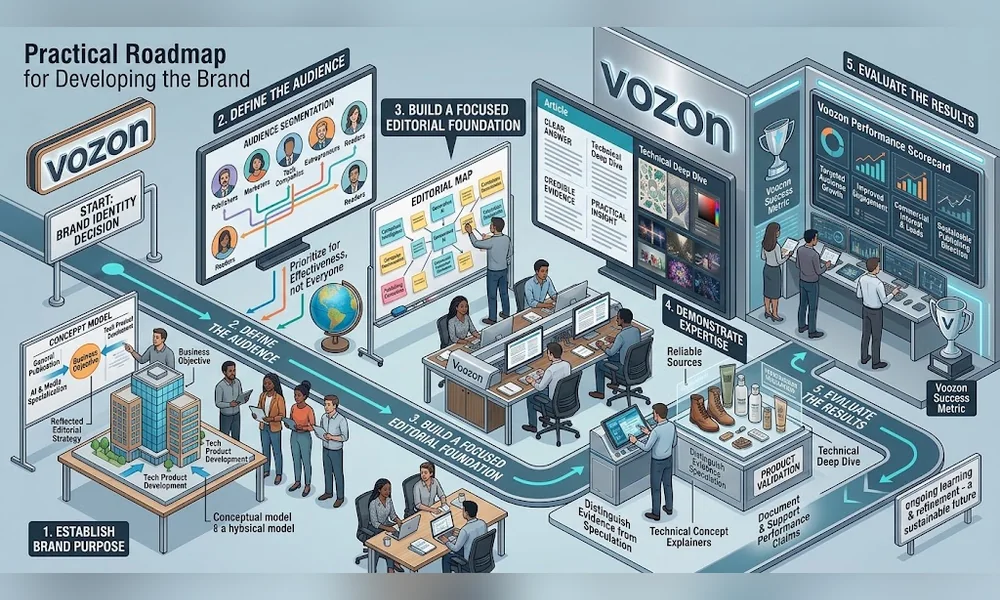
If Voozon's owners decide to pursue an AI media and advertising identity, the next steps should be deliberate.
Establish the brand's purpose
Determine whether Voozon is intended to remain a general publication, specialize in AI and media, or eventually develop technology products. The editorial strategy should reflect the actual business objective.
Define the audience
Potential audiences include publishers, marketers, advertising professionals, technology companies, entrepreneurs, and readers interested in the future of digital business.
The brand should prioritize the groups it can serve most effectively rather than trying to appeal to everyone at once.
Build a focused editorial foundation
Develop original, well-researched coverage around AI in advertising, contextual intelligence, media technology, campaign measurement, generative AI, and the changing economics of publishing.
Each article should provide a clear answer, credible evidence, practical insight, or a genuinely useful perspective.
Demonstrate expertise
Use reliable sources, explain technical concepts clearly, distinguish evidence from speculation, and avoid attributing capabilities to companies without verification.
If the brand later introduces products or services, document what they actually do and support performance claims with appropriate evidence.
Evaluate the results
Measure whether the positioning attracts the intended audience, improves engagement, generates relevant commercial interest, and creates a sustainable publishing direction.
Brand development should be treated as an ongoing process of learning and refinement rather than a one-time declaration.
10. The Future of Voozon: A Direction to Explore, Not a Claim to Assume
At present, the public information available about Voozon's specific role in AI media and advertising does not provide a sufficient basis to describe it as an established player in that sector.
That limitation should be acknowledged openly.
It does not prevent the brand from exploring a new direction, but it does mean that its future positioning must be developed through deliberate decisions and verifiable work.
Voozon could potentially build an identity around intelligent media, using editorial analysis to explain how AI influences publishing, advertising, and audience discovery. Alternatively, its owners may have a different vision that would make another direction more appropriate.
The brand's future should be determined by its actual objectives, capabilities, and audience needs—not by assumptions created for the sake of a compelling article.
The broader opportunity remains significant as a subject of exploration. AI is changing the tools available to publishers and advertisers, while raising the importance of originality, relevance, privacy, and trust.
A distinctive Voozon identity could be developed around those questions, provided the positioning is supported by consistent publishing, credible expertise, and a clear purpose.
Conclusion: The Next Era of Media Must Be More Intelligent and More Credible
Artificial intelligence is making it easier to create content, analyze information, and automate parts of digital advertising. But these capabilities alone will not determine which brands earn lasting attention.
The more important questions concern usefulness, originality, relevance, and trust.
For Voozon, the intersection of AI, media, and advertising offers a possible foundation for a more distinctive identity. The opportunity is to explore how technology can improve the relationship between publishers, businesses, and audiences while maintaining a clear distinction between established facts and future possibilities.
That is not a claim that Voozon already operates an AI advertising platform. It is a proposed direction that would need to be validated by the brand's owners and developed through real work.
The next generation of digital media will require more than faster production and larger audiences. It will require better decisions about what deserves attention, why information matters, and how commercial communication can create genuine value.
If Voozon chooses to build around that principle, its most important asset will not be the AI label. It will be the credibility, clarity, and usefulness of the identity it establishes.
Disclaimer
This article explores a potential brand-positioning concept for Voozon in the context of artificial intelligence, digital publishing, and advertising. Publicly available information establishing Voozon's specific activities, products, or capabilities in AI advertising appears limited, and no proprietary technology, partnerships, customer relationships, or commercial results are asserted here without verification.
References to possible business directions are illustrative and should not be interpreted as official statements, confirmed plans, or existing services offered by Voozon. The article discusses general industry developments and does not guarantee commercial, marketing, traffic, or financial outcomes. Any sponsored placement or material commercial relationship associated with publication should be disclosed clearly where applicable.
