

Key Takeways
- Structured data improves visibility in AI-powered search results.
- Product, review, and local business schemas remain highly effective.
- Google retired FAQ rich results in May 2026.
- JSON-LD is the preferred format for modern schema markup.
- Accurate schema boosts rich snippets, maps, and video features.
- Search engines require schema data to match visible page content.
- Validation tools help prevent schema errors and penalties.
Winning the battle for search engine real estate requires sending clear, machine-readable signals directly to search engine crawlers. As search engines shift toward artificial intelligence engines and interactive visual displays, standard meta descriptions no longer carry the weight they once did. Implementing advanced schema markup examples is the absolute fastest way to turn boring blue search links into high-converting, fully interactive search features.
However, the playbook for structured data has completely changed. Following major updates—including Google's official retirement of FAQ rich results on May 7, 2026 chasing outdated markup formats will result in empty code and wasted development hours. At Memorable Design, we focus on building durable digital foundations. This deep dive covers 12 highly effective code structures using a modern json-ld schema implementation that actively triggers advanced search features today.
The 2026 Structured Data Validation Matrix
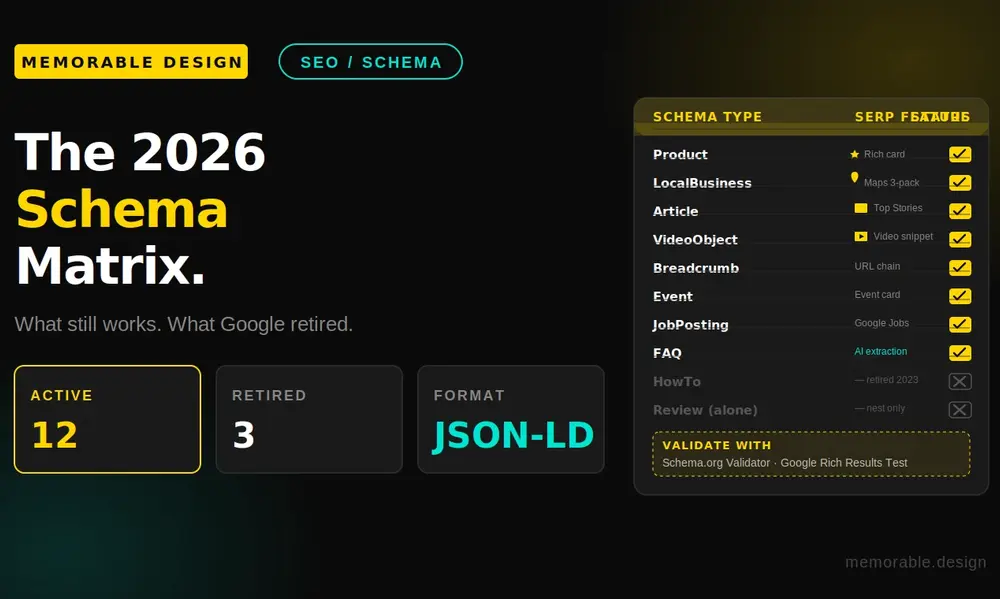
Before pasting script tags into your website header, you must know which schemas actively alter search appearances and which formats have been retired. The table below outlines the current status of core markup categories based on the latest web guidelines.
| Schema Object Type | Primary SERP Visual Trigger | Current Rich Result Status | Core Code Requirement |
| Product (Merchant) | Price, Stock, Free Delivery Badges | Fully Active | Requires price, currency, and availability |
| Product (Video Link) | Embedded Product Demo Carousels | Active (New 2026 Update) | Requires valid video URL and thumbnail |
| Review / Rating | Bright Gold Aggregate Star Arrays | Fully Active | Requires numeric ratingValue scale |
| Local Business | Maps Pack & Knowledge Panel Hub | Fully Active | Requires complete street Address node |
| Article / Blog | Top Stories Visual Carousel Spots | Fully Active | Requires headline and verified author |
| FAQPage / HowTo | Expanding Dropdown Dropmenus | Retired by Google | Content parsed for AI, but visual dropdowns are gone |
1. Product Schema Markup (E-Commerce Listings)
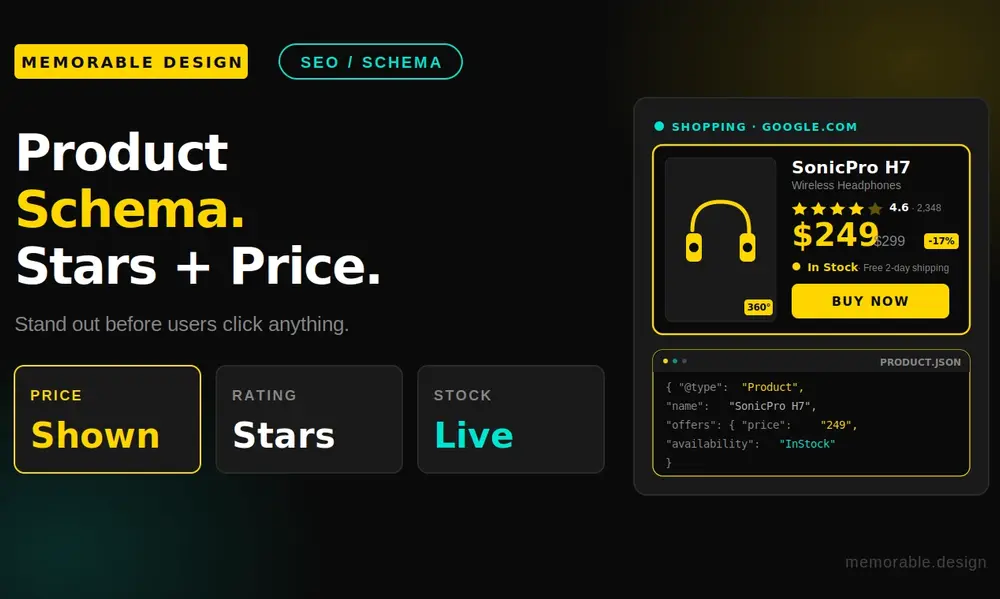
If you operate an online store, using an accurate product schema markup array is mandatory to stand out in shopping search results. This structured code injects real-time price drops, real-world stock availability, and shipping variables directly into organic search snippets.
[Product Schema Pipeline]
├── Base Product Node (Name, Brand, Images)
├── Offer Object (Price, Currency, Availability)
└── Shipping/Return Specs (Delivery Cutoffs, Return Windows)
A major update introduced in April 2026 added strict support for the handling_cutoff_time and video_link properties within e-commerce listings. Adding a video link allows search platforms to pull user-generated product videos directly into your organic retail search display, drastically boosting click-through rates.
JSON
{
"@context": "https://schema.org",
"@type": "Product",
"name": "Minimalist Ceramic Planter",
"image": [
"https://example.com/photos/1x1/planter.jpg"
],
"description": "Handcrafted matte ceramic planter designed for indoor succulents.",
"sku": "CP-001",
"mpn": "925872",
"brand": {
"@type": "Brand",
"name": "Peeacelily"
},
"offers": {
"@type": "Offer",
"url": "https://example.com/store/ceramic-planter",
"priceCurrency": "USD",
"price": "34.99",
"priceValidUntil": "2027-01-01",
"itemCondition": "https://schema.org/NewCondition",
"availability": "https://schema.org/InStock",
"shippingDetails": {
"@type": "OfferShippingDetails",
"deliveryTime": {
"@type": "ShippingDeliveryTime",
"handlingTime": {
"@type": "QuantitativeValue",
"minValue": 0,
"maxValue": 1,
"unitCode": "DAY"
}
}
}
},
"video": {
"@type": "VideoObject",
"name": "How to Unbox Your Ceramic Planter",
"thumbnailUrl": "https://example.com/thumbs/video.jpg",
"uploadDate": "2026-04-15",
"contentUrl": "https://example.com/videos/planter-unbox.mp4"
}
}
2. Review Schema Markup (Aggregate Star Ratings)
Nothing catches a shopper's eye faster than a row of bright gold stars sitting beneath your page link. Using a clean review schema markup template compiles scattershot customer feedback into a highly authoritative rating block that search systems trust completely.
To make sure your review stars actually display, never apply review code to your homepage; always attach it to specific, distinct product pages or standalone service offerings. Furthermore, the review text must be visible as plain text on the page so that search engine crawlers can cross-reference the data accurately.
JSON
{
"@context": "https://schema.org",
"@type": "Product",
"name": "Premium Branding Package",
"image": "https://example.com/assets/branding-package.jpg",
"aggregateRating": {
"@type": "AggregateRating",
"ratingValue": "4.9",
"reviewCount": "142",
"bestRating": "5",
"worstRating": "1"
},
"review": [
{
"@type": "Review",
"author": {
"@type": "Person",
"name": "Sarah Jenkins"
},
"datePublished": "2026-03-10",
"reviewBody": "The absolute gold standard for corporate brand re-designs.",
"reviewRating": {
"@type": "Rating",
"ratingValue": "5"
}
}
]
}
3. Local Business Schema (Geographic Maps Dominance)
For companies relying on physical foot traffic or local service areas, deploying a robust local business schema is the secret weapon to climbing into the coveted Google Maps Local 3-Pack. This specific block links your website directly to real-world coordinates and operating hours.
A useful feature updated in recent schema rollouts is the floorLevel property, which helps users locate businesses tucked inside massive shopping centers or multi-story office high-rises. It provides clear, actionable data right from the initial search path.
JSON
{
"@context": "https://schema.org",
"@type": "CreativeAgency",
"name": "Memorable Design HQ",
"image": "https://example.com/images/office-front.jpg",
"@id": "https://example.com/#agency",
"url": "https://example.com",
"telephone": "+1-555-867-5309",
"priceRange": "$$$",
"address": {
"@type": "PostalAddress",
"streetAddress": "742 Evergreen Terrace, Floor 4",
"addressLocality": "Austin",
"addressRegion": "TX",
"postalCode": "78701",
"addressCountry": "US"
},
"geo": {
"@type": "GeoCoordinates",
"latitude": 30.2672,
"longitude": -97.7431
},
"openingHoursSpecification": [
{
"@type": "OpeningHoursSpecification",
"dayOfWeek": ["Monday", "Tuesday", "Wednesday", "Thursday", "Friday"],
"opens": "09:00",
"closes": "18:00"
}
]
}
4. Article and BlogPosting Structured Data
If your primary focus is producing high-quality content, Article and BlogPosting configurations ensure your posts populate visual Google Discover feeds and Top Stories carousels. This setup builds massive topical authority by explicitly connecting your articles to verified human authors.
JSON
{
"@context": "https://schema.org",
"@type": "BlogPosting",
"headline": "The Ultimate 2026 Guide to Corporate Web Typography",
"image": [
"https://example.com/blog/wp-content/uploads/2026/05/typography-guide.jpg"
],
"datePublished": "2026-05-12T08:00:00+00:00",
"dateModified": "2026-05-25T14:30:00+00:00",
"author": {
"@type": "Person",
"name": "Marcus Vance",
"jobTitle": "Lead Brand Strategist",
"sameAs": "https://example.com/authors/marcus-vance"
},
"publisher": {
"@type": "Organization",
"name": "Memorable Design",
"logo": {
"@type": "ImageObject",
"url": "https://example.com/assets/logo.png"
}
}
}
5. Organization Schema (The Definitive Knowledge Graph Base)
The foundation of any advanced search visibility strategy is establishing your brand as an independent, trusted entity. By mapping out your social channels, parent companies, and internal contact points using Organization code, you feed search engines the exact relationships they need to construct a robust Knowledge Panel for your business.
JSON
{
"@context": "https://schema.org",
"@type": "Organization",
"name": "Memorable Design",
"url": "https://example.com",
"logo": "https://example.com/assets/logo.png",
"sameAs": [
"https://www.facebook.com/memorabledesign",
"https://www.linkedin.com/company/memorabledesign",
"https://twitter.com/memorabledsgn"
],
"contactPoint": {
"@type": "ContactPoint",
"telephone": "+1-800-555-0199",
"contactType": "customer service",
"availableLanguage": "en"
}
}
6. VideoObject Schema (Video Snippet Capture)
Video content continues to take over modern search layouts. By detailing your video content using a clean json-ld schema implementation, search bots can easily read your exact video timestamps, description logs, and interaction milestones.
This markup structure enables Google to highlight "Key Moments" right within the search listings. This allows users to skip directly to the exact section of a long tutorial or product demonstration that answers their specific question.
JSON
{
"@context": "https://schema.org",
"@type": "VideoObject",
"name": "How to Build a Responsive Logo System",
"description": "A comprehensive walkthrough covering responsive vector transitions for web screens.",
"thumbnailUrl": "https://example.com/thumbnails/logo-tutorial.jpg",
"uploadDate": "2026-01-14T12:00:00Z",
"duration": "PT4M10S",
"contentUrl": "https://example.com/videos/logo-tutorial.mp4",
"embedUrl": "https://example.com/embed/logo-tutorial",
"hasPart": [
{
"@type": "Clip",
"name": "Analyzing Vector Viewports",
"startOffset": 0,
"endOffset": 90
},
{
"@type": "Clip",
"name": "Writing CSS Theme Media Queries",
"startOffset": 91,
"endOffset": 250
}
]
}
7. BreadcrumbList Schema (Navigational Directory Styling)
Instead of displaying a long, messy website link in search results, a clean BreadcrumbList configuration organizes your URL into a neat, readable directory trail. This shows users exactly where the page sits inside your site's overall structure before they even click.
JSON
{
"@context": "https://schema.org",
"@type": "BreadcrumbList",
"itemListElement": [{
"@type": "ListItem",
"position": 1,
"name": "Resources",
"item": "https://example.com/resources"
},{
"@type": "ListItem",
"position": 2,
"name": "Development Checklists",
"item": "https://example.com/resources/checklists"
}]
}
8. Event Schema (Interactive Visual Event Displays)
For businesses that host live workshops, webinars, or music performances, Event markup feeds clean scheduling info straight into Google’s specialized event discovery grids. This places your calendar listings directly in front of active local searchers.
JSON
{
"@context": "https://schema.org",
"@type": "ConferenceEvent",
"name": "The Future of AI Search Optimization Summit",
"startDate": "2026-10-15T09:00:00-05:00",
"endDate": "2026-10-16T17:00:00-05:00",
"eventAttendanceMode": "https://schema.org/OnlineEventAttendanceMode",
"eventStatus": "https://schema.org/EventScheduled",
"location": {
"@type": "VirtualLocation",
"url": "https://example.com/summit-live"
},
"offers": {
"@type": "Offer",
"price": "149.00",
"priceCurrency": "USD",
"url": "https://example.com/summit-tickets",
"availability": "https://schema.org/InStock"
},
"performer": {
"@type": "Person",
"name": "Dr. Aris Thorne"
}
}
9. ProfilePage Schema (Author E-E-A-T Enforcement)
In line with recent helpful content updates focusing on trust and real-world experience, the ProfilePage schema tells search engines exactly who wrote your content. This explicitly highlights their real-world credentials, social bios, and industry expertise.
JSON
{
"@context": "https://schema.org",
"@type": "ProfilePage",
"mainEntity": {
"@type": "Person",
"name": "Julian Vance",
"alternateName": "DesignAlchemist",
"description": "Senior UI Designer specializing in fluid interface code structures.",
"image": "https://example.com/team/julian.jpg",
"sameAs": [
"https://www.linkedin.com/in/julian-vance-design"
]
}
}
10. JobPosting Schema (Google Jobs Panel Capture)
If you are expanding your team, writing standard text job descriptions limits your visibility. Using structural JobPosting code pulls your open roles straight into the highly visible Google Jobs widget, driving high-quality candidate applications for free.
JSON
{
"@context": "https://schema.org",
"@type": "JobPosting",
"title": "Senior Front-End Interface Engineer",
"description": "Seeking an absolute expert in CSS vector engineering and programmatic structural layout design.",
"datePosted": "2026-05-20",
"validThrough": "2026-09-01",
"employmentType": "FULL_TIME",
"hiringOrganization": {
"@type": "Organization",
"name": "Memorable Design",
"sameAs": "https://example.com"
},
"jobLocation": {
"@type": "Place",
"address": {
"@type": "PostalAddress",
"addressLocality": "Austin",
"addressRegion": "TX",
"addressCountry": "US"
}
},
"baseSalary": {
"@type": "MonetaryAmount",
"currency": "USD",
"value": {
"@type": "QuantitativeValue",
"value": 115000,
"unitCode": "YEAR"
}
}
}
11. Modern Modernized How-To Code Layout
While legacy visual drop-down accordions for how-to lists have been phased out by major search platforms, keeping clean how-to schema example tags in your code remains incredibly valuable. AI engines and voice assistants rely heavily on this step-by-step structure to quickly parse and deliver answers for complex tutorials.
- Isolate Clear Chronological Phases: Break down your processes into distinct steps, making sure every phase contains explicit instruction text.
- Keep Text and Code Perfectly Synchronized: The steps written inside your JSON-LD code block must match the visible text on the page word-for-word.
12. Clarified Legacy FAQ Page Setup
The visual dropdowns for the classic faq schema example were officially turned off in search listings in May 2026 to clean up crowded search results pages. However, leaving clean Q&A schema on your pages doesn't hurt your site, and it remains a fantastic way to feed clear data directly into generative AI search summaries.
- Keep Your Answers Short and Clear: Draft direct, single-sentence answers to your questions so AI search engines can easily pull them into quick-answer boxes.
- Avoid Marketing Filler: Focus on real, actionable answers instead of stuffing your questions with repetitive sales copy or unnecessary keywords.
Golden Governance Rules for Structural Code Maintenance
To keep your search visibility sharp and avoid warning flags in Google Search Console, follow these core technical guidelines across your entire site:
- Always Sync Your Data with On-Page Text: Every price point, review count, and physical address in your hidden code block must perfectly match what users see on the live page.
- Validate Every Script Before Publishing: Run every new code block through the official Schema.org Validator and Google’s Rich Results Test to catch syntax errors or missing required properties early.
Summary of Modern Schema Strategies
Structured data is no longer about trying to trick search platforms into giving you a flashy, oversized link. As search engines continue to evolve into AI-powered answering systems, clean code acts as a direct translator that helps machines index your business data accurately.
By focusing on high-value, active formats like product schema markup and clear author profiles, you build a durable digital presence that ranks well today and adapts easily to future updates. If you are ready to completely modernize your website's search strategy, contact the team at Memorable Design to deploy a custom structured data setup built for the future.
Frequently Asked Questions (FAQs)
What is the most effective way to test a json-ld schema implementation?
The safest method is using two free validation tools: the official Schema.org Validator to confirm your overall syntax is clean, followed by Google's Rich Results Test to verify your code qualifies for active search features.
Did Google completely stop supporting the classic faq schema example?
Yes, as of May 7, 2026, Google officially stopped displaying interactive FAQ dropdown menus in organic search results. While the code can safely remain on your site without causing issues, it will no longer expand your organic search listing size.
Can using incorrect schema markup examples trigger manual penalties?
Yes. If your hidden code claims a product has a 5-star rating or a $10 price tag, but the live text on the page shows no reviews and a $50 price, search engines can flag your site for deceptive or manipulative structured data.
Why did my rich snippet schema stop appearing in organic search results?
Rich results are never guaranteed. Beyond basic code validation errors, search platforms may temporarily pull your specialized snippets if your page authority drops, if your content triggers quality updates, or if the layout format is deprecated.
