
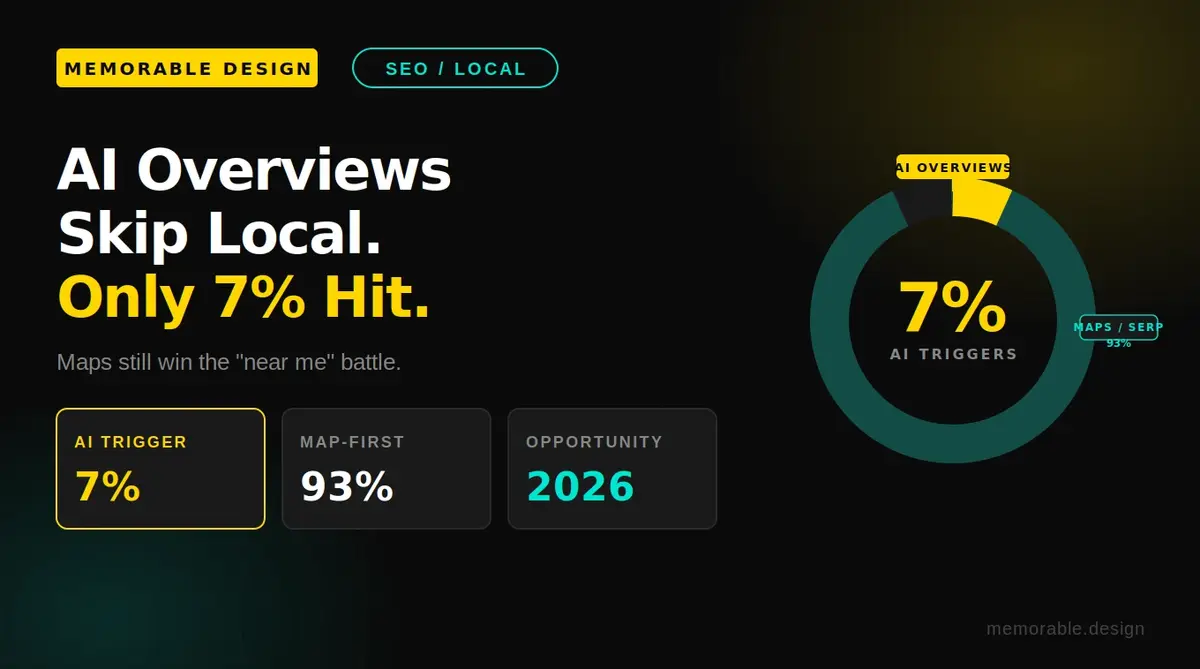
AI Overviews currently appear in only 7% of direct local searches because Google still prioritizes fast, accurate map-based results for high-intent queries like “plumber near me.” However, informational and long-tail searches are increasingly triggering AI summaries. To stay visible, businesses should optimize their Google Business Profile, improve website speed and schema markup, maintain consistent local listings, and create hyper-local content that answers real customer questions.
The rollout of Google’s AI Overviews sent shockwaves through the digital marketing world. Business owners panicked, fearing that traditional organic visibility would vanish overnight under a mountain of machine-generated summaries. Yet, as we navigate through 2026, a fascinating anomaly has emerged in neighborhood-level search data. Recent industry tracking reveals that AI Overviews only trigger on an estimated 7% of direct local queries like "plumber near me" or "roofing repair open now."
This low trigger rate does not mean Google is abandoning its generative engine initiatives. Rather, it highlights how carefully the search giant is protecting the commercial ecosystem that drives its mapping software. For neighborhood merchants, this 7% statistic offers a vital window of opportunity. Understanding why the algorithm behaves this way allows you to secure your footprint before the next digital shift. Building a bulletproof presence requires aligning your website architecture and directories with the latest intent frameworks here at Memorable Design.
1. The Real Reason AI Stays Away from the Local Pack
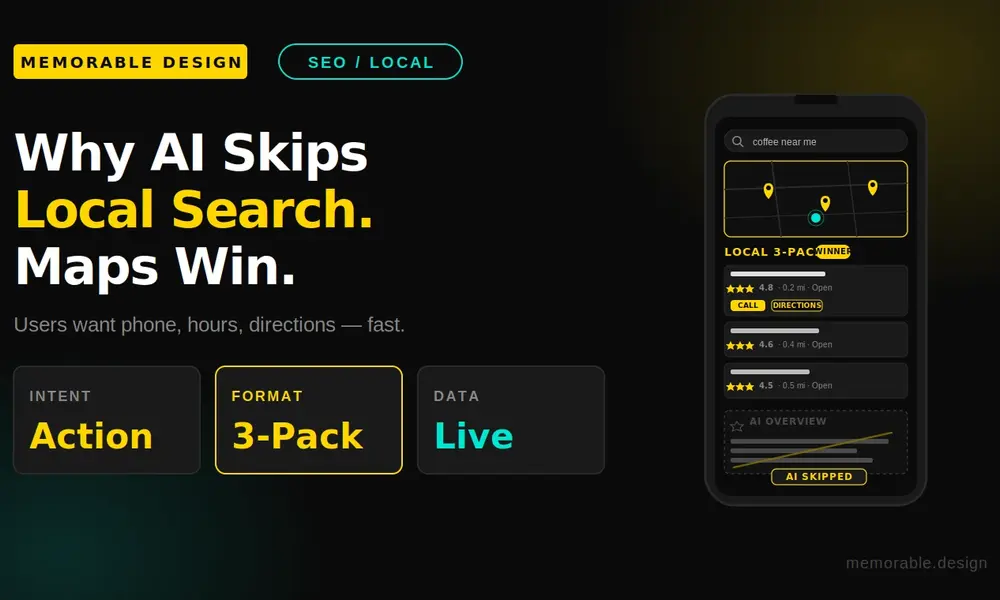
To understand why generative responses rarely appear for high-intent nearby searches, you have to look at how Google prioritizes its user experience. When someone types a query with immediate transactional intent, they are not looking to read an introductory essay on industry history. They want phone numbers, operating hours, and structural driving directions right away. The traditional 3-Pack mechanism already delivers this data perfectly, making a text-heavy summary redundant.
Furthermore, real-time data accuracy represents a massive hurdle for Large Language Models. If an AI engine confidently recommends a boutique based on old blog posts, only for a customer to find the shop went out of business months ago, consumer trust breaks down. Google consciously avoids this risk by defaulting to its structured database whenever proximity and real-time operational status are the primary ranking requirements.
2. Deciphering the Queries That Actually Trigger AI
While standard transactional phrases see very low AI activation rates, informational and research-based queries are experiencing massive generative growth. The system acts as a guide during your target audience's early decision-making steps, stepping in when a user expresses uncertainty or requires a comparative analysis before making a purchase decision.
How AI Overviews distribute across query types:
* High-intent transactional terms ("dentist near me") trigger overviews under 10% of the time.
* Long-tail queries containing 4+ words are roughly 60% more likely to trigger a generative summary.
* Informational queries ("how to fix a leaky pipe before calling a plumber") carry a 57% to 99% trigger rate.
If your local digital marketing strategy focuses entirely on generic terms, you are missing out on the early stages of the customer journey. Consumers regularly use conversational phrases to evaluate their options before finalizing a booking. Capturing this traffic requires a sophisticated understanding of contemporary local search 2026 trends.
3. Elevating Your Google Business Profile AI Infrastructure
Your directory listing is no longer just a passive business card floating on a map. In the modern search ecosystem, your google business profile ai presence serves as an active data feed that feeds corporate machine-learning models. If your profile is thin, incomplete, or dormant, algorithm layers will simply filter your business entity out of advanced results.
Critical profile indicators evaluated by modern AI engines:
* Review Recency: Maintaining a consistent stream of feedback within a rolling 90-day window.
* Category Coherence: Selecting an unambiguous primary classification that matches your website code.
* Real-Time Responses: Utilizing profile messaging and quoting options within an established 48-hour limit.
To remain competitive, you must move away from static profile management. Uploading fresh interior images monthly, posting weekly operational updates, and answering consumer inquiries directly in the community Q&A section all send critical signals of active operations. These continuous updates give the algorithm the confidence it needs to recommend your services over a quiet competitor.
4. How to Optimize Your Website Structure for Generative Sourcing
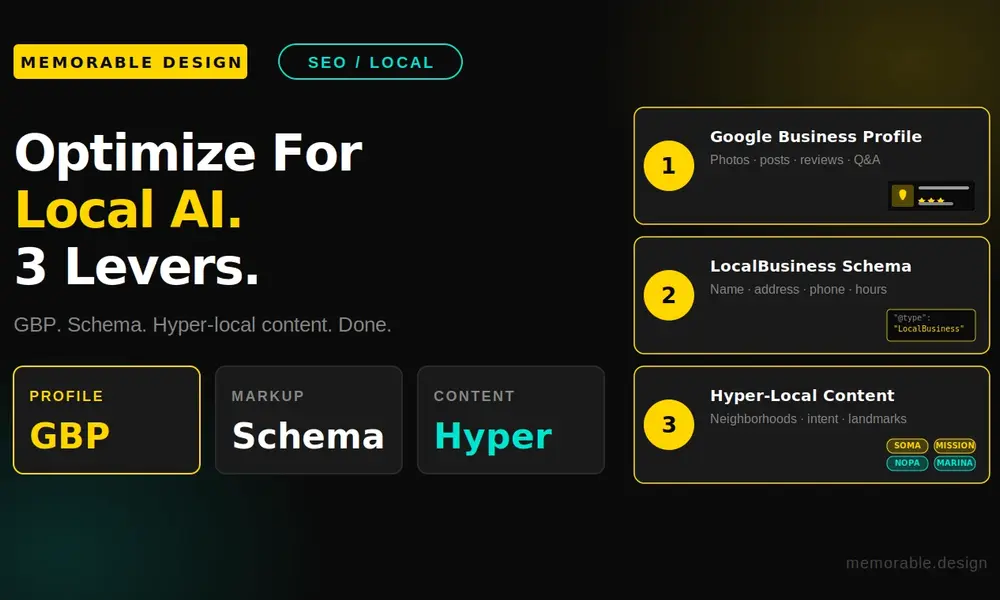
If you want your neighborhood company to be cited as a trusted source within informational generative summaries, your website's technical setup must prioritize clean machine readability. This involves moving past simple keyword placement and embracing semantic depth, clear structural hierarchy, and advanced structured data integrations.
Standard Core Web Vital Benchmarks for Neighborhood Visibility
Before focusing on content extraction, your underlying web infrastructure must meet strict performance guidelines. Sites that suffer from poor loading speeds or sudden layout shifts are routinely bypassed by search crawlers, regardless of how well-written their articles are.
| Performance Metric | Optimal Threshold | Critical Warning Zone | Required Remediation Action |
| Largest Contentful Paint (LCP) | Under 2.5 seconds | Above 4.0 seconds | Optimize server response times and compress large hero images. |
| Cumulative Layout Shift (CLS) | Under 0.1 | Above 0.25 | Hardcode explicit width and height dimensions for all visual assets. |
| Interaction to Next Paint (INP) | Under 200ms | Above 500ms | Minimize heavy background JavaScript execution and clean up redundant code. |
5. Winning the Battle for Local Pack Visibility
Securing long-term local pack visibility in this new landscape requires a two-sided optimization approach. You must maintain perfect Name, Address, and Phone (NAP) consistency across trusted directories like Yelp, Apple Maps, and specialized trade platforms to verify your physical location. At the same time, your website needs to feature localized service pages that address regional pain points directly.
Instead of building a single generic page that claims to cover an entire metropolitan area, invest time into creating dedicated landing pages for individual neighborhoods. Detail specific landmarks, local building regulations, and actual case studies from jobs completed in those exact zip codes. This hyper-local content structure creates an authoritative entity footprint that automated crawlers can easily cross-reference and trust.
6. Implementing Advanced LocalBusiness Schema
The most effective way to ensure search systems understand your operational boundaries is by implementing advanced LocalBusiness JSON-LD schema markup in your website's header. This structured code acts as a direct translator, converting your human-readable contact information into explicit relational data that helps engines build out their broader Knowledge Graphs.
Ensure that every single attribute hardcoded into your schema template matches your official map profile character for character. This includes your physical address format, suite numbers, primary phone routing channels, geo-coordinates, and accepted payment methods. Any discrepancies across these technical assets introduce algorithmic doubt, which quickly degrades your ranking authority during core updates.
Preparing Your Brand for the Future of Search
The current 7% trigger rate is not a permanent shield; it is a grace period. As search models become faster, more accurate, and more deeply integrated with real-time merchant inventories, generative results will inevitably expand deeper into conversational neighborhood commerce.
By optimizing your directory profiles today, building out comprehensive local content paths, and ensuring your technical schema architecture is flawless, you protect your current rankings while setting yourself up for future growth. Navigating this shift is about turning technical clarity into long-term market authority. Focus on providing real, human value across your entire digital footprint, and the algorithms will naturally reward your business here at Memorable Design.
Frequently Asked Questions
Why do AI Overviews appear so rarely for local seo ai overviews keywords right now?
Google suppresses generative text results for standard nearby queries because users prefer the quick, functional utility of the traditional 3-Pack maps layout. Generating text answers for simple directional searches increases accuracy risks and processing costs without improving the consumer experience.
How will local search 2026 frameworks change for service-based businesses over the next year?
Over the coming year, neighborhood search systems will rely much more heavily on real-time operational signals rather than old, static backlinks. Review velocity, profile update frequencies, and complete schema transparency will become the primary factors determining which businesses get recommended.
Can a messy google business profile ai integration hurt my traditional map rankings?
Yes, having conflicting data fields, unmonitored duplicate listings, or unaddressed customer reviews can create structural entity confusion. If Google's algorithms cannot verify your operational legitimacy across different data sources, your overall map visibility will decline.
What content format works best to secure high local pack visibility during algorithm updates?
The most successful approach is a dedicated question-and-answer section on your service pages, written in a clear, conversational style. Answering real-world customer questions directly makes it easy for automated systems to pull your content into both standard snippet areas and emerging AI summaries.
Does my website need specialized technical code to appear in AI search results?
While standard crawling guidelines still apply, adding valid LocalBusiness and FAQ JSON-LD schema markup greatly increases your chances of being cited. This structured data gives search engines a clean, clear map of your business details, removing any ambiguity about what you offer and where you operate.
