
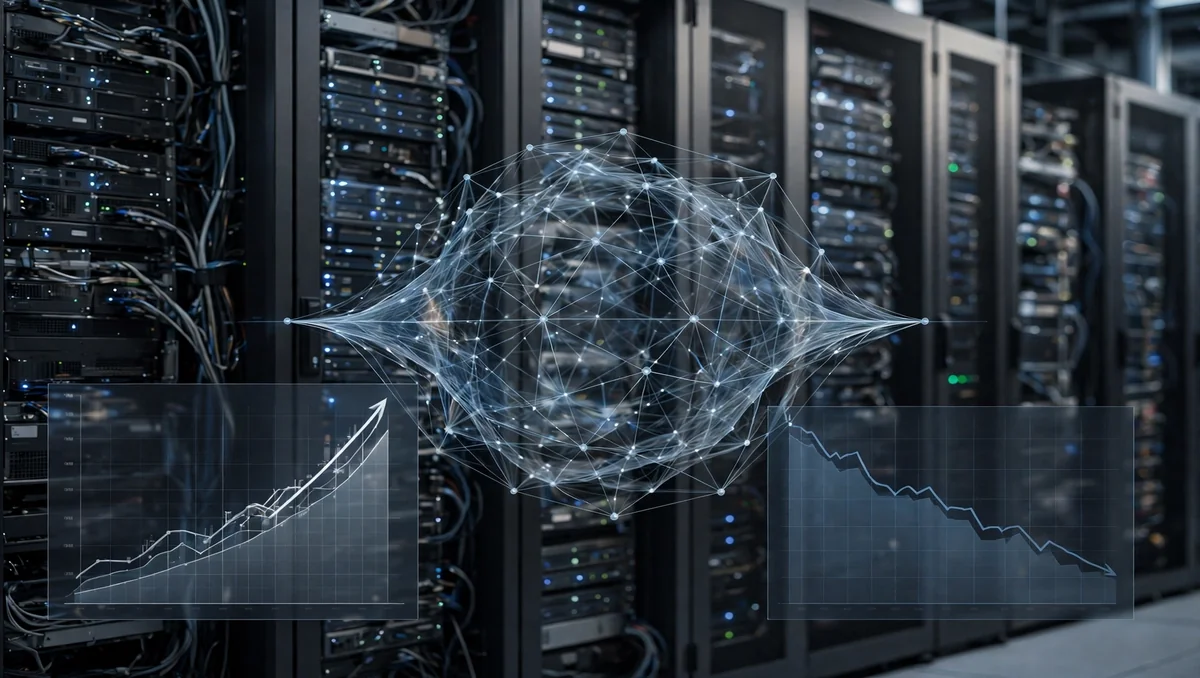
OpenAI's $852 billion valuation was a landmark moment for the artificial intelligence industry. In March 2026 the company announced $122 billion in committed capital at a post-money valuation of $852 billion. That number showed how strongly investors believed in ChatGPT and the wider AI business.
But a huge valuation doesn't mean a company is making money. OpenAI is growing fast and its products are being used by millions of people and businesses. At the same time its spending on computing power research and infrastructure is creating very large losses. The real question is simple: can OpenAI turn its growth into a business that earns more than it spends?
Key Takeaways
- OpenAI's March 2026 funding round valued it at $852 billion after raising $122 billion in committed capital.
- Reuters reported a later $11 billion funding commitment at a $1.25 trillion valuation in November 2026.
- Third-quarter revenue reached $10 billion but adjusted operating losses were still $10.9 billion.
- AI infrastructure and computing power are major costs.
- The reported $278 billion cash burn through 2030 is a forecast and not a confirmed future loss.
- Long-term success depends on revenue growth customer retention and lower delivery costs.
What Does the $852 Billion Valuation Actually Mean?
A valuation is the price investors place on a company during a funding deal. It isn't the amount of cash the company has in its bank account and it isn't a measure of yearly profit.
OpenAI's March funding round included $122 billion in committed capital. The company said the deal valued it at $852 billion after the investment. This is called a post-money valuation because it reflects the company's value after the new funding is included.
There is an important update. On November 6 Reuters reported that OpenAI had secured another $11 billion as the first part of a later funding round. That deal put its reported valuation at $1.25 trillion. The original $852 billion figure still matters because it marked a major step in the company's funding story. But it is no longer the latest reported valuation.
A higher valuation tells us that investors are willing to pay more for a share of the company. It doesn't prove that the company has solved its cost problem. Private company valuations can also change as funding terms and market conditions change.
OpenAI's Growth Is Not Just Hype
There is real demand behind OpenAI's valuation. ChatGPT has become a familiar tool for writing research coding and everyday questions. Businesses are also using OpenAI models through paid ChatGPT plans and its API.
The company has several ways to earn revenue:
- Paid ChatGPT subscriptions for individuals and teams.
- Enterprise plans sold to businesses.
- API access for developers building AI features into their products.
- Business tools such as coding agents and workplace assistants.
- Commercial partnerships and other distribution deals.
This matters because OpenAI isn't relying on one type of customer. A student paying for a personal plan and a company using AI across thousands of employees are very different customers.
Business contracts can bring larger and more regular payments if customers keep using the products. As ChatGPT adoption grows among individuals and businesses, understanding ChatGPT search optimization is becoming increasingly important for companies looking to improve their visibility in AI-powered search results.
The latest figures shared with investors show that revenue reached $10 billion in the third quarter of 2026. That was roughly 50% higher than the previous quarter. The Wall Street Journal also reported that about 100 million people were paying for ChatGPT. This is a strong sign that demand is real. It still doesn't tell us how much profit the company keeps from each customer.
Why Are OpenAI's Losses Still So Large?
AI is expensive to build and expensive to run. Every time a user asks a model to write a report or analyze a file the company must provide computing power. More complex tasks can require more processing and more time.
OpenAI also spends heavily on research. It needs engineers and researchers to improve models and build new products. It also needs data centers and long-term access to chips and electricity. These costs arrive before the company knows exactly how much revenue a new product will generate.
The latest third-quarter figures shared with investors showed an adjusted operating loss of $10.9 billion. That was slightly higher than the $10.1 billion loss in the second quarter. The adjusted operating margin improved from minus 150% to minus 109%. In simple terms the business became more efficient relative to its revenue but it was still losing a very large amount.
There is another accounting detail worth understanding. The reported adjusted operating loss excludes $2.6 billion in stock-based compensation according to the Wall Street Journal. Stock-based compensation is the value of shares given to employees as part of their pay. It isn't the same as an immediate cash payment but it is still a real cost to shareholders because it can dilute ownership.
The Biggest Bill May Be Computing Power

OpenAI's financial challenge is tied to infrastructure. Training a powerful model can require huge computing resources. Serving that model to millions of users creates a continuing bill too.
Reuters reported in September that a Financial Times report based on a company presentation projected $278 billion in negative free cash flow between 2026 and 2030. The same report said OpenAI expected to spend about $856 billion on computing power and infrastructure by the end of 2030.
These are forecasts rather than money already spent. Forecasts can change as demand shifts and technology becomes more efficient. Still they show the scale of the plan. OpenAI is betting that it needs to secure computing capacity now to support future products and customers.
This creates a difficult balance. If the company builds too little infrastructure it may struggle to meet demand. If it builds too much it could be left paying for expensive capacity that customers don't use enough.
Can OpenAI Make Money From Its Products?
The next test isn't simply whether people use ChatGPT. It is whether each product can earn enough to cover the cost of delivering it. As AI adoption grows, businesses must also understand AI search optimization to maintain their visibility and reach audiences through AI-powered search platforms.
Subscriptions are easy to understand. A customer pays a monthly fee and receives access within the plan's limits. But heavy users may consume far more computing resources than light users. If the price doesn't reflect that difference the company can have popular products that are costly to serve.
Enterprise sales could help. Companies may pay for security controls and admin features as well as access to models. They may also use AI in important workflows where the service becomes difficult to replace. But business customers want proof that AI saves time or increases revenue. They won't keep paying simply because a product is new.
API pricing is another pressure point. Developers compare model quality and price before choosing a provider. If rivals offer similar results at a lower cost OpenAI may need to lower prices or improve performance without raising its own expenses.
Competition Makes the Question Harder

OpenAI is no longer competing in an empty market. Google has its Gemini models. Anthropic sells Claude to consumers and businesses. Meta and other developers are also pushing AI tools and models. As competition grows across these AI platforms, LLM SEO is becoming increasingly important for businesses that want their content and brands to gain visibility in AI-powered search results.
The latest reported figures make the competition especially relevant. The Wall Street Journal said Anthropic reported $17 billion in third-quarter revenue and a $567 million operating loss. These numbers aren't automatically a perfect comparison because companies can report revenue and adjusted costs differently. Still they show that investors are looking closely at how much revenue AI companies generate and how much they spend to earn it.
OpenAI has advantages. ChatGPT has a large user base and its products are familiar to consumers. Its developer platform and partnerships also give it routes into other businesses. Yet brand recognition alone won't protect its margins if customers can switch to another model.
What Should Investors Watch Next?
The most useful signals will be more detailed than a headline valuation. OpenAI's future depends on whether revenue keeps growing while the cost of serving each customer comes down.
Watch these areas:
- Revenue quality: Is growth coming from repeat customers and long-term business contracts?
- Operating losses: Are losses falling as a share of revenue over several quarters?
- Compute costs: Is each model response becoming cheaper to deliver?
- Customer retention: Do businesses renew their contracts after testing AI tools?
- Funding needs: Can OpenAI finance its plans without depending on constant large funding rounds?
- Product focus: Can it concentrate spending on products that customers are willing to pay for?
OpenAI has also been adjusting its strategy as competition increases. That makes execution important. A company can have impressive research and still struggle if its products don't fit customer needs or if its costs grow faster than sales.
What Does This Mean for the Future of OpenAI?
The $852 billion valuation was a bet on what OpenAI could become. The later reported $1.25 trillion valuation shows that investors were still willing to place an even higher price on that future in November. But both figures are investor valuations rather than proof of financial health.
OpenAI could become a highly profitable technology company if it turns its reach into durable subscriptions and business contracts while lowering the cost of AI services. It could also face years of heavy spending if users expect more capable models and cheaper access at the same time.
For now the fairest view is neither blind excitement nor panic. OpenAI has real demand and a growing business. It also has huge infrastructure needs and losses that can't be ignored. The next chapter will be decided by how well it converts its technical lead into steady cash flow.
Frequently Asked Questions
Is OpenAI Really Worth $852 Billion?
That was the post-money valuation announced with its March 2026 funding round. Reuters later reported a $1.25 trillion valuation tied to an additional funding round in November 2026. These are private funding valuations and not public stock market prices.
How Much Revenue Does OpenAI Make?
The Wall Street Journal reported that OpenAI's revenue reached $10 billion in the third quarter of 2026. This is a quarterly figure and shouldn't be confused with annual revenue or profit.
Why Does OpenAI Lose Money if ChatGPT Has Paying Users?
Paying users bring in revenue but running AI models requires expensive computing power. OpenAI also spends on research staff infrastructure and product development. Revenue can grow while total expenses remain higher.
Is OpenAI Expected to Lose $278 Billion?
Reuters reported that the Financial Times had seen a company presentation projecting $278 billion in negative free cash flow from 2026 to 2030. This is a forecast not a final result. Actual spending and cash flow may change.
Does a Higher Valuation Mean OpenAI Is Profitable?
No. Valuation reflects what investors are willing to pay based on expected future performance. Profitability depends on whether revenue eventually exceeds all operating and financing costs.
About This Analysis
This article was prepared for Memorable Design using OpenAI's funding announcement and reporting from Reuters and The Wall Street Journal. Financial projections are identified as forecasts and shouldn't be treated as confirmed results. Readers should review original company disclosures and current reporting before making financial decisions.
Disclaimer: This article is for informational and educational purposes only. It is not investment advice or a recommendation to buy or sell shares or private-market interests. Company valuations and financial forecasts can change. Always verify figures through official disclosures and consult a qualified financial adviser before making investment decisions
