
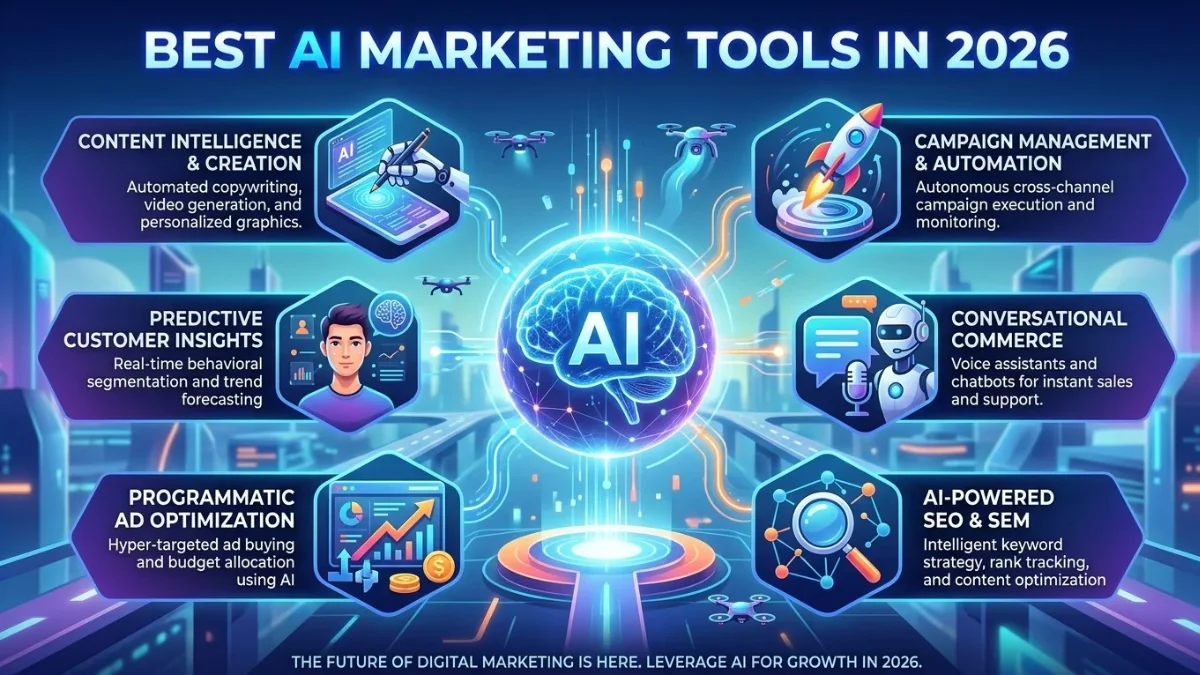
AI marketing tools help businesses automate content creation, SEO, advertising, analytics, and customer engagement. The best solutions combine AI content tools, AI SEO tools, and marketing automation into scalable workflows that improve productivity, campaign performance, and marketing ROI while supporting human decision-making.
Choosing the right AI marketing tools is no longer about finding a single platform it is about building an efficient marketing ecosystem. This guide from Memorable.design explores the most effective AI solutions, practical workflows, comparison criteria, and expert recommendations to help businesses create smarter, faster, and more measurable marketing strategies.
Key Takeaways
-
Compare AI marketing tools using real business requirements instead of feature lists.
-
Discover AI SEO tools and AI content tools that fit different marketing goals.
-
Learn practical marketing automation workflows that reduce manual work.
-
Find the right AI stack based on business size, budget, and campaign objectives.
The AI Marketing Tools Directory: Use Cases, Rules, and Costs
Here is the breakdown:
1. Enterprise Platforms
-
HubSpot Breeze
-
Best For: Pipeline enrichment, automated CRM updates, and contextual email campaigns.
-
Core Rule: Requires 100% clean first-party contact data to prevent broken personalization paths.
-
Cost: Included in Starter ($15/mo), Professional ($800/mo base), and Enterprise ($3,600/mo base).
-
-
Salesforce Einstein
-
Best For: Enterprise predictive lead scoring and dynamic B2B journey mapping.
-
Core Rule: Needs an internal developer and deep historical customer data to train the algorithms.
-
Cost: Custom enterprise quotes only (typically starts around $1,250/mo).
-
2. AI SEO and GEO Platforms
-
Semrush One
-
Best For: Keyword intelligence, automated topic clustering, and competitor gap analysis.
-
Core Rule: Filter lists manually; do not blindly target keywords without checking buyer intent.
-
Cost: Pro ($139.95/mo), Guru ($249.95/mo), and Business ($499.95/mo).
-
-
Surfer SEO
-
Best For: Live NLP content auditing and optimization against ranking SERP links.
-
Core Rule: Avoid keyword stuffing just to force a high score; human readability drives conversions.
-
Cost: Essential ($89/mo), Advanced ($179/mo), and Max ($299/mo).
-
-
AthenaHQ
-
Best For: Tracking brand citations across AI answer engines like ChatGPT, Claude, and Perplexity.
-
Core Rule: Maintain flawless technical schema markup so AI crawlers can reference your products.
-
Cost: Growth plans start at $295/mo; custom quotes for enterprise setups.
-
-
Moonrank
-
Best For: Automated daily site audits and content optimization for conversational search visibility.
-
Core Rule: Every automated draft must pass a human editorial check to verify product accuracy.
-
Cost: Flat $99/mo (or $66/mo when billed annually).
-
3. AI Content Tools
-
Claude AI
-
Best For: Ingesting massive data reports and style guides to draft high-quality articles and reports.
-
Core Rule: Supply a comprehensive style guide and strict negative word lists to eliminate robotic language.
-
Cost: Free tier, Pro ($20/mo), and Team ($30/mo per user).
-
-
HeyGen
-
Best For: Turning text scripts into high-definition AI avatar spokesperson videos.
-
Core Rule: Use high-quality, studio-grade audio recordings for voice cloning to prevent mechanical distortion.
-
Cost: Creator ($29/mo), Business ($89/mo), and custom Enterprise scaling.
-
4. Marketing Automation and Ad Optimization
-
Ryze AI
-
Best For: 24/7 autonomous ad budget shifting and bid optimization across Google, Meta, and TikTok.
-
Core Rule: Set firm daily budget limits and target ROAS caps to control automated scaling.
-
Cost: Flat-rate billing starting at $89/mo.
-
-
ActiveCampaign
-
Best For: Triggering multi-step behavioral email tracks based on live website interactions.
-
Core Rule: Keep automation paths clean; overlapping triggers break tracks and spam users.
-
Cost: Starter tiers begin at $29/mo and scale to $149/mo for the Plus suite.
-
AI Marketing Tools Workflow Blueprint for Modern Marketing Teams
Link your software applications into a single, high-velocity pipeline to drive actual campaign performance.
AI Marketing Tools Selection Checklist Before Investing
Run through these quick operational checkmarks to protect your workflows and data integrity.
Decision Criteria
-
Integration: Does the tool offer native, two-way data syncing with your current CRM?
-
Data Privacy: Do terms explicitly state your data stays out of public model training loops?
-
Compliance: Does the platform meet regional privacy rules like GDPR and CCPA?
-
Usability: Can your daily team operate the dashboard without constant developer help?
-
Reliability: Does the provider offer stable uptime history and live customer support?
Implementation Readiness
-
Training: Set up internal team guidelines on tool usage to maintain quality.
-
Alignment: Adjust workflows so the software replaces old manual steps rather than creating extra work.
-
Measurement: Establish clear baseline metrics before launch to measure time saved and ROI gains.
Conclusion
The best AI marketing tools are those that fit your goals, workflows, and growth stage—not simply the most popular options. By combining AI SEO tools, AI content tools, and marketing automation strategically, businesses can achieve sustainable results. Memorabledesign recommends evaluating every solution through measurable business outcomes rather than trends.
Frequently Asked Questions
What is the best AI marketing tool for beginners?
Claude AI and Canva AI are the top entry-level choices. They feature minimal learning curves, clear visual dashboards, and highly accessible free tiers for initial copy and asset generation.
How much do professional AI marketing stacks cost per month?
A capable mid-tier growth stack costs between $200 and $400 monthly (e.g., combining Surfer SEO, ChatGPT Plus, and ActiveCampaign). Enterprise setups run custom models starting above $1,250 to $3,600 monthly.
Do AI content tools hurt Google SEO rankings?
No, provided the content delivers high factual accuracy and clear, unique value. Google ranks content based on helpfulness rather than whether it was written by a human or an AI, though raw, unedited AI drafts often fail to rank due to low quality.
What is the difference between AI SEO and Generative Engine Optimization (GEO)?
Traditional AI SEO optimizes your site for standard search engine algorithm rankings and clicks. GEO focuses on structuring content so conversational engines (like ChatGPT, Gemini, and Perplexity) quote and cite your brand inside their AI-generated responses.
Can AI marketing tools fully automate ad management?
Yes, specialized optimization engines like Ryze AI manage bids and shift ad budgets across platforms 24/7. But, humans must still set strict budget caps and target ROAS limits to prevent over-spending.
