

Modern businesses no longer ask whether they should move to the cloud, but rather which cloud infrastructure providers best align with their technical requirements, budget, and long-term business goals.
Cloud infrastructure providers deliver compute power, storage, networking, and virtualization resources over the internet on a pay-as-you-go basis. Instead of purchasing, building, and maintaining physical data centers, organizations can rent virtual machines, managed databases, and enterprise-grade security tools from specialized cloud platforms.
Selecting the right cloud provider shapes your organization's security posture, application performance, operational efficiency, and monthly technology spend. This guide breaks down the core concepts of cloud infrastructure, compares industry leaders, explores critical evaluation criteria, and provides practical advice for choosing the ideal partner.
What Is Cloud Infrastructure?
Cloud infrastructure refers to the hardware and software components, such as servers, storage drives, network equipment, and virtualization software, that form the backbone of cloud computing.
Rather than managing physical hardware on-premises, enterprises access these virtualized resources through Infrastructure as a Service (IaaS) and Platform as a Service (PaaS) models.
Key Components of Cloud Infrastructure
- Compute: Virtual machines (VMs), container engines, and serverless architectures that execute application code and process data tasks.
- Storage: Block storage for databases, object storage for unstructured media and backups, and file storage for shared network drives.
- Networking: Virtual Private Clouds (VPCs), subnets, load balancers, content delivery networks (CDNs), and dedicated direct connections to route traffic efficiently and securely.
- Database & Middleware: Managed relational and non-relational database services that handle administration, replication, and software patching automatically.
Major Categories of Cloud Infrastructure Providers

Cloud infrastructure providers cater to distinct operational scales, technical requirements, and compliance needs. Understanding where different platforms fit helps narrow your search.
1. Hyperscale Providers
Hyperscalers operate vast global networks of data centers offering hundreds of fully managed services, ranging from basic virtual servers to specialized artificial intelligence (AI) and machine learning (ML) toolkits. They offer massive elasticity, global reach, and robust uptime guarantees, though their complex pricing models can require active cost management.
2. Enterprise Ecosystem Providers
These providers integrate cloud infrastructure directly with established enterprise software suites, product management tools, and operating systems. They are particularly attractive to organizations deeply invested in specific corporate software ecosystems.
3. Specialized & Developer-Focused Cloud Providers
Alternative cloud platforms prioritize simplicity, transparent pricing, and ease of use over vast service catalog depth. They provide core compute, storage, and networking tools ideal for startups, independent developers, small-to-medium businesses (SMBs), or targeted container workloads.
4. Niche & High-Performance Computing (HPC) Clouds
Tailored specifically for intensive compute tasks, these specialized providers focus on GPU-dense configurations, artificial intelligence model training, graphics rendering, and specialized hardware compliance.
Comparative Overview of Leading Platforms

To evaluate cloud infrastructure providers effectively, compare their core strengths, primary use cases, and ideal target environments.
| Provider / Type | Primary Strengths | Ideal Use Case | Key Considerations |
| Amazon Web Services (AWS) | Market maturity, largest service catalog, broad global coverage | Enterprise scale, complex microservices, legacy migrations | Steeper learning curve, complex billing |
| Microsoft Azure | Seamless enterprise integration, strong hybrid capabilities | Enterprises using Windows Server, Active Directory, or .NET | Can be complex to manage outside native Microsoft tooling |
| Google Cloud Platform (GCP) | Advanced data analytics, Kubernetes management, AI/ML tools | Data science, containerized workloads, machine learning operations | Smaller total market footprint than AWS or Azure |
| Developer-Focused Clouds | Simple pricing, quick deployment, user-friendly control panels | Startups, web applications, staging environments, SMB workloads | Limited native enterprise governance and niche specialized tools |
| Specialized GPU Clouds | High-density compute, optimized hardware for AI training | Machine learning research, 3D rendering, compute-intensive simulation | Highly specialized; less suited as general-purpose IT backbone |
Essential Benefits of Modern Cloud Infrastructure
Migrating workloads to established cloud infrastructure providers delivers fundamental business and operational advantages:
Scalability and Elasticity
Cloud platforms allow organizations to scale resources up or down dynamically in response to real-time traffic spikes or seasonal demand shifts, eliminating the need to over-provision physical hardware.
Operational Cost Efficiency
By transitioning capital expenditure (CapEx) into operational expenditure (OpEx), companies pay only for the resources they consume. This model reduces initial capital outlay and eliminates routine physical data center maintenance costs.
High Availability and Business Continuity
Leading providers operate redundant data centers across multiple geographic regions and availability zones. Built-in failover capabilities and automated disaster recovery options minimize service downtime.
Advanced Security and Compliance
Top-tier infrastructure providers invest heavily in physical security, encryption technologies, continuous monitoring, and global regulatory compliance certifications (such as ISO 27001, SOC 2, HIPAA, and GDPR).
Key Criteria for Selecting a Cloud Infrastructure Provider
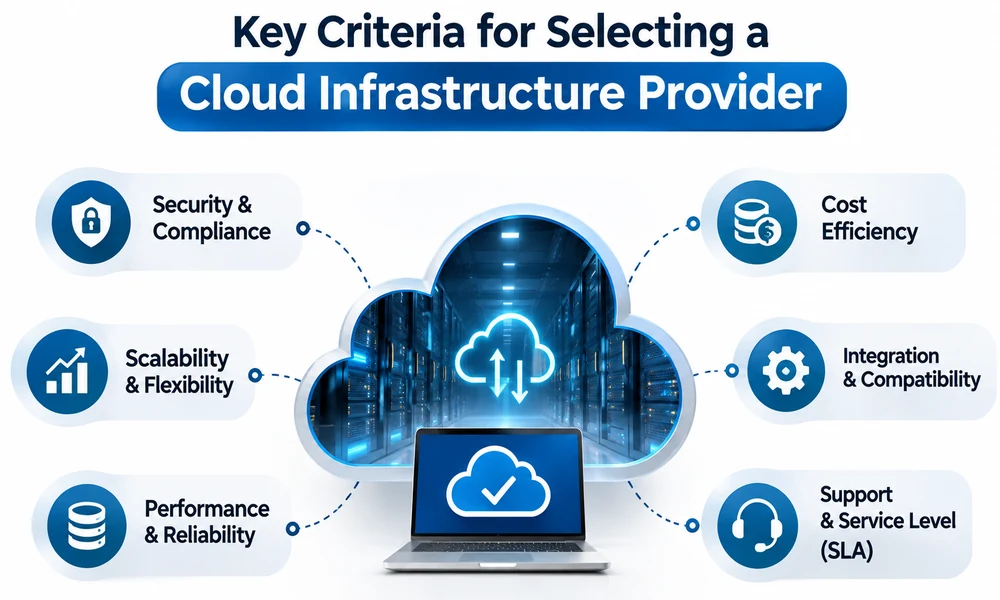
Choosing the right cloud partner requires evaluating several core technical and business factors:
1. Performance and Service Level Agreements (SLAs)
Examine guaranteed uptime metrics, network latency across target geographic markets, and storage throughput speeds. Most enterprise platforms guarantee 99.99% ("four nines") availability for core infrastructure services.
2. Security and Compliance Frameworks
Ensure the provider holds relevant industry compliance certifications for your business vertical. Verify that the platform supports robust Identity and Access Management (IAM), role-based access control (RBAC), and encryption at rest and in transit.
3. Pricing Structures and Financial Predictability
Understand how the provider bills for bandwidth egress, storage tiers, API requests, and compute instances. Evaluate pricing options such as pay-as-you-go, reserved instances, committed use discounts, and spot instances to manage long-term operational expenses.
4. Ecosystem and Integration Capabilities
Consider how easily the platform integrates with your existing DevOps pipelines, continuous integration/continuous deployment (CI/CD) tools, monitoring solutions, and software stacks.
5. Multi-Cloud and Hybrid Cloud Support
Look for support for open standards, container platforms (like Kubernetes), and hybrid management tools to prevent restrictive vendor lock-in and enable flexible workload distribution.
Common Mistakes to Avoid When Choosing a Provider
- Ignoring Data Egress Costs: Many organizations underestimate the expense of moving data out of a cloud environment. Egress fees can build up rapidly if your applications frequently transfer data to external services or on-premises systems.
- Overlooking Governance and Access Control: Failing to establish strict IAM policies and resource tagging early often leads to security vulnerabilities and untracked cloud spending.
- Assuming Compliance Is Fully Automated: Cloud security operates on a Shared Responsibility Model. While the provider secures the underlying physical infrastructure, you remain responsible for securing your application code, data, and access configurations.
- Selecting Based Solely on Brand Recognition: Choosing a hyperscaler when a simpler developer-focused platform meets your technical needs can result in unnecessary administrative overhead and unexpected billing complexity.
Final Thoughts
Selecting the right cloud infrastructure provider requires matching your technical specifications, security requirements, and financial targets with a provider's core capabilities. Whether you choose a feature-rich hyperscaler, an enterprise ecosystem, or a streamlined developer-focused cloud, focus on long-term flexibility, transparent cost management, and robust security governance.
By carefully evaluating your workload demands and avoiding common pitfalls like unmonitored egress costs, you can build a stable, scalable foundation for your digital operations.
Frequently Asked Questions
What is the difference between IaaS, PaaS, and SaaS?
IaaS (Infrastructure as a Service) provides fundamental computing resources like virtual machines, storage, and networking, giving you full operating system control. PaaS (Platform as a Service) supplies a pre-configured framework for application development, managing underlying servers automatically. SaaS (Software as a Service) delivers ready-to-use software applications over the internet to end users.
How does the Shared Responsibility Model work in cloud computing?
The Shared Responsibility Model divides security duties between the cloud provider and the customer. The provider secures the global physical data centers, hardware, hypervisors, and core networking. The customer is responsible for configuring operating systems, network firewalls, user access rights, application security, and data protection.
What is multi-cloud, and why do companies use it?
Multi-cloud is an operational strategy where an organization uses services from two or more distinct cloud infrastructure providers. Companies adopt multi-cloud architectures to avoid vendor lock-in, take advantage of specific provider strengths (such as using one provider for data analytics and another for enterprise software), and improve disaster recovery resiliency.
Are cloud infrastructure providers secure enough for sensitive data?
Yes. Major cloud infrastructure providers employ dedicated cybersecurity teams, state-of-the-art encryption, physical data center protection, and continuous vulnerability scans. They frequently maintain stricter security standards than typical on-premises enterprise environments. However, overall security ultimately depends on proper configuration by the customer.
What are cloud egress fees?
Egress fees are the costs charged by cloud infrastructure providers when data is transferred out of their network to the internet, another region, or an external data center. Data ingress (transferring data into the cloud) is generally free, making it important to factor outbound data movement into your budget.
Can small businesses use enterprise cloud providers economically?
Yes. Most cloud platforms offer pay-as-you-go pricing, free tier allocations, and scalable resource settings that allow small businesses to start with modest budgets and scale resources as their application usage grows.
