
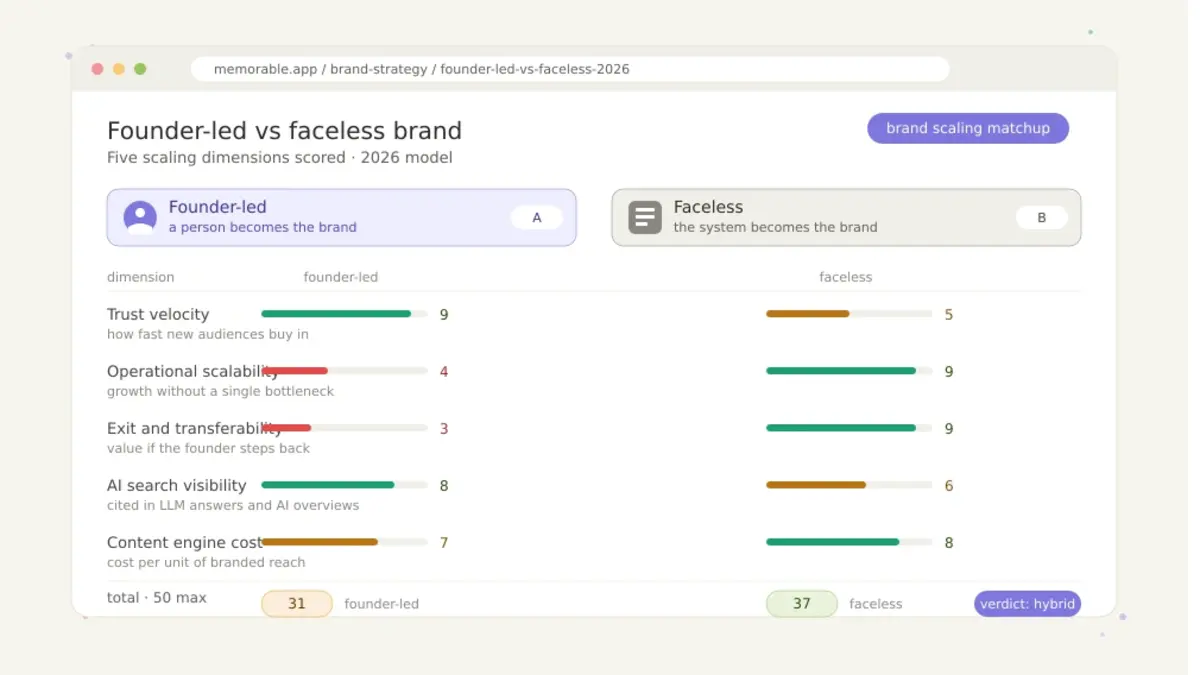
The debate founder led brand vs faceless brand in 2026 centers on trust, scalability, and long-term growth. Founder-led brands grow faster through personal storytelling, authenticity, and stronger audience trust, while faceless brands scale more efficiently through systems, institutional stability, and easier exits. The article explores how Google’s E-E-A-T updates favor human-driven content, why hybrid branding models are becoming popular, and how businesses can choose the right strategy based on their goals, industry, and scalability vision.
The digital landscape has shifted from a battle of budgets to a battle of trust. In an era where AI can generate a thousand logos in a minute, consumers are becoming increasingly skeptical of who they are actually buying from. This brings us to a critical crossroads for modern entrepreneurs: the debate of a founder led brand vs faceless brand. In 2026, the answer to which scales better depends on your exit strategy and your industry.
At Memorable Design, we’ve seen that the most successful companies in 2026 don't just pick a side; they understand the mechanics of both. The February 2026 Google Core Update has made it clear that "Experience" and "Person-First" content are the keys to ranking. Whether you are building a founder led brand vs faceless brand, your success hinges on how you prove your authority to both humans and algorithms. This guide explores how to navigate these two paths and which one holds the most potential for your specific business goals.
The Rise of the Human Element in Marketing

Why are we seeing such a massive surge in founder led marketing? The reason is simple: people are tired of being sold to by corporate entities. We are living in a "Biographical Economy" where the story behind the product is often as valuable as the product itself. When a founder shows their face, shares their failures, and documents their process, they create a "parasocial" bond that a logo simply cannot replicate.
A founder led brand vs faceless brand comparison often shows that the former enjoys a much lower Customer Acquisition Cost (CAC). This is because the founder acts as the primary marketing channel. By the time a customer reaches the checkout page, they aren't just buying a solution—they are supporting a person they feel they know. This human-centric approach is particularly powerful in service-based industries and high-ticket consulting.
The Scalability Paradox: Is Your Face a Bottleneck?
While a personal connection drives initial growth, it can eventually become a hurdle. In a Founder Led Brand vs Faceless Brand scenario, the "personal" side often struggles with what we call the "Founder Trap." If customers believe they are buying you, they might feel cheated when they are handed off to an account manager or a junior consultant.
To scale a founder-led company, you must eventually transition from being the "doer" to being the "symbol." This requires a strategic shift where the founder's values are baked into the company culture. If you don't build systems that can function without your daily presence, you haven't built a scalable business; you've built a high-paying job. At Memorable Design, we help founders build visual identities that carry their "essence" even when they aren't in the room.
When a Faceless Brand Strategy Wins?
Despite the current trend toward personality-driven growth, the faceless brand strategy remains the king of the "Exit." Think of brands like Airbnb or Uber. While they had founders, the brand was built on a utility and a promise, not the personality of the CEO. Faceless brands are built to be sold. They are institutional, reliable, and their value is tied to their intellectual property and systems.
A faceless brand can scale infinitely because it isn't limited by the energy levels or reputation of a single human being. If a founder gets "canceled" or decides to retire, a founder-led brand can tank overnight. A faceless brand, however, is immune to these human fluctuations. It relies on consistent high-quality service and a strong, recognizable visual identity rather than a charismatic leader.
Comparison Table: Founder Led Brand vs Faceless Brand
To help you decide which path fits your 2026 goals, let’s look at the mechanical differences between these two models.
| Feature | Founder-Led Brand | Faceless Brand |
| Trust Building | Immediate through storytelling | Earned over time via reviews |
| Marketing Cost | Lower (Organic & Social) | Higher (Paid Ads & SEO) |
| Exit Strategy | Difficult; value is in the person | Easier; value is in the assets |
| Scalability | Limited by the founder's time | Infinite through systems |
| Risk Factor | High (Reputation-dependent) | Low (Institutional stability) |
Navigating the Hybrid Model
In 2026, many of the most successful companies are adopting a hybrid approach. They use founder led marketing to "warm up" the audience and build initial traction, but they maintain a faceless brand strategy for their products and services. This allows the business to benefit from the trust of a personal brand while maintaining the professional polish of a business entity.
This hybrid model is the sweet spot for modern scaling. You use the founder's voice to cut through the noise on social media, but the actual transaction happens through a brand that feels bigger than one person. This is where Memorable Design excels creating a brand architecture that allows a founder to shine without making the business entirely dependent on them.
SEO and E-E-A-T: The Algorithm's Preference
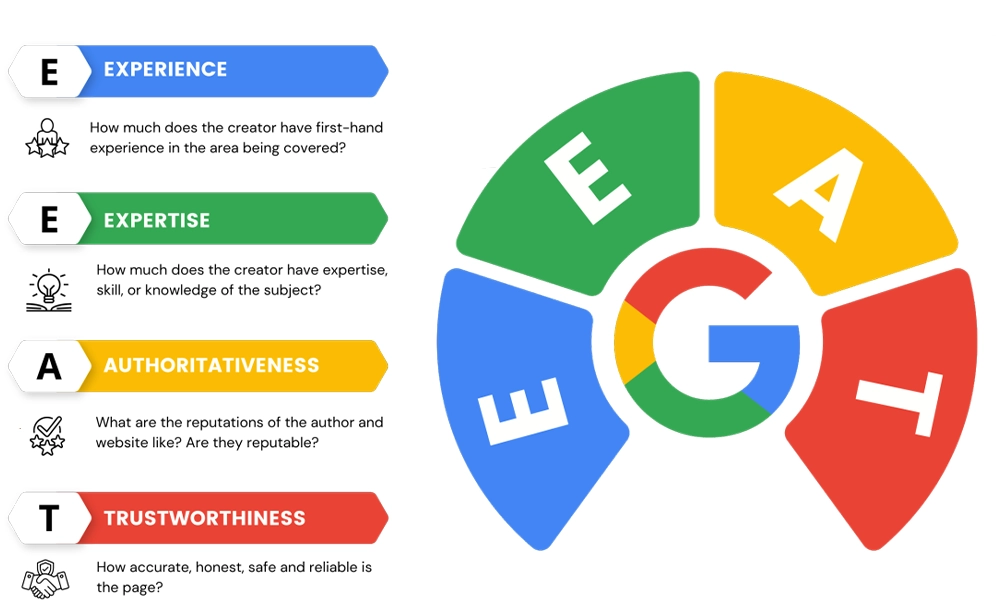
The Google Core Update of February 2026 has doubled down on E-E-A-T (Experience, Expertise, Authoritativeness, and Trustworthiness). This significantly favors the founder led brand vs faceless brand in search results. Google wants to see a real person with real experience behind the content.
When you create content as a founder, you naturally include personal anecdotes and unique insights—things AI cannot easily replicate. This "Information Gain" is a massive ranking signal. If you choose the faceless route, you must work twice as hard to prove your authority. You'll need to showcase a team of experts, cite credible sources, and ensure your site’s technical SEO is flawless to compete with the inherent trust of a human face.
Leveraging Founder Expertise
- Author Bylines: Every blog post should have a clear author bio linking to a verified LinkedIn profile.
- Case Studies: Share specific projects you’ve handled, detailing the challenges and results in a way only a practitioner could.
- Video Content: Embed videos of the founder explaining complex topics to keep users on the page longer.
- Social Proof: Display testimonials that specifically mention the founder’s impact on the client’s success.
Strengthening Faceless Authority
- Company Heritage: Focus on the "About Us" page to show the history and mission of the collective team.
- Certifications: Highlight industry awards, ISO certifications, and professional memberships.
- Deep Technical Guides: Provide the most comprehensive data-driven guides in your niche to become a "go-to" resource.
- User-Generated Content: Let your customers be the "face" of the brand through their reviews and photos.
Founder Led Brand vs Faceless Brand: The Content Strategy
Your content strategy will look radically different depending on which path you take. For a personal brand vs business brand, the tone of voice is the biggest differentiator. A personal brand uses "I" and "me," while a business brand uses "we" and "the company."
For founder led marketing, the content should be 70% education and 30% lifestyle/behind-the-scenes. People want to see the mess, the process, and the "why." For a faceless brand, the content should be 90% utility and 10% culture. The goal is to be seen as the most efficient solution to a specific problem. Both require a high level of Memorable Design to ensure that regardless of who is talking, the message looks professional and trustworthy.
Conclusion: Founder Led Brand vs Faceless Brand
Ultimately, the choice in the founder led brand vs faceless brand debate comes down to your personal strengths and long-term vision. If you are a natural communicator who loves building relationships and storytelling, a founder-led approach will get you to market faster and with less capital. If you are a systems-builder who wants to create a legacy that exists long after you’re gone, a faceless brand is the way to go.
In 2026, scaling is about authenticity. Whether that authenticity comes from a person or a perfectly executed company mission, you cannot fake it. At Memorable Design, we believe that the best brands are the ones that know exactly who they are—and who they aren't. Choose the path that aligns with your personality, stick to a consistent strategy, and the scale will follow naturally.
FAQs: Founder Led Brand vs Faceless Brand
Can I transition from a founder led brand to a faceless brand later?
Yes, and many do. This is often called "institutionalizing" the brand. You start by being the face of the company to build trust, and as you grow, you gradually shift the spotlight to your team and your customer success stories. This is the most common path for companies looking for a high-value exit.
Which is better for B2B companies?
For B2B, founder led marketing is currently dominating. Business decisions are often high-risk and high-cost, so buyers want to trust the person behind the contract. Seeing a founder’s expertise on LinkedIn or in a video can significantly shorten the sales cycle compared to a cold corporate pitch.
What is the biggest risk of a personal brand?
The biggest risk is "reputation fragility." If the founder makes a mistake in their personal life, the business can suffer immediately. Additionally, if the founder becomes the bottleneck for every decision, the business cannot grow beyond their personal capacity, which limits its total market value.
How does Google treat Founder Led Brand vs Faceless Brand?
Google treats both founder led brand vs faceless brand well as long as they provide high-quality, helpful content. However, personal brands often have a "head start" because they naturally fulfill the "Experience" part of E-E-A-T. Faceless brands must work harder to prove their expertise through third-party mentions, high-quality backlinks, and consistent technical excellence.
