
The landscape of SEO trends 2026 shifts from links to direct citations. Success requires prioritizing generative engine optimization (GEO) and answer engine optimization (AEO), aligning content with recent core updates, and optimizing user experience to secure placements within conversational AI search summaries.
The latest Google core updates have transformed how users discover content. To stay ahead, Memorabledesign breaks down the essential shifts in search architecture. This guide explores the critical future SEO strategies needed to transition from simple blue-link optimization to multi-modal, conversational visibility across the digital landscape.
Key Takeaways
-
Cite-First Optimization: To survive AI Mode, content must be structured explicitly for direct extraction by LLM crawlers.
-
The E-E-A-T Moat: True first-hand case studies and verified expert author profiles protect rankings from automated programmatic cleanups.
-
User Intent Over Keywords: Long-tail, conversational queries now dictate real-world visibility over traditional short-tail volume metrics.
How Recent Google Core Updates Rewrote the Search Playbook for SEO Trends 2026
Google dropped a massive bomb on programmatic content with its spring updates, and the dust is still settling. The March spam update and the May core update worked together to clean out sites that churned out thousands of pages of low-effort text.
- If a page just summarizes what already exists on the web without adding new value, it simply drops out of the index. Google’s systems are looking for real alignment with how people actually think and search.
- Users do not type simple two-word phrases as much anymore, especially since the search bar now accepts voice, images, and long questions all at once. Because of this, your content architecture has to map out a multi-step user journey. You cannot just answer a single question and stop there.
- Building successful future SEO strategies means you have to plan for a search ecosystem that lives beyond the traditional Google homepage. Apple’s native search features, open-source AI engines, and social platforms are capturing a huge chunk of search traffic.
- To protect your traffic, your brand needs to be mentioned across the entire web. When Google’s algorithms see your brand being discussed on forums, cited in industry papers, and shared on social networks, they view your site as a true authority. That real-world footprint is exactly what keeps you visible when the algorithms shift.
The Step-by-Step Blueprint to Get Your Content Cited in AI Overviews
Generative Engine Optimization (GEO) is the technical art of making your content incredibly easy for artificial intelligence to read, understand, and credit. When Google’s AI Mode builds a summary at the top of the search results, it acts like a research assistant.
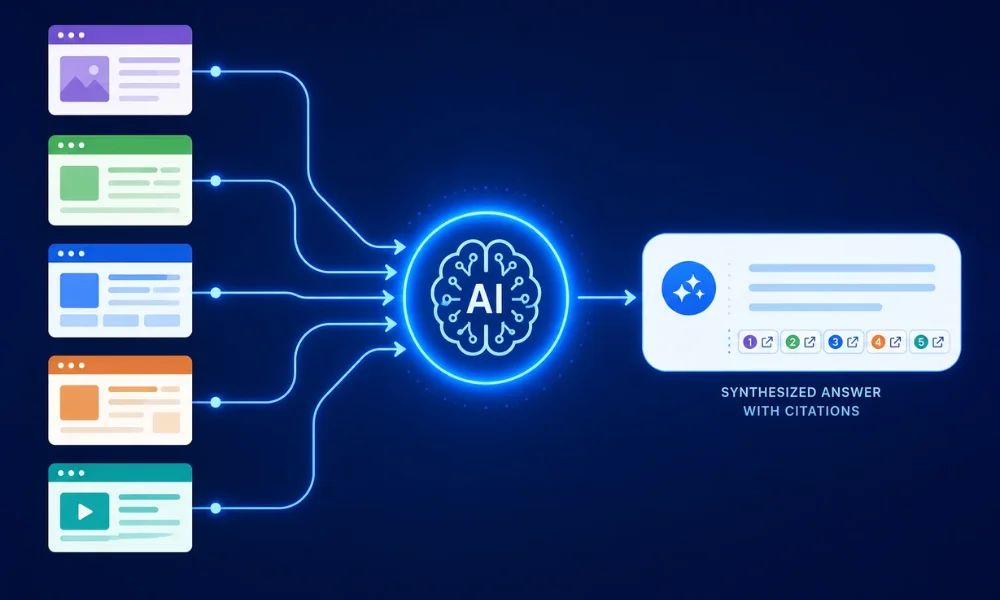
It scans the web, grabs the best data points, and links back to the sources. If your site isn’t structured correctly, the AI will pull information from your competitors instead.
To win these citations, you need to use an answer-first writing layout. This means you state the core answer directly below your heading in clear, plain English, and then you use the rest of the section to provide the supporting details.
How to Implement Actionable AI SEO trends 2026 and Win the AI Summary Box
Winning this space requires a complete shift in how you build your pages. The old way was about repeating keywords, but the new way is about building tight semantic entity networks.
-
Direct Answer Extraction: Keep your primary answers under 45 words right at the start of a section so AI crawlers can clip them instantly.
-
Clear Entity Connections: Explicitly connect your brand to specific concepts, tools, and locations so Google’s Knowledge Graph understands exactly what you do.
-
Open Access Permissions: Double-check your
robots.txtfile to ensure that Google-Extended and other major AI crawlers have full access to read your informational pages.
When you map out these topic clusters, you prove to the search engine that you understand the entire subject. This matters because AI overviews rarely cite a single isolated page. Instead, they look for websites that show deep, interconnected knowledge.
You also need to keep an eye on your technical settings. If you block AI bots from reading your text to protect your copyright, you might accidentally stop them from giving you traffic-driving citations. It is a delicate balance, but open access combined with unique data is the fastest way to get your link placed inside the AI overview box.
New Google ranking factors Explained
The days of relying solely on heavy backlink profiles to force your way to the top of Google are gone. Links still carry weight, but user interaction signals are quickly becoming the primary Google ranking factors that sustain long-term visibility.
Google monitors how users interact with your page from the very second they click it. If someone lands on your site, scrolls down, clicks an internal link, and spends three minutes reading, Google gets a strong signal that your page solved their problem.
Balancing Real Human Proof and Machine Readability within SEO Trends 2026
Creating content that satisfies both an advanced algorithm and a living human reader comes down to transparency and proof. You cannot just make a claim anymore; you have to prove it.
-
First-Hand Evidence Mandate: Include original screenshots, unique data charts, or specific step-by-step case studies that an AI cannot simply fabricate.
-
Verified Author Credibility: Link your author bios to real social profiles and professional portfolios to show Google’s quality raters that a human expert wrote the piece.
-
Advanced JSON-LD Markup: Implement clean structured data that explicitly states the author’s credentials, the organization’s info, and the exact topic being discussed.
Machines love structured, predictable code, but humans love personality and genuine insights. By embedding real-world data and case studies directly into your text, you give the human reader exactly what they want.
At the same time, when you wrap that data in clean schema markup, you hand the search engine the exact technical breadcrumbs it needs to index your page correctly. This balance ensures your content survives both manual quality reviews and automated algorithm updates.
Optimizing Your Website for Conversational and Voice Search Questions
Answer Engine Optimization (AEO) focuses entirely on the conversational nature of modern search queries. Since people use voice search on their phones and speak naturally to AI assistants, queries have become much longer and more specific.
People do not just search for web design tips anymore. Instead, they ask, How do I fix a high bounce rate on my homepage after the new update? Your content needs to adapt to this conversational shift.
The Tactical Checklist for Executing Leading SEO Trends 2026
To build a page that captures these specific, high-intent conversational searches, use this formatting checklist:
-
Multi-Modal Asset Design: Always pair your text with helpful, optimized images, simple diagrams, or short video clips that break down complex ideas.
-
The Next-Question Architecture: Look at what users usually ask next, and answer those follow-up questions right inside the same article.
-
Scannable Content Blocks: Break your paragraphs down to a maximum of three lines, and use bold phrases to guide the reader’s eye down the page.
When you use the next-question framework, you keep the user on your site much longer. If your article answers their first question, but then immediately addresses the next two problems they are going to face, they have no reason to click back to the search results.
This directly boosts your dwell time and signals to Google that your page is the ultimate resource for that topic. Combine this with fast-loading multi-modal elements, and you create an incredible user experience that ranks well and converts readers.
Conclusion: SEO Trends 2026
Succeeding in the modern landscape requires a fundamental shift toward unique value. By prioritizing high-intent architecture and clear semantic structures, Memorabledesign ensures your brand remains highly visible, deeply authoritative, and consistently cited across the evolving digital channels of tomorrow’s web ecosystem.
Frequently Asked Questions
What are the most important Google ranking factors today?
Real user interaction signals, actual first-hand expert proof (E-E-A-T), and how easily an AI search agent can scrape your page data.
How do AI SEO trends 2026 impact small business websites?
They level the playing field. Google now prioritizes hyper-niche, real-world expert blogs over massive corporate websites that lack personal experience.
What are the best future SEO strategies to protect site traffic?
Optimize your text for direct AI summaries, answer user questions immediately, and build a strong brand presence across forums and social platforms.
