
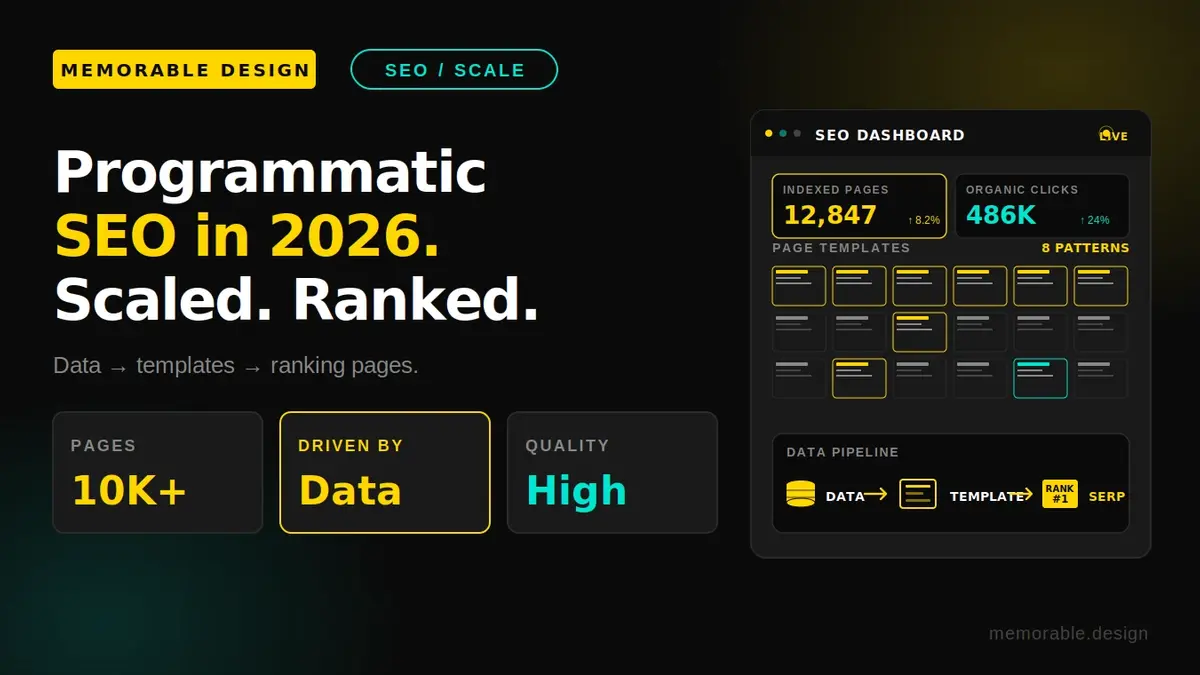
Programmatic SEO in 2026 succeeds by prioritizing user value over mass-produced pages. Google rewards data-driven, highly unique content such as comparison pages, dynamic location pages, calculators, and curated directories. Successful strategies combine automation with human expertise, local context, structured data, and E-E-A-T signals to create scalable yet trustworthy experiences that avoid looking spammy.
The "gold rush" of mass-produced, low-quality pages is officially over, but that doesn't mean automation is dead. In fact, programmatic seo 2026 is more sophisticated than ever, moving away from mindless duplication toward high-value, data-driven experiences. To succeed today without looking spammy, you must focus on utility rather than volume. By using a scaled content strategy that integrates unique data sets, dynamic imagery, and user-generated insights, you can create thousands of pages that Google views as helpful and authoritative rather than "thin" or "repetitive."
At Memorable Design, we believe that automation should be the engine, but human expertise must be the steering wheel. To win in the current search landscape, your programmatic pages must answer specific user intents—like comparing local services or calculating specific costs with a level of detail that a generic AI prompt simply cannot match. The secret lies in the patterns of structure and data integration that prove you are providing a genuine service to the end user.
The Shift in Programmatic SEO 2026
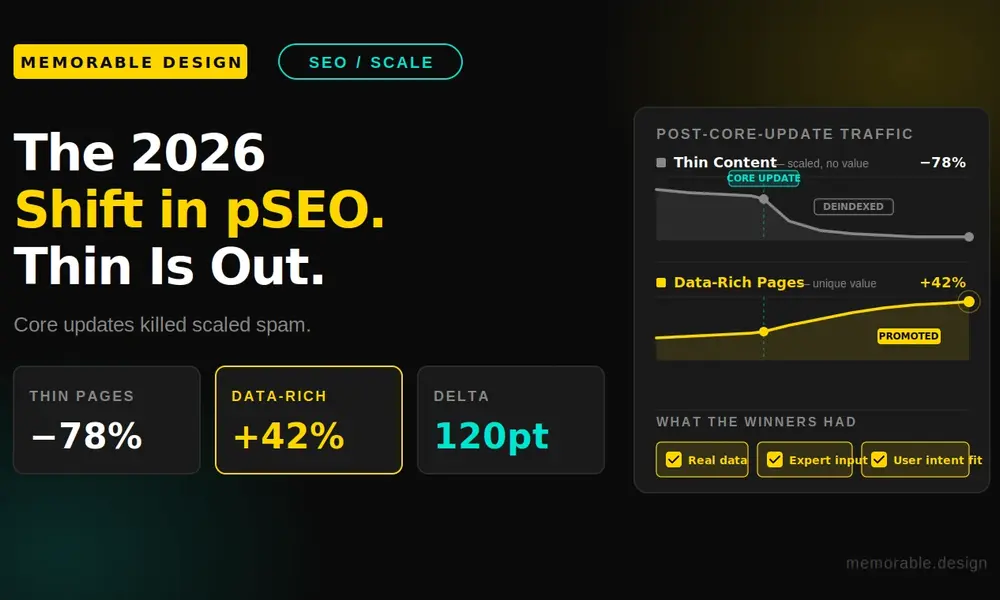
The February 2026 Google Core Update made one thing very clear: if a page exists only to capture a keyword, it won't rank. In the early days, programmatic SEO was about "mad-libs" style templates where only the city name changed. Today, programmatic seo 2026 requires a "Data-First" mentality. This means your pages must be populated with information that is difficult to find elsewhere, such as localized pricing, real-time availability, or proprietary survey results.
Search engines have become incredibly adept at spotting "thin" content. If you are using a scaled content strategy, every page in your set needs to have at least 30% unique content that isn't found on the other 999 pages. This is achieved by pulling from diverse databases rather than just swapping out a single variable. When done correctly, this approach builds immense topical authority and provides a massive net for long-tail search queries.
1. The "Comparison and Alternative" Pattern
One of the most successful programmatic seo examples is the "X vs Y" or "Alternatives to X" pattern. Users in the middle of the marketing funnel are constantly looking for comparisons to help them make a final decision. Instead of writing these manually, you can build a database of product specifications, pricing, and user ratings.
By creating a template that pulls these data points into a side-by-side table, you provide immediate value. For instance, a software review site might use this to compare hundreds of different tools. The key to making this look "not spammy" is to include a section for "Pro Tips" or "Expert Analysis" that adds a layer of human-like nuance to the raw data. This satisfies the "Expertise" and "Experience" requirements of E-E-A-T while maintaining the efficiency of a scaled content strategy.
2. Dynamic Location Pages for Local Intent
If you operate a service-based business, location pages seo is likely the backbone of your organic traffic. However, Google now penalizes sites that use identical text for "Plumber in Chicago" and "Plumber in Miami." To stay rewarded, your location pages must be hyper-local.
Include dynamic elements like local maps, weather-specific advice, or regional testimonials. If you are a landscaping company, your Chicago page should talk about cold-hardy plants, while your Miami page discusses tropical palm care. This level of detail proves to Google that you aren't just "keyword fishing," but actually understand the local market. At Memorable Design, we often integrate local permit information or regional cost averages to ensure these pages provide high utility to the resident.
3. Data-Driven Calculators and Tools
Google loves "interactive" utility. One of the strongest programmatic seo examples involves creating pages around specific calculations. Whether it's a "Mortgage Calculator for [City Name]" or a "Cost to Build a Deck in [State]," these pages are naturally "sticky" and encourage high user engagement.
The programmatic element comes from the background data. The calculator remains the same, but the default values (like local tax rates or labor costs) update based on the page's focus. This creates a highly personalized experience at scale. When you combine this with a clear paragraph snippet format that answers the primary question (e.g., "The average cost to build a deck in Ohio is $X"), you significantly increase your chances of appearing in AI Overviews and featured snippets.
4. The "Best of" Aggregation Pattern
Curation is a form of creation. By aggregating public data—such as crime rates, school scores, or restaurant health ratings—you can create "Best places to live in [County]" or "Top-rated diners in [Neighborhood]" pages. The value here is the convenience of having all that data filtered and sorted in one place.
To avoid the spam label, you must provide a unique "Sort" or "Filter" mechanism that allows users to interact with the data. A static list is easy to ignore, but a dynamic, sortable directory is a powerful tool. This pattern is a staple of programmatic seo 2026 because it leverages existing authority from public datasets to create new, helpful landing pages for highly specific searches.
Comparison: Spammy vs. High-Quality Programmatic SEO

| Feature | Spammy Approach (Avoid) | High-Quality Approach (2026 Standard) |
| Content Uniqueness | Swaps only 1 or 2 keywords | Uses dynamic data blocks and local insights |
| Data Source | Scraped from a single competitor | Multi-source API integration or proprietary data |
| User Intent | Purely for ad impressions | Solves a specific problem or calculation |
| Visuals | Same stock photo on every page | Dynamic maps, charts, or user-uploaded images |
| Internal Linking | Random or "flat" structure | Contextual "Hub and Spoke" architecture |
Scaling Without Sacrificing E-E-A-T
The biggest challenge with a scaled content strategy is maintaining the "Trustworthiness" pillar. If a user lands on one of your programmatic pages and it feels "hollow," they will bounce immediately, signaling to Google that the page isn't helpful. At Memorable Design, we solve this by ensuring every template has a "Human in the Loop" section.
This might be a rotating "Editor's Choice" block or a dynamically inserted quote from a subject matter expert. Additionally, implementing "Schema Markup" is non-negotiable. Using structured data helps search engines understand that your location pages seo are part of a legitimate business entity. It provides the "Authoritativeness" that separates a professional brand from a "niche site" chaser.
Technical Foundations for 2026 Succes
To ensure your programmatic seo 2026 efforts are indexed and rewarded, you must pay attention to "Crawl Budget." Google will not crawl 10,000 pages if the first 100 it finds are low-value. You need a strong internal linking structure that guides the bot to your highest-value "Hub" pages first.
- Breadcrumb Navigation: Always include breadcrumbs to show the hierarchy of your scaled pages.
- Sitemap Management: Break your sitemaps into smaller chunks (e.g., by region or category) to ensure faster discovery.
- Canonicalization: Be aggressive with your canonical tags to ensure you aren't accidentally creating "duplicate content" issues within your own site.
- Page Speed: Programmatic pages often rely on heavy database calls. Ensure your server-side rendering is optimized so the page loads in under 2 seconds.
Conclusion: The Future of Scaled Growth
The future of programmatic seo 2026 is bright for those who prioritize the user experience. By moving away from "keyword stuffing" and toward "data-driven utility," you can build a massive organic footprint that stands the test of core updates. Whether you are building out location pages seo or creating complex programmatic seo examples like comparison engines, the goal remains the same: be the most helpful resource on the internet for that specific query.
Success in a scaled content strategy requires a blend of technical prowess and creative empathy. At Memorable Design, we’ve found that when you treat every automated page as a chance to solve a human problem, the rankings follow naturally. Don't just build pages; build tools, resources, and directories that you would actually want to use yourself.
Frequently Asked Questions
Is programmatic SEO still safe after the 2026 updates?
Yes, but only if the content provides genuine value. Google has become very efficient at de-indexing "mass-generated" pages that offer no unique data or utility. If your programmatic pages are simply copies of each other with different city names, they are at high risk. If they provide unique data, they are very safe.
How much unique content do I need per page?
While there is no "magic number," a good rule of thumb for programmatic seo 2026 is to ensure at least 25-30% of the text and data on the page is unique to that specific URL. This can be achieved through local statistics, unique images, or dynamic "advice" blocks based on the page's variables.
What are the best industries for programmatic SEO?
Real estate, travel, e-commerce, and local services are the most common programmatic seo examples. Any industry that relies on large datasets—like flight prices, house listings, or local weather—is a prime candidate for a scaled content strategy.
Can I use AI to write my programmatic templates?
You can use AI to help draft the base templates, but you should never let it run "unsupervised." Human editing is required to ensure the "voice" is consistent and that the facts are accurate. The best results come from using AI to summarize your proprietary data rather than letting it "hallucinate" information from scratch.
How do I improve location pages seo without being repetitive?
Focus on local "Context." Include maps of the specific neighborhood, mention nearby landmarks, pull in local reviews, and provide advice that is specific to that climate or demographic. The more "Local Signals" you can feed into your location pages seo, the more trustworthy they will appear to Google.
